Annual Average Temperature and Heatwave Days Increase More
"Related to Steady Growth of Small and Medium Cities"
As the nationwide heatwave continues, an analysis has revealed that the number of heatwave days is increasing more sharply in small and medium-sized cities than in large cities.
Urbanization contributes to heatwave increase... raising temperatures by 0.09~0.18 degrees
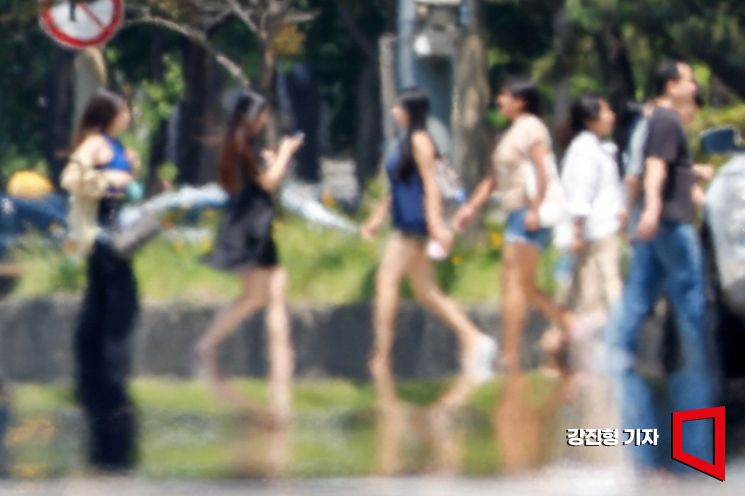 'Heatwave advisory will be in effect in the Seoul area starting from 11 a.m.'
 An emergency alert message arrived on the cellphone with a loud notification sound. This is not the typical midsummer situation of late July to early August. It is a heatwave advisory issued in mid-June. Due to global warming, the entire world is suffering from abnormal weather patterns. The four distinct seasons in South Korea are now a thing of the past. Photo by Jinhyung Kang aymsdream@
On the 16th, the Korea Meteorological Administration (KMA) released a comparison of temperatures and heatwave days (days with a daily maximum temperature of 33 degrees Celsius or higher) across 30 regions, including 16 domestic cities.
According to the analysis, 16 cities?8 large cities with populations over 1 million (Seoul, Busan, Incheon, Daegu, Daejeon, Gwangju, Suwon, Ulsan) and 8 small to medium-sized cities with populations over 300,000 (Cheongju, Cheonan, Jeonju, Pohang, Jeju, Gumi, Jinju, Wonju)?have experienced an average annual temperature increase of 0.37 degrees every 10 years over the past 48 years (1973?2020).
Among this, the temperature rise attributed to urbanization was estimated to be between 0.09 and 0.18 degrees, accounting for approximately 24% to 49% of the total temperature increase.
Comparing large cities and small to medium-sized cities, the latter showed a higher increase in average annual temperature, rising by 0.38 degrees every 10 years compared to 0.36 degrees in large cities. The frequency of heatwave days in small to medium-sized cities also increased by 1.8 days every 10 years, faster than the 1.6-day increase observed in large cities.
Gumi hotter than 'Daefrica'... linked to growth of small and medium-sized cities
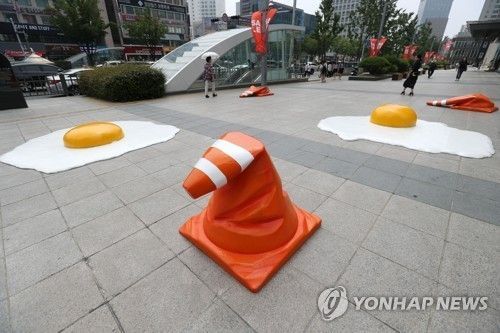 Egg fry and melting lava cone sculptures installed in front of Hyundai Department Store Daegu Branch in Gyesean-dong, Jung-gu, Daegu City, summer 2017. [Image source=Yonhap News]
In particular, when comparing adjacent cities with meteorological observation stations less than 50 km apart, the difference between large cities and small to medium-sized cities became more pronounced.
For example, Daejeon saw an increase of 1.1 heatwave days every 10 years, whereas Cheongju experienced an increase of 1.7 days. The number of heatwave days in Daejeon decreased from an average of 11.8 days per year during 1973?1996 to 11.3 days during 1997?2020, while Cheongju’s increased slightly from 13.7 to 13.8 days.
Gumi, a small to medium-sized city in North Gyeongsang Province, saw heatwave days increase by 2.7 days every 10 years, surpassing the nearby large city Daegu’s increase of 2.2 days.
Similarly, Pohang experienced an increase of 1.1 days, showing a more distinct upward trend than Ulsan’s 0.5-day increase.
The KMA explained, "The proportion of the population living in large cities peaked at about 52% in the 1990s and has since slightly declined, whereas the population proportion in small to medium-sized cities recently reached a peak of 31%. Unlike large cities, whose growth stagnated after the 1990s, small to medium-sized cities have continued to grow recently, which appears to have influenced the rising temperature and increasing heatwave trends."
Yoo Hee-dong, head of the KMA, stated, "This analysis shows that the continuous growth of small to medium-sized cities recently may be contributing to the increase in extreme phenomena such as heatwaves. The KMA will analyze various data to understand climate change and extreme events caused by global warming and provide this information to the public."
Non-urban areas warming more slowly than cities... caution urged for heat-related illnesses amid consecutive heatwaves
Additionally, 14 non-urban areas with populations around 100,000 (Jecheon, Tongyeong, Yangpyeong, Yeongcheon, Namwon, Buyeo, Ganghwa, Geumsan, Yeongdeok, Sancheong, Boeun, Imsil, Seongsan, Chupungnyeong) recorded an average annual temperature increase of 0.23 degrees every 10 years over the past 48 years, and heatwave days increased by 1.1 days every 10 years, indicating that warming is progressing more slowly than in cities.
Meanwhile, according to the Korea Disease Control and Prevention Agency, as of the 14th, the cumulative number of heat-related illness cases nationwide reached 2,244. Last year, during the same period, there were 1,409 cases, showing a significant increase this year compared to last year.
It is essential to take special care by drinking water frequently and taking regular breaks both outdoors and indoors.
© The Asia Business Daily(www.asiae.co.kr). All rights reserved.



















