Samba, Half-Year Sales 1.5 Trillion... 4 Trillion Annually Next Year?
Celltrion and Healthcare Drive 1 Trillion Achievement
LG Life Sciences Division with 'Aveo' Nears 1 Trillion Annual Sales
Yuhan and Hanmi Show Solid Performance with New Drug Momentum
Domestic major pharmaceutical and bio companies, which had taken off amid the COVID-19 pandemic, are creating new factors for performance growth by making large-scale investments and engaging in research and development (R&D). In the contract development and manufacturing organization (CDMO) industry, steady expansion of production capacity is driving strong performance, while major pharmaceutical companies are securing next-generation growth engines through R&D amid solid sales growth, leading to an increasing number of cases where stock prices are also showing positive trends.
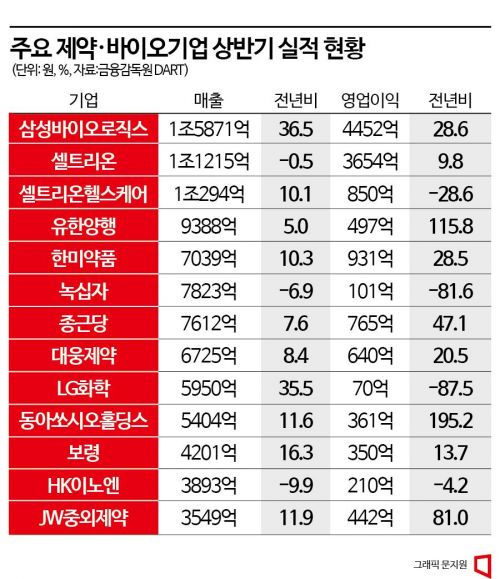
According to the related industry on the 16th, among domestic pharmaceutical and bio companies, Samsung Biologics recorded the highest sales in the first half of the year. With sales of 1.5871 trillion KRW and operating profit of 445.2 billion KRW, it continues the achievement of surpassing 3 trillion KRW in annual sales for the first time in the industry last year. Especially, in the second half of the year, when sales from the fully operational 4th plant begin to be reflected in earnest, faster growth is expected. Accordingly, securities firms estimate fourth-quarter sales at around 1.0578 trillion KRW, with some forecasts suggesting that 'quarterly sales of 1 trillion KRW' may be possible. In the domestic pharmaceutical and bio industry, which is relatively small compared to the global scale, companies with annual sales exceeding 1 trillion KRW are classified as large enterprises, and it is expected that this milestone could be achieved on a quarterly basis as well. If this growth trend continues, there is even analysis that achieving 4 trillion KRW in annual sales next year is possible.
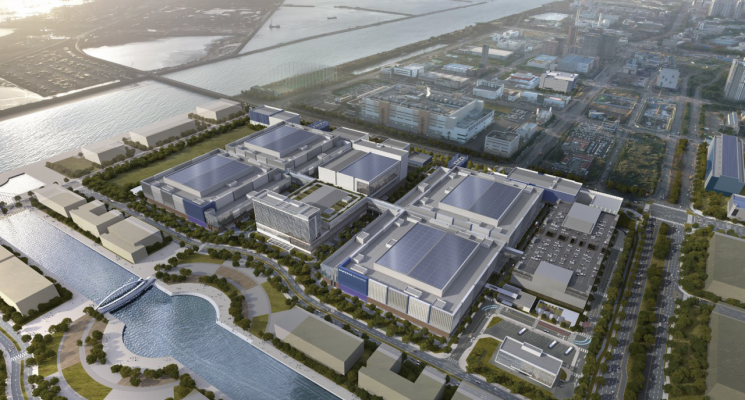
Samsung Biologics is not stopping there and is steadily expanding its production capacity. Currently, it holds the world's largest production capacity of 604,000 liters, but starting with the recently groundbroken 5th plant, it plans to secure a total production capacity of 720,000 liters by 2032 at the nearby 2nd Bio Campus, aiming to establish an overwhelming gap.
The Celltrion Group is also continuing its sales growth. Celltrion and Celltrion Healthcare jointly achieved 1 trillion KRW in sales in the first half of the year. In particular, Celltrion Healthcare surpassed 1 trillion KRW in half-year sales for the first time in the second half of last year and is expected to continue its growth this year, potentially reaching 2 trillion KRW in annual sales. The company stated, "We recently signed rebate contracts with major Pharmacy Benefit Managers (PBMs) and public insurance formularies to list 'Uplizna' as a preferred drug," and it is expected that Uplizna, recently launched in the U.S. market, and 'Remsima SC,' which is anticipated to receive new drug approval from the U.S. Food and Drug Administration (FDA) within the year, will drive performance growth.
However, Celltrion reported a decline in both sales and operating profit in the second quarter. The company explained that "other sales decreased due to adjustments in the timing of international procurement tenders for chemical products such as AIDS treatments, affected by COVID-19," but emphasized that "sales of the core business, biosimilars, increased by 10.4% compared to the same period last year." Celltrion also expects that if sales of Uplizna and Remsima SC increase, given their high profitability, sales growth can continue.
Traditional Pharmaceuticals Secure Growth Engines through R&D
In the pharmaceutical industry, R&D is becoming a new growth engine, acting as a momentum for both short- and long-term sales growth. LG Chem’s Life Sciences Division is on the verge of achieving its first annual sales of 1 trillion KRW this year. Sales have steadily increased, from 760 billion KRW in 2021 to 910 billion KRW last year, and the acquisition of the U.S. biotech company Aveo Pharmaceuticals last year has contributed to a 35.5% increase in first-half sales to 595 billion KRW. As a biotech company with FDA-approved anticancer drugs, it is evaluated as having secured future R&D momentum while driving immediate sales growth. However, operating profit showed a decline due to one-time costs and intangible asset amortization following the Aveo acquisition.
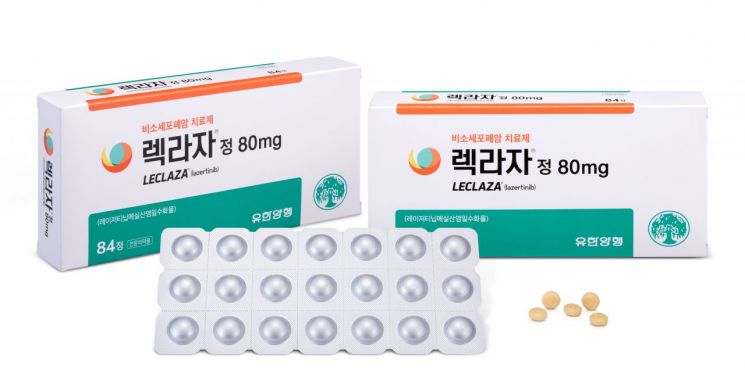
Even if R&D does not immediately translate into sales, it acts as momentum combined with steady performance growth, leading to sharp rises in stock prices. Yuhan Corporation and Hanmi Pharmaceutical are representative examples. Yuhan Corporation recorded 938.8 billion KRW in sales in the first half, and Hanmi Pharmaceutical 703.9 billion KRW, achieving sales growth of 5.0% and 10.3%, respectively. Amid solid performance growth, Yuhan Corporation is expected to reveal the global combination clinical trial results of the non-small cell lung cancer treatment new drug 'Reclaza' in the upcoming European Society for Medical Oncology (ESMO) conference in October, while Hanmi Pharmaceutical recently submitted a clinical phase 3 trial plan (IND) for 'Epeglenatide,' a 'Korean-style obesity treatment drug,' to the Ministry of Food and Drug Safety. Amid these successive momentum factors, Yuhan Corporation’s stock price has risen about 33% and Hanmi Pharmaceutical’s about 15% since the beginning of the year.
On the other hand, vaccine and diagnostic companies that saw explosive sales growth during the COVID-19 period and recorded trillion-KRW-level annual sales mostly experienced sharp declines in sales. SD Biosensor, once considered a candidate for the first company to achieve 3 trillion KRW in annual sales, recorded only 345 billion KRW in sales in the first half of the year. This is a drastic 84.2% decrease compared to 2.1835 trillion KRW in sales in the first half of last year. Another diagnostic company, Seegene, saw first-half sales drop 69.8% to 175 billion KRW, and vaccine company SK Bioscience’s sales fell 79.1% to 47.1 billion KRW.
© The Asia Business Daily(www.asiae.co.kr). All rights reserved.



















