New Export Channels Developed with 4.1 Trillion
18.6 Trillion Invested to Strengthen Strategic Industry Competitiveness
Banking Sector Also Launches 5.4 Trillion Preferential Products
In a situation where export declines continue due to sluggishness in key industries such as semiconductors, the government will provide an additional approximately 23 trillion won in policy financing to strengthen the competitiveness of export-driven industries. In particular, this additional policy financing supply will see private commercial banks strengthen their roles by collaborating with public guarantee institutions to offer special guarantees and voluntarily introduce preferential products.
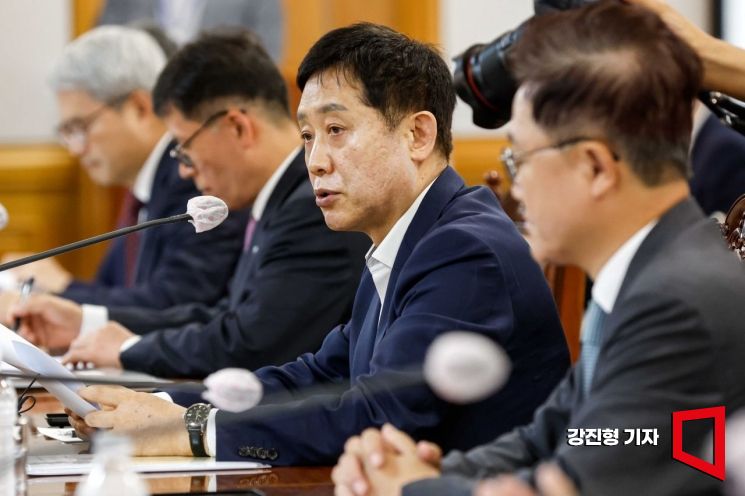 Kim Ju-hyun, Chairman of the Financial Services Commission, is delivering opening remarks at the "Comprehensive Support Measures for Export Finance" meeting held on the 16th at the Korea Federation of Banks building in Jung-gu, Seoul. Photo by Kang Jin-hyung aymsdream@
On the morning of the 16th, the Financial Services Commission held a meeting chaired by Chairman Kim Joo-hyun with bank presidents and heads of policy finance institutions at the Bankers' Hall in Jung-gu, Seoul, and announced the finalization of the "Comprehensive Export Finance Support Plan" containing these details. This is a follow-up measure to the export strategy meeting presided over by President Yoon Seok-yeol in February and the recent trilateral meeting among the private sector, ruling party, and government.
Chairman Kim stated, "To resolve livelihood issues, rapid economic recovery, a stable foreign exchange market, and the creation of quality jobs through growth are urgent, and the core of this is the export industry. We have listened to the difficulties faced by export companies and related organizations on the ground to prepare this measure. This plan aims to supply a total of 23 trillion won in funds appropriately to propel our exports to a new leap forward."
This policy fund supply is characterized by joint export support from the government, policy finance institutions, and private financial companies. To strengthen export competitiveness, policy finance institutions will invest 12 trillion won, 5.4 trillion won will be invested through collaboration between policy and private financial companies, and the banking sector will contribute 5.4 trillion won.
First, the authorities will support more than 4.1 trillion won for Korean companies to pioneer new export routes. This is intended to support export expansion through diversification amid intensified competition in advanced industrial sectors and protectionism between countries.
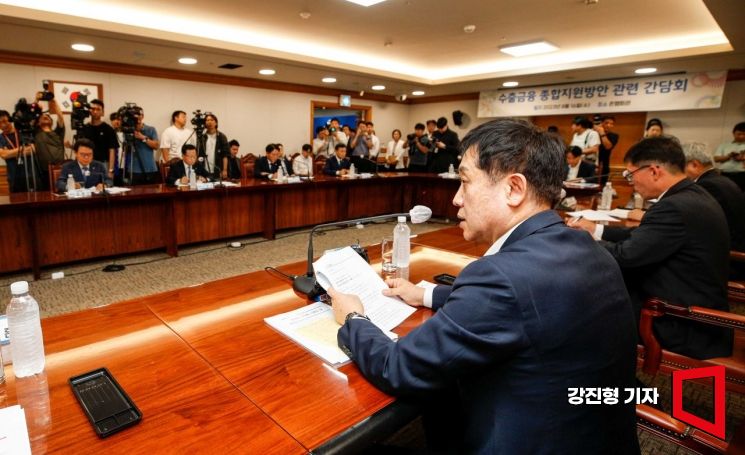 Kim Ju-hyun, Chairman of the Financial Services Commission, is delivering opening remarks at the "Comprehensive Export Finance Support Measures Meeting" held on the 16th at the Korea Federation of Banks building in Jung-gu, Seoul. Photo by Kang Jin-hyung aymsdream@
Accordingly, the authorities will provide 3.3 trillion won for new export market entry, including special guarantees of 800 billion won for companies diversifying exports, special guarantees of 1 trillion won for partner companies accompanying large corporations overseas, and on-lending support of 1.5 trillion won for companies securing new export routes.
Additionally, more than 300 billion won in policy funds will be supplied for overseas large-scale projects and shipbuilding orders. Policy finance institutions will share roles to help Korean companies win large overseas projects, and a "project package finance model" that allows participation by private financial companies will be established. Furthermore, a 500 billion won supply chain response fund will be created to reduce external dependence on supply chains for major export products and promote overseas expansion in response to trade regulations.
About 18.6 trillion won will be additionally invested to strengthen the competitiveness of domestic export strategic industries. First, 11 trillion won in policy financing will be provided to four major sectors with significant ripple effects across industries: semiconductors, secondary batteries, bio, and nuclear power generation. Additionally, 1 trillion won each will be supplied for support of strategic export item companies and special support for export companies' facility investments.
In particular, the banking sector will autonomously cooperate with public guarantee institutions to supply 5.4 trillion won worth of its own preferential export products. The scale of preferential products by bank is as follows: KB Kookmin Bank 860 billion won, Shinhan Bank 800 billion won, Woori Bank 1.5 trillion won, Hana Bank 1.5 trillion won, and NH Nonghyup Bank 600 billion won. Depending on the product, banks plan to reduce loan interest rates and guarantee fees by up to 1.5 percentage points and 0.8 percentage points respectively to alleviate the cost burden on export companies.
Additionally, policies will be promoted to ease trade finance burdens for an estimated 2,500 excellent export companies. First, when banks purchase export bills, they will reduce the purchase discount rate by up to 1.7 percentage points to help export companies collect payments early. Also, to ensure timely import of intermediate goods by excellent export companies, banks will reduce letter of credit (LC) usage fees by up to 0.7 percentage points and extend the maturity period up to one year. To hedge export payment exchange rates, forward contract fees will be reduced by up to 90%, and mandatory deposits will be waived to further ease burdens.
Chairman Kim mentioned the recent consideration in Italy of imposing a windfall tax on banks, saying, "Major countries are experiencing difficulties due to rapid interest rate hikes and economic downturns, and this is an example showing that the banking industry is expected to play a more active role in overcoming these difficulties." He added, "This export finance support is not only a meaningful social contribution but also helps secure a customer base for the future growth of the banking industry."
Meanwhile, regarding the recent trend of expanding household debt, Chairman Kim said, "We need to carefully examine whether the banking sector is circumventing the Debt Service Ratio (DSR) regulations beyond common sense or excessively lending to those with insufficient repayment ability." He added, "I hope banks actively cooperate in institutional improvements to improve the household debt structure, such as expanding fixed-rate loans and revitalizing covered bonds."
© The Asia Business Daily(www.asiae.co.kr). All rights reserved.


















