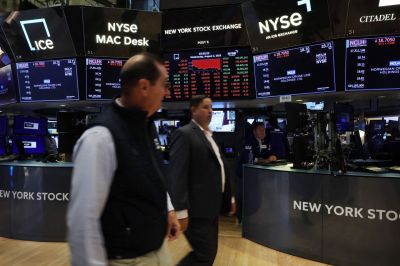
Major indices on the U.S. New York Stock Exchange showed broad weakness early on the 15th (local time) due to sluggish economic data from China. Although the retail sales indicator, a pillar accounting for two-thirds of the U.S. real economy, recorded an increase exceeding expectations, this also led to market caution that the Federal Reserve's (Fed) tightening could be prolonged.
At around 10:32 a.m. at the New York Stock Exchange (NYSE), the Dow Jones Industrial Average, composed of blue-chip stocks, was trading at around 34,984, down 322.81 points (0.91%) from the previous close. The S&P 500, focused on large-cap stocks, was down 44.55 points (0.99%) at 4,445, and the tech-heavy Nasdaq was down 141.41 points (1.03%) at 13,646.
Currently, all 11 sectors in the S&P 500 are in decline. Notably, energy, financial, and materials stocks are experiencing significant drops. Fitch warned that dozens of banks, including JPMorgan Chase, may need to be downgraded, leading to widespread weakness in bank stocks. JPMorgan fell 2.5% from the previous close. Citigroup is down about 1.6%, and Wells Fargo is down about 2%. Nvidia, which surged more than 7% the previous day, is trading slightly higher. Home Depot's earnings per share released before the market open exceeded expectations, but with the annual outlook maintained, it showed a slight increase. Retailers Target and Walmart, awaiting earnings reports this week, are showing weakness.
Additionally, DR Horton is trading slightly higher after it was confirmed that Warren Buffett's Berkshire Hathaway purchased shares. Hanon Armstrong rose more than 1% following an upgrade in investment opinion by Bank of America (BoA). Phillips 66 fell more than 1% due to a downgrade in investment opinion by BoA.
Investors are closely watching corporate earnings reports, key economic indicators, and banking sector concerns while awaiting the release of the July Federal Open Market Committee (FOMC) minutes scheduled for this week.
The U.S. retail sales for July, released before the market opened, exceeded market expectations. According to the U.S. Department of Commerce, July retail sales increased by 0.7% from the previous month, marking the fourth consecutive month of growth. This is the largest increase in the past six months and significantly surpasses the expert forecast of a 0.4% increase compiled by The Wall Street Journal (WSJ). Core retail sales, excluding automobiles, rose 1.0% from the previous month.
This indicator was released amid rising expectations of a so-called "soft landing," as recent inflation indicators such as the Consumer Price Index (CPI) have shown clear easing trends. However, such strong consumption data could also support the need for the Federal Reserve (Fed) to maintain high interest rates for a longer period. Lindsay Piegza, chief economist at Stifel Financial, commented on the data, saying, "Thanks to consumer resilience, optimism about a soft landing will be strengthened," and "At the same time, this means the Fed will need to keep interest rates high for longer."
On the other hand, the New York Empire State Manufacturing Index for August, released the same day, fell to -19. This is much lower than both July's figure and the Dow Jones estimate of -1.4. Earlier released Chinese data on July retail sales and industrial production were worse than expected. Additionally, the People's Bank of China surprised markets by cutting policy rates, further intensifying concerns over China's real estate crisis. China's announcement to suspend unemployment rate releases is also seen as indicating serious local unemployment issues.
International credit rating agency Fitch's warning that dozens of U.S. banks, including JPMorgan Chase, could face mass downgrades is also weighing on market sentiment. Chris Wolfe of Fitch stated in a CNBC interview released that morning that if the operating environment (OE) rating for the U.S. banking sector is lowered from AA- to A+, "a comprehensive rating reassessment of more than 70 U.S. banks could occur." Moody's had previously downgraded some regional banks' credit ratings and warned that downgrades of major banks could follow.
This week, as the earnings season nears its end, a large number of retail companies that can confirm U.S. consumer strength are scheduled to report earnings. Following Home Depot's report today, retail giant Target and TJX, the parent company of discount retailers TJ Maxx and HomeGoods, will report on the 16th, followed by Walmart and Ross Stores on the 17th. Home Depot, which posted weak results in the first quarter, has lowered its annual earnings guidance for this year. In contrast, Walmart raised its sales outlook earlier this year in May, supported by strong grocery and e-commerce businesses. Evercore ISI stated that Walmart's second-quarter earnings could significantly exceed Wall Street expectations.
The Fed, which raised the U.S. benchmark interest rate to 5.25-5.5%, is scheduled to release the FOMC minutes on the 16th. Investors are expected to look for indications on the interest rate direction after September and changes in economic outlook through these minutes. The market still largely expects a rate hold in September. According to the Chicago Mercantile Exchange (CME) FedWatch tool, as of this day, federal funds futures markets reflect more than an 88% probability that the Fed will hold rates steady in September. Additionally, this week includes interest rate decisions by the Reserve Bank of New Zealand and the Norges Bank. On the 18th, the Korea-U.S.-Japan summit will be held at Camp David in the United States.
In the New York bond market today, the benchmark 10-year U.S. Treasury yield is trading around 4.17%, and the 2-year yield is around 4.90%. The dollar index, which shows the value of the dollar against the currencies of six major countries, is down about 0.2% from the previous close at 102.9. The Chicago Board Options Exchange (CBOE) Volatility Index (VIX), known as Wall Street's "fear gauge," rose more than 8% to around 16.
European stock markets are declining. Germany's DAX index is trading down 1.03%. The UK's FTSE index is down 1.76%, and France's CAC index is down 1.33%.
© The Asia Business Daily(www.asiae.co.kr). All rights reserved.

















