Assemblyman Kim Jong-min "Burden of Proof on Perpetrator Companies Must Be Strengthened"
A bill to strengthen the response to technology theft from small and medium-sized enterprises (SMEs) has been introduced.
On the 15th, Kim Jong-min, a member of the Democratic Party of Korea, announced that he had taken the lead in proposing two bills, including the "Monopoly Regulation and Fair Trade Act" and the "Fair Transactions in Subcontracting Act."
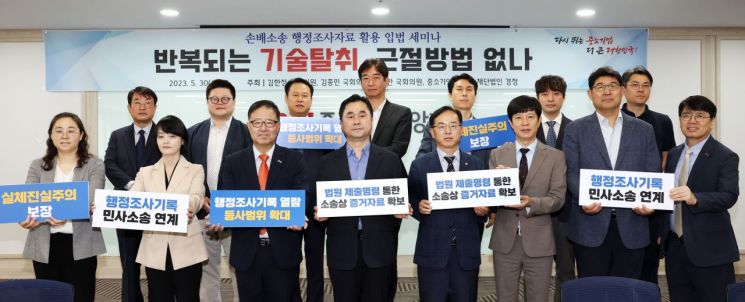 A seminar titled "Is There No Way to Eradicate Repeated Technology Theft?" was held on May 30 at the Korea Federation of Small and Medium Business in Yeouido, Seoul. Attendees including Jung Yun-mo, Executive Vice President of the Korea Federation of Small and Medium Business (third from the left in the front row), Kim Jong-min, member of the Democratic Party of Korea, Kim Kyung-man, member of the Democratic Party of Korea, and Jang Tae-gwan, Chairman of the Gyeongcheong Foundation, are posing for a commemorative photo.
 [Photo by Korea Federation of Small and Medium Business]
According to the results of a survey on the level of technology protection for SMEs, the scale of technology theft damage suffered by SMEs from 2017 to 2021 amounted to 280 billion KRW. However, there have been ongoing calls to supplement the system due to institutional problems unfavorable to SMEs in the legal process of proving technology theft acts and identifying responsibility.
First, Article 111 of the current Fair Trade Act stipulates that courts may order the submission of materials necessary for proving damages or calculating the amount of damages when requesting materials from the opposing party in a lawsuit. The problem is that the obligation to submit materials to the opposing party is imposed only when a loss has occurred. It has been pointed out that this is insufficient as a legal basis to cover the frequently occurring acts of technology theft.
When the court requests the submission of records in a lawsuit for damages, the Fair Trade Commission (FTC) refuses to submit materials other than the resolution documents, and in practice, there have been no cases where litigation parties have used the FTC’s administrative investigation records as evidence. Therefore, there is a need to enhance the effectiveness of securing materials.
Additionally, although there is a right to file an objection against the FTC’s investigation and disposition regarding technology theft acts, there was a blind spot in the rules that prohibited objections to decisions of no charges or case closures.
Accordingly, Representative Kim proposed amendments to the Fair Trade Act to establish an objection procedure that allows appeals against no-charge decisions or case closure decisions made by the FTC examiners, to enable courts to request the submission of materials from the opposing party for "proof of infringement," and to introduce a proviso that exempts confidentiality obligations when materials are provided pursuant to court submission orders. This lays the foundation for creating a fair and equitable environment in legal disputes related to technology theft.
According to the current reporting regulations for violations under the Subcontracting Transactions Act, the statute of limitations for FTC disposition starts from the date of the report when an investigation is initiated based on a report from the victim company. However, the application criteria for the report date are ambiguous, leading to criticism that the guarantee of the legal rights statute of limitations for the reporting victim companies is also unclear.
Representative Kim amended the Subcontracting Transactions Act to clearly define the date the report is received by the FTC, thereby ensuring the legitimate opportunity for reporting companies.
Kim stated, "In a situation where SMEs still have a high rate of losing lawsuits, an environment must first be created where technology theft acts can be clearly proven and SMEs can have their rightful rights recognized. While strengthening the burden of proof on offending companies regarding technology theft, we will also continue to consider establishing enhanced technology theft prevention systems, such as a Korean-style discovery system, and strive to create a fair market ecosystem."
© The Asia Business Daily(www.asiae.co.kr). All rights reserved.
![Clutching a Stolen Dior Bag, Saying "I Hate Being Poor but Real"... The Grotesque Con of a "Human Knockoff" [Slate]](https://cwcontent.asiae.co.kr/asiaresize/183/2026021902243444107_1771435474.jpg)
















