3 out of 10 People Say "Traveling to Japan on Gwangbokjeol is Personal Freedom"
One in four members of Generation Z (born 1995?2009) was found to not properly understand the meaning of Gwangbokjeol (Korean Liberation Day).
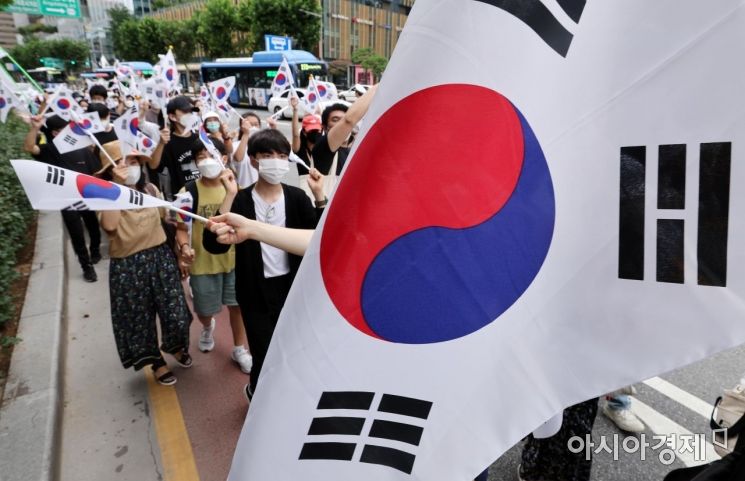 On August 15, the 77th anniversary of Liberation Day, citizens are marching to Bosingak in Jongno, Seoul, waving the Taegeukgi flag. Photo by Hyunmin Kim kimhyun81@
On the 14th, data consulting firm PMI announced the results of a survey on 'Perceptions of Liberation Day by Generation,' conducted among 3,000 men and women nationwide aged 20 to 69.
When asked 'How accurately do you know about Gwangbokjeol?', 11.2% of all Generation Z respondents answered 'I do not know at all.' Those who answered 'I do not know well' accounted for 15.6%.
On the other hand, the highest percentage of respondents who answered that they 'know very well' about the meaning of Gwangbokjeol, the activities done on the day, the year and date of liberation, was the pre-Baby Boom generation (born before 1964) at 51.4%. This was followed by Generation X (born 1965?1980) at 32.3%, the Millennial generation (born 1981?1994) at 26.4%, and Generation Z at 21.9%, showing that the younger the age group, the less they knew about the meaning of Gwangbokjeol.
Regarding questions related to traveling to Japan on Gwangbokjeol, 50.6% of all respondents answered, 'It is possible to travel to Japan, but it should be avoided on meaningful days like Gwangbokjeol.' Additionally, 19.9% responded negatively to traveling to Japan itself, considering the historical relationship between the two countries, meaning 7 out of 10 people had a negative view of traveling to Japan on Gwangbokjeol.
Conversely, 29.5% of respondents said, 'It is an individual's freedom to go wherever and whenever they want.' Especially, 32.6% of Generation Z gave this response, the highest percentage among the groups. In other words, 3 out of 10 Generation Z individuals think that historical significance and personal freedom are separate matters. Other generations showed responses in the 20% range (pre-Baby Boom 26.6%, Generation X 29%, Millennial generation 29.8%).
Regarding whether Korea-Japan relations need improvement, 44.9% of all respondents said, 'Korea-Japan relations still need improvement.' By generation, the results were 57.4% for the pre-Baby Boom generation, 45.9% for Generation X, 39.7% for the Millennial generation, and 36.6% for Generation Z.
© The Asia Business Daily(www.asiae.co.kr). All rights reserved.

















