Martial Arts Survey... EU 33%, US 23%, Japan 22%
The proportion of South Korea's patents in hydrogen storage and transportation accounts for only 5% of the global total, which is lower than the European Union (EU) at 33%, the United States at 23%, and Japan at 22%.
The Korea International Trade Association's International Trade and Commerce Research Institute announced on the 15th that it had published a report titled "Current Status and Policy Tasks for Fostering the Hydrogen Storage and Transportation Industry" containing this information.
Hydrogen has a low energy density per unit volume. To store and transport it, compression or conversion processes are required.
The growth potential of the storage and transportation market is high. The global hydrogen storage market size is expected to grow from $14.7 billion (approximately 19.6 trillion KRW) in 2021 at an average annual growth rate of 4.4%, reaching about $21.7 billion (approximately 28.9 trillion KRW) by 2030.
The transportation market is currently focused on gas-based transport, limiting its scope domestically, but once liquid and liquid-phase technologies are commercialized, the liquefied hydrogen transportation market size is expected to reach about $566 billion (approximately 754.2 trillion KRW) by 2050.
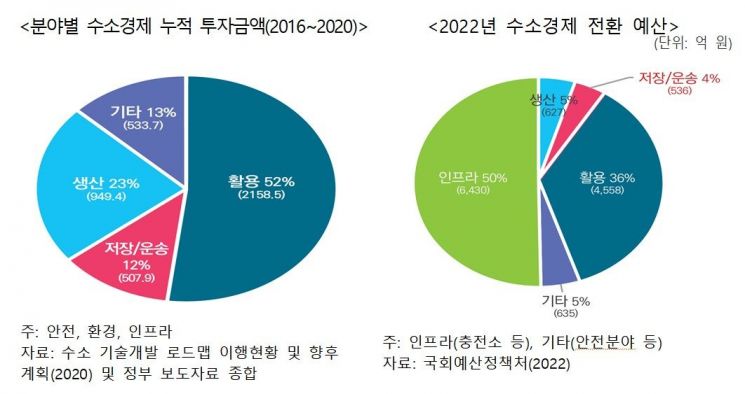
South Korea's hydrogen industry is concentrated on investment in utilization technologies. The investment proportion in the storage and transportation sector is not large. Of the government’s hydrogen budget of 414.9 billion KRW from 2016 to 2020, only 50.7 billion KRW (12%) was allocated to storage and transportation. Last year, only 4% (53.6 billion KRW) of the hydrogen economy transition budget was allocated. As a result, from 2011 to 2020, South Korea’s share of hydrogen storage and transportation patent applications was 5%, lower than the EU, the US, and Japan.
Countries such as Germany, the United States, Japan, and Australia are actively implementing policies to foster storage and transportation. Germany is conducting four projects in the storage and transportation sector worth up to $82.8 million (approximately 110 billion KRW). The U.S. Department of Energy (DOE) promoted seven hydrogen storage and transportation projects from 2020 to 2021.
Japan is ahead in commercializing liquefied maritime transportation. It supports storage and transportation technology and infrastructure development projects with about 20 billion yen (approximately 18 billion KRW). Australia is pursuing joint projects with Germany, Japan, and others. To achieve technological independence, the Australian Renewable Energy Agency (ARENA) supports seven storage and transportation projects with 9.5 million Australian dollars (approximately 8 billion KRW).
The report stated that hydrogen storage and transportation policies must be actively implemented. It recommended creating special criteria for research and development (R&D) projects to increase R&D support and enhancing the overseas hydrogen supply chain support system. It also suggested relaxing tube trailer volume and pressure standards and exempting R&D facility permits and inspection regulations under the Hydrogen Act.
Lim Ji-hoon, senior researcher at the Korea International Trade Association, said, "The hydrogen economy is characterized by difficulty in producing immediate business results and investments not directly linked to profits, so government support is necessary," adding, "Policies for domestic technological independence and industry fostering must be established."
© The Asia Business Daily(www.asiae.co.kr). All rights reserved.
![Clutching a Stolen Dior Bag, Saying "I Hate Being Poor but Real"... The Grotesque Con of a "Human Knockoff" [Slate]](https://cwcontent.asiae.co.kr/asiaresize/183/2026021902243444107_1771435474.jpg)

















