Kim Chang-soon (84, female), who has lived in Bukchon, Seoul for 60 years, removed her doorbell last year. This was because tourists flocking to Bukchon kept ringing the doorbell after the COVID-19 situation eased. At first, she opened the door when tourists said they urgently needed to use the bathroom, but after this happened repeatedly, she decided to remove the doorbell altogether. Kim said, "Until last year, Bukchon wasn't noisy enough to be bothersome, but I'm worried that Bukchon will become noisy again when yukeo (Chinese tourists) flood in," adding, "We can't block tourists for the sake of local merchants here, but I don't know how long we have to keep sacrificing."
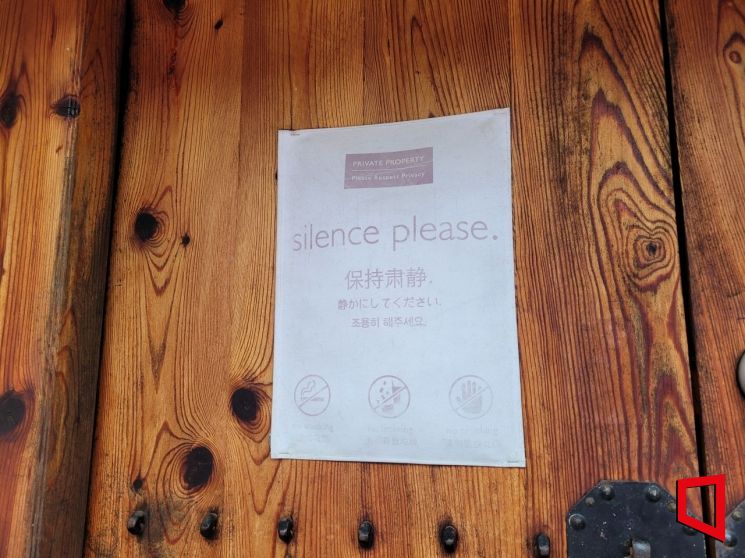 On the 11th, a notice requesting quiet viewing was posted on a house in Bukchon Hanok Village.
 [Photo by Gong Byung-sun]
As yukeo return to Korea, expectations for the commercial districts of famous tourist spots are rising, but residents around these areas are concerned about the inconveniences caused by 'overtourism.' On the 10th, the China National Tourism Administration decided to allow group tours of Chinese tourists to 78 countries worldwide, including Korea, the United States, Japan, and Germany. This is the first time in 6 years and 5 months since the Chinese government lifted the group tour ban on Korea, which was a retaliatory measure following the deployment of THAAD in March 2017. Yukeo are among the tourists who visit Korea the most. In 2016, before the THAAD deployment, 8.06 million yukeo visited Korea. Even in 2019, after the retaliatory measures, 6,023,021 yukeo visited Korea, showing that Chinese tourism has a significant economic impact.
In Seoul, the Insadong commercial district in Jongno-gu, known as a famous tourist spot, is preparing to welcome yukeo. Merchants expect increased sales as the number of group tourists rises. In fact, on the 11th, when heavy rain fell due to Typhoon Khanun, many foreign tourists were seen browsing traditional crafts. Seven Chinese tourists passed by a traditional tea house and looked around the Insadong streets. Kwon Jung-sook (65, female), who sells traditional crafts, said, "Many Chinese tourists are big spenders, so they definitely help boost sales," adding, "Insadong's commercial district is quite refined, so I hope there will be a lot of promotion ahead of the yukeo visits."
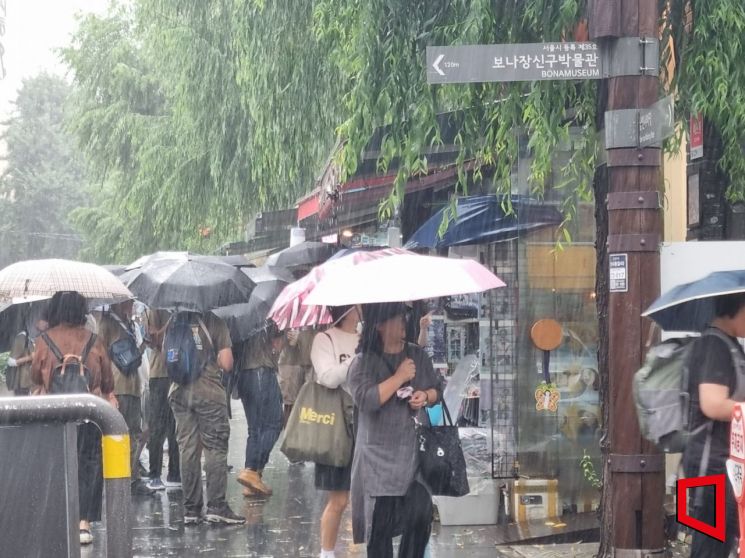 On the 11th, despite heavy rain caused by Typhoon 'Khanun' in Insadong, Jongno-gu, Seoul, visits from yukeo (Chinese tourists) continued.
 [Photo by Gong Byung-seon]
On the other hand, residents of Bukchon Hanok Village, located about a 15-minute walk from Insadong, have already expressed concerns. Jongno-gu has assigned eight guides throughout the Hanok Village to promote 'quiet tourism' for visitors who want to explore Bukchon peacefully. However, residents point out that it is difficult to prevent overtourism caused by yukeo with guides alone. Lee (67, female), who has lived in Bukchon for seven years, said, "Sometimes tourists suddenly enter, thinking it's a museum or gallery," adding, "It's hard to live with the front door open." Another resident, Kang (66, male), said, "Since yukeo come in groups, noise is inevitable," and lamented, "Measures such as restricting Bukchon tourism after 5 p.m. are in place, but I'm worried about potential conflicts."
Experts pointed out that instead of simply accepting many tourists, it is necessary to create high-quality tourism products that can enhance understanding of Korean culture. Lee Hoon, a professor at Hanyang University's Department of Tourism, said, "When group tourists come with low-cost package deals, they sometimes show a lack of respect for the culture of tourist sites," adding, "The private travel associations and the government need to cooperate to develop and manage high-quality tourism products."
© The Asia Business Daily(www.asiae.co.kr). All rights reserved.
![Clutching a Stolen Dior Bag, Saying "I Hate Being Poor but Real"... The Grotesque Con of a "Human Knockoff" [Slate]](https://cwcontent.asiae.co.kr/asiaresize/183/2026021902243444107_1771435474.jpg)

















