
The government is expected to put the brakes on new projects across ministries while maintaining a sound fiscal policy in the formulation of next year’s budget. The Ministry of Economy and Finance has stated that, aside from essential budgets required by each ministry, it will thoroughly review the feasibility of newly initiated projects. This is a tough measure to secure fiscal soundness. Some voices express concern that the government’s stance to minimize budget increases for next year might cause the golden opportunity for new projects to be missed.
According to related ministries on the 14th, the budget allocation rate for new projects in each ministry for next year is expected to fall below 10%. This comes as the Ministry of Economy and Finance, which handles ministry budgets, has unusually requested all ministries to resubmit revised budget proposals, initiating a large-scale expenditure restructuring. In this process, the budgets requested for new projects by each ministry are particularly taking a direct hit. The government finds it burdensome to allocate budgets for new projects whose effectiveness has not been proven while maintaining tight fiscal discipline. A ministry official said, “There is an openly circulating internal talk that items containing the word ‘new’ in the budget proposals will mostly be difficult to allocate.”
Given this situation, ministries seem to be effectively holding back their budget requests for new projects next year. For example, the Ministry of Oceans and Fisheries, aside from partially increasing next year’s budget for radiation monitoring and stabilizing seafood supply due to the impact of Japan’s Fukushima contaminated water discharge (about 344 billion KRW this year), is judging that securing budgets for new projects such as crew mutual aid is practically difficult. Inside and outside the government, there are also predictions that among the budgets requested by each ministry to the Ministry of Economy and Finance, the Ministry of Agriculture, Food and Rural Affairs will face cuts of about 20 trillion KRW, the Ministry of Environment about 12 trillion KRW, and the Ministry of Oceans and Fisheries about 8 trillion KRW.
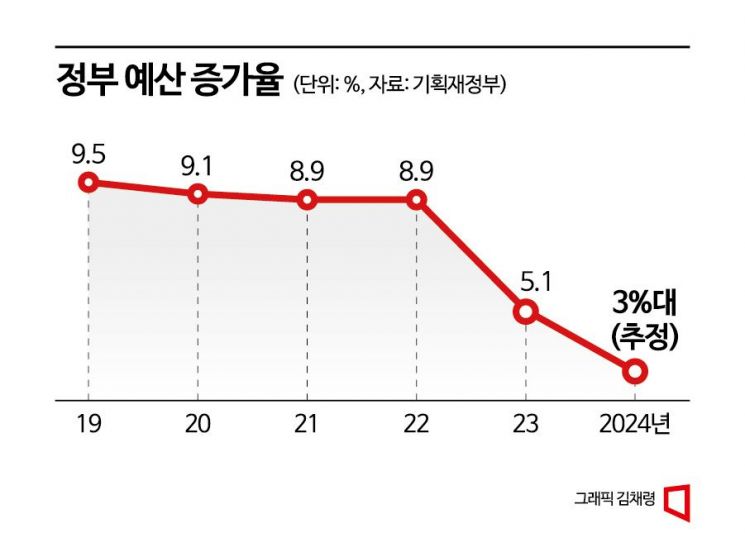
The reason the government is tightening its belt by reducing budget allocations for new projects is that the tax revenue shortage is worsening. According to the Ministry of Economy and Finance, the managed fiscal balance deficit in the first half of this year approached 83 trillion KRW, indicating that the national finances are gradually shrinking. This is due to poor corporate performance in the first half, which led to a significant decrease in corporate tax and income tax revenues. Corporate tax collected until June this year was 46.7 trillion KRW, down 26.4% (16.8 trillion KRW) compared to the same period last year.
Accordingly, the government is strongly considering limiting the expenditure growth rate in next year’s budget to the 3% range. This is based on the judgment that the expenditure growth rate must be kept low until tax revenue conditions improve. Earlier, the Ministry of Economy and Finance reported to the ruling party leadership last week that total expenditure for next year would be set at around 658 to 663 trillion KRW, a 3% increase from this year’s 638.7 trillion KRW. This figure is 1 percentage point lower than the ‘mid-4% range’ reported at the fiscal strategy meeting at the end of June. Compared to the government’s previous budget expenditure growth rates of 7-9% annually, this is more than a 50% reduction. During the Moon Jae-in administration, the budget growth rates were 9.5% in 2019, 9.1% in 2020, and 8.9% from 2021 to 2022.
However, concerns are also emerging that insufficient budget allocations may delay or weaken key projects in each ministry. A representative example is the total budget for water resources in the Ministry of Land, Infrastructure and Transport and the Ministry of Environment, which decreased to 44.6% in 2020 (about 1.29 trillion KRW) compared to 2014 (about 2.33 trillion KRW). As related budgets have decreased, there have been criticisms that recent abnormal weather has caused issues with flood prevention and water control. The Ministry of Economy and Finance plans to minimize the expenditure growth rate in next year’s budget while strengthening new budgets related to people’s livelihoods as much as possible. In particular, it intends to actively review areas with excessive spending in national subsidy projects and reduce expenditures on private organizations and social enterprises with poor performance.
© The Asia Business Daily(www.asiae.co.kr). All rights reserved.


















