Wholesale Price of 8kg Albaegi Cabbage at 36,000 Won... Over 140% Increase in a Month
Price Rise Due to Last Month's Heavy Rain Damage and Chuseok Peak Season Concerns
Following last month's record-breaking heavy rains, agricultural product prices are soaring due to Typhoon 'Khanun' that struck the Korean Peninsula earlier this month. The impact of the heavy rain damage, which will be fully reflected in the August Consumer Price Index, combined with reduced supply caused by the typhoon and heatwave, as well as increased fruit demand ahead of the Chuseok holiday, has put the prices of daily necessities on high alert.
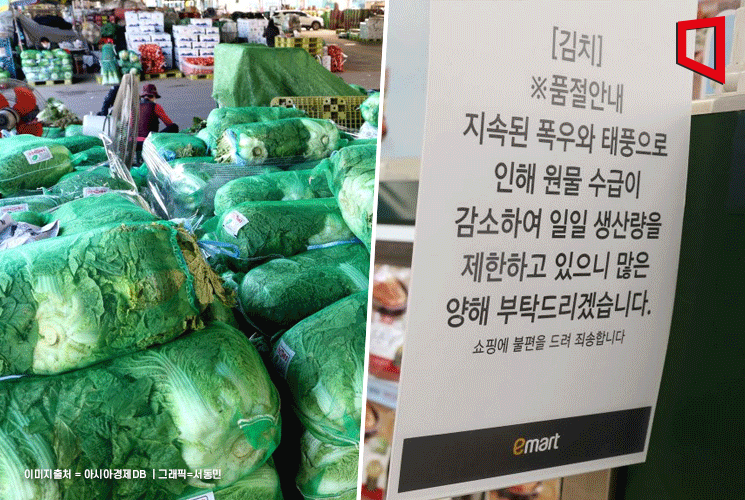
According to the agricultural product distribution information from the Korea Agro-Fisheries & Food Trade Corporation (aT) on the 14th, the wholesale price of 8kg of albaegi cabbage was 36,040 won as of the 11th, rising by 21,132 won (141.7%) compared to one month ago (14,908 won). Albaegi cabbage is a vegetable mainly used for fresh kimchi or wraps.
Wholesale prices of water parsley, green onions/scallions, cabbage, and pumpkin also more than doubled within a month. Water parsley (7.5kg) rose from 35,516 won to 83,800 won, and scallions (1kg) increased from 7,094 won to 14,560 won, up 135.9% and 112.3% respectively. Cabbage (8kg) went up by 7,522 won (106.9%) from 7,038 won to 14,560 won.
Key ingredients for kimchi-making, such as napa cabbage and radish, are also showing sharp price increases. The average wholesale price of napa cabbage (10kg) jumped from 9,880 won a month ago to 25,760 won (160.7%) as of the 11th. This price is 82.6% higher than the average price (14,106 won). The wholesale price of radish (20kg) also rose by 127.3% compared to one month ago (12,900 won), reaching 29,320 won, and increased by 57.1% compared to the average price (18,664 won).
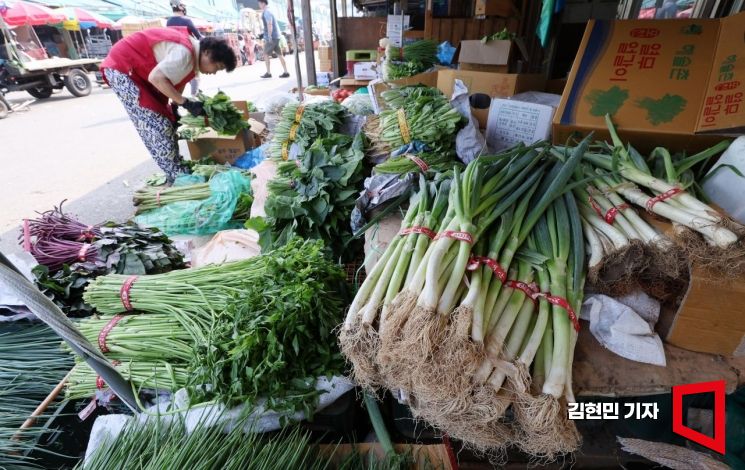
The recent price hikes are due to accumulated crop damage caused by heavy rains, heatwaves, and the typhoon. According to the Ministry of Agriculture, Food and Rural Affairs, as of the 28th of last month, the area of crops damaged by flooding or fruit drop due to the concentrated heavy rains in July reached 36,252 hectares (362.52 million square meters). Additionally, 1,565.4 hectares of crop damage occurred due to Typhoon Khanun.
The problem is that further price increases are looming. Agricultural product consumer prices rose by 4.7% in July, but this increase only partially reflected the damage from last month's heavy rains. Statistics Korea compiles price increases for major items in three rounds, and the price hikes caused by the heavy rains last month were only reflected in the third round of data. This means the impact of the heavy rains will be fully reflected in August. Furthermore, with the Chuseok holiday approaching next month, the price increase of agricultural products, especially fruits, may accelerate further.
An official from the Ministry of Agriculture, Food and Rural Affairs said, "The government is implementing supply-demand stabilization measures for each item and directly easing consumers' price burdens by selecting high-priced items weekly and providing a 20% discount (30% at traditional markets) up to 10,000 won per person. To stabilize fruit supply during the Chuseok holiday, we plan to cooperate closely with related parties, including local agricultural cooperatives responsible for production, large distribution companies at the consumer interface, wholesale corporations, and intermediate wholesalers' associations, to ensure that high-quality fruits are supplied at appropriate prices at the right time."
© The Asia Business Daily(www.asiae.co.kr). All rights reserved.


















