Only Some Companies Conduct Campaigns
Impact of Korea-Japan Relations Improvement and Endemic
The distribution industry has conducted 'Liberation Day marketing' every year ahead of Liberation Day. Around the 15th, limited-edition products sold only for a certain period or discount events were held to promote patriotism. However, this year the atmosphere is quite different. Unlike previous years when everyone jumped into Liberation Day marketing, there is a noticeable trend of scaling back such promotions.
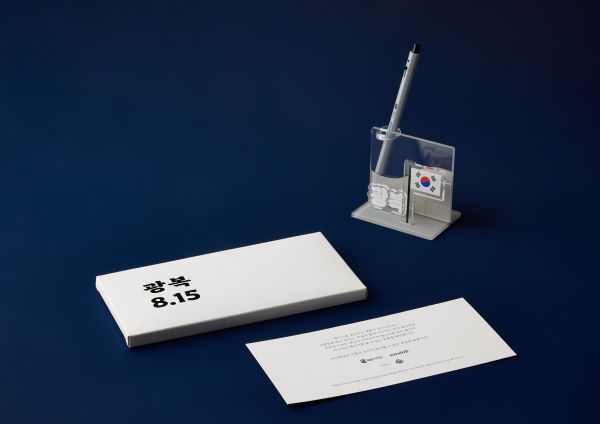 GS25 is conducting the 'Raising the Taegeukgi' campaign, producing 8,150 sets of Taegeukgi dioramas (miniature models installed with a landscape or picture as the background) in collaboration with Sandoll, Korea's first digital font company, and Ottogi, a comprehensive food company, to give away as prizes to customers.
 [Photo by GS Retail]
According to the industry on the 14th, Liberation Day marketing, which was actively carried out mainly by offline distribution companies in the past, has virtually disappeared. Even the so-called 'Big 3' in distribution?Lotte, Shinsegae, and Hyundai Department Store affiliates?are not conducting Liberation Day marketing this year. Although the large marts operated by these groups are holding discount events targeting the transitional holidays between Malbok and Liberation Day, these promotions are far from Liberation Day marketing.
Of course, some companies are still conducting Liberation Day marketing this year. 11st, convenience stores GS25 and CU fall into this category. 11st is exclusively selling limited-edition products inspired by the Taegeukgi in collaboration with HC Happycall, GS25 is running a 'Display the Taegeukgi' campaign, and CU is conducting a donation campaign for 'Housing Improvement for Descendants of Independence Activists.' However, the industry evaluates that the scale has significantly decreased compared to previous years.
Liberation Day marketing focuses on patriotism. Since it originated with the intention of helping descendants of independence activists and reflecting on the meaning of liberation, underlying it is anti-Japanese sentiment. Because of this, its effectiveness is maximized when Korea-Japan relations deteriorate. The fact that the most active period of Liberation Day marketing in the distribution industry was August 2019 also proves this. At that time, anti-Japanese sentiment peaked amid the boycott movement triggered by Japan's export restrictions.
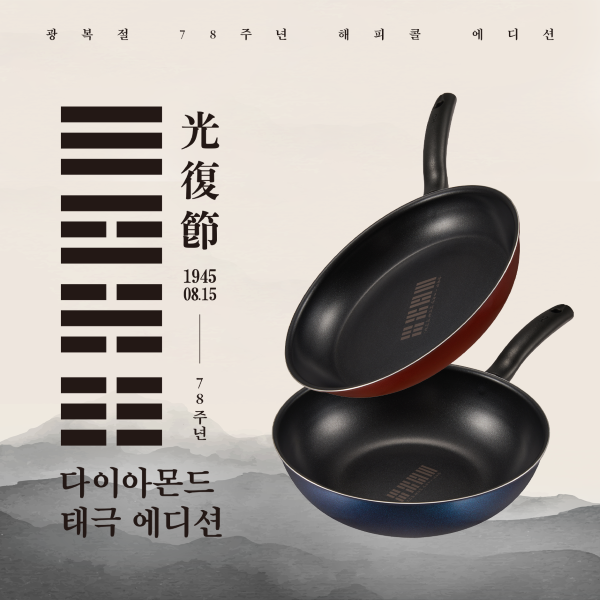 11st is exclusively selling limited edition products designed with the Taegeukgi motif in collaboration with HC Happycall ahead of Liberation Day.
 [Photo by 11st]
The slowdown in Liberation Day marketing this year is somewhat understandable when looking at the current state of Korea-Japan relations. Professor Jeong Yeon-seung of Dankook University's Department of Business Administration (President of the Service Marketing Association) said, "Given the improving atmosphere in Korea-Japan relations, it seems difficult for companies to engage in Liberation Day marketing related to Korea-Japan relations," adding, "It means they have to be cautious given the current mood."
There is also a view that the COVID-19 endemic has influenced the reduction of Liberation Day marketing. During the COVID-19 period, offline distribution companies used such marketing as part of efforts to regain customers lost to online channels, but the atmosphere is different now. Professor Jeong said, "Since the endemic is not yet a complete return to the past, companies seem to be observing consumer trends more carefully rather than launching aggressive marketing campaigns."
© The Asia Business Daily(www.asiae.co.kr). All rights reserved.


















