Possibility of Korea-US and Korea-Japan Summits Following Korea-US-Japan Meeting
Japan's Contaminated Water Not on Agenda... Regularization of Military Drills May Be Discussed
"A Framework for Korea-US-Japan Security Cooperation Can Be Established and Institutionalized"
President Yoon Suk-yeol will attend the Korea-US-Japan summit meeting held at Camp David in the United States on the 18th. As this is the first-ever standalone summit meeting in history, not a multilateral summit meeting, the leaders are expected to discuss practical cooperation plans in various fields such as security cooperation, advanced technology, and supply chains. There is also a possibility that Korea-US and Korea-Japan summit meetings will take place on the occasion of this summit meeting.
Kim Tae-hyo, First Deputy Director of the National Security Office, held a briefing at the Presidential Office in Yongsan, Seoul, on the afternoon of the 13th, stating, "President Yoon will depart on the 17th to attend the Korea-US-Japan summit meeting to be held at Camp David in the United States on the 18th, at the invitation of US President Joe Biden," and added, "President Yoon will hold the Korea-US-Japan summit meeting with President Biden and Japanese Prime Minister Kishida Fumio on the morning of the 18th, followed by a summit luncheon and a joint press conference to announce the results of consultations among the three leaders."
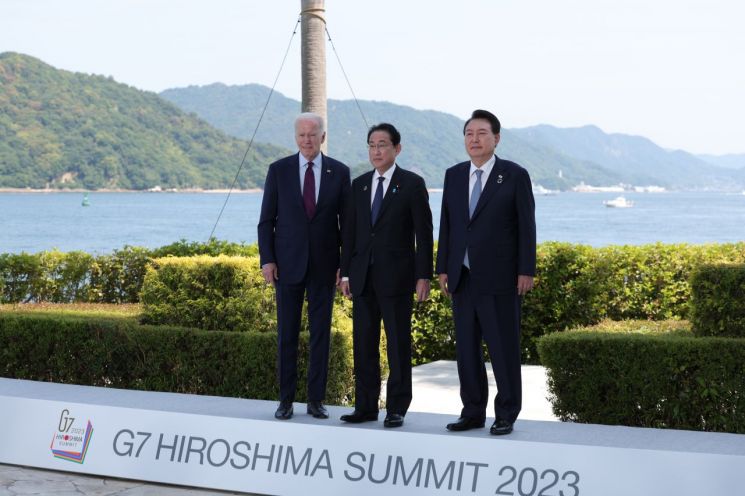
Not a Summit Meeting but a Summit... Expectations for Strengthening the Status of the Three-Nation Meeting
This is the first time in history that the leaders of Korea, the US, and Japan meet separately, not as part of a multilateral meeting. Previously, Korea-US-Japan summit meetings were held a total of 12 times, starting with the Asia-Pacific Economic Cooperation (APEC) summit meeting held in Indonesia in November 1994, as part of multilateral meetings. Since the inauguration of the Yoon Suk-yeol administration, a total of three Korea-US-Japan summit meetings?the most among all previous administrations?have been held. These include the NATO summit in Madrid, Spain, in June last year, the ASEAN summit in Phnom Penh, Cambodia, in November, and the G7 summit in Hiroshima, Japan, in May this year.
Since this summit meeting is labeled as a "Korea-US-Japan summit meeting" rather than the commonly used term "Korea-US-Japan summit," it is expected that the status of Korea-US-Japan cooperation and meetings among the three leaders will be further strengthened in the future. This choice of terminology can also be interpreted as highlighting Korea-US-Japan cooperation in response to the "Korea-China-Japan summit meeting," which has been held regularly since 2008. Since the Korea-China-Japan summit meetings have not been held since 2020, after the COVID-19 pandemic, and amid intensified US-China hegemonic competition, it is essential for the US to cooperate with both Korea and Japan to maintain hegemony in the Pacific region, making this the possible beginning of regular Korea-US-Japan summit meetings.
The Presidential Office also expects that through this summit meeting, the three countries will establish the core framework for security cooperation and institutionalize it. Deputy Director Kim said, "The three leaders will discuss a joint vision and basic principles for the meeting and establish a comprehensive and multi-layered cooperation system in various fields." It is expected to be an opportunity to strengthen trilateral security cooperation to respond to common regional threats and ensure peace and security. Kim added, "They will focus on discussing practical cooperation measures to jointly respond to North Korea's nuclear missile threats." In addition, cooperation plans for regional common prosperity and future growth are also expected to be addressed. The three leaders are likely to exchange views on expanding advanced technology sectors to secure future growth engines for Korea-US-Japan, as well as strengthening partnerships for joint responses such as supply chain and energy supply stability.
This is also significant in that the scope of trilateral cooperation has expanded since President Yoon took office. At the Korea-US-Japan summit meeting held in Phnom Penh, the three leaders agreed on the most comprehensive statement ever, including ▲ real-time sharing of North Korean missile warning information ▲ establishment of Korea-US-Japan economic security dialogue ▲ strengthening cooperation in key and emerging technologies, health, and climate change ▲ joint cooperation with ASEAN, Mekong, and Pacific island countries ▲ reaffirmation of the importance of maintaining peace and stability in the Taiwan Strait ▲ condemnation of Russia's invasion of Ukraine.
Interest in Camp David, where the Korea-US-Japan summit meeting will be held, has also increased. It is a place where major world leaders have gathered to reach historically significant agreements and where relations between hostile countries have improved, making it a location with high diplomatic symbolism. During World War II in 1943, British Prime Minister Winston Churchill was the first foreign leader to visit Camp David and discuss the end of the war with President Franklin D. Roosevelt. In 1956, when the US-Soviet Cold War intensified, a summit meeting was held between President Dwight Eisenhower and Soviet Secretary General Nikita Khrushchev. Among Korean leaders, former President Lee Myung-bak was the first to visit in April 2008, invited by then US President George W. Bush.
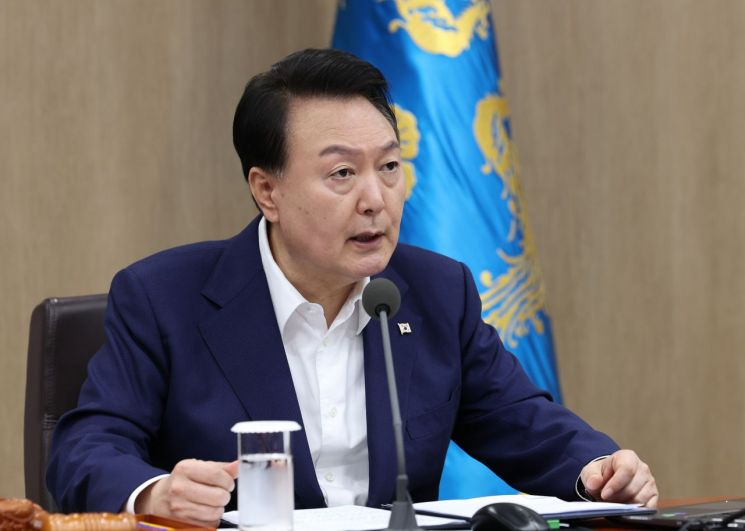
Possibility of Consecutive Korea-US and Korea-Japan Summit Meetings... Focus on Security Discussions Excluding Contaminated Water
There is also a possibility of holding bilateral Korea-US and Korea-Japan summit meetings on the occasion of this Korea-US-Japan summit meeting. A Presidential Office official said, "We are coordinating to hold Korea-US and Korea-Japan summit meetings on the occasion of this summit meeting," adding, "This visit will focus on trilateral consultations, and most of the schedule will be devoted to the Korea-US-Japan summit meeting."
However, the issue of the discharge of contaminated water from Fukushima is unlikely to be formally discussed as an agenda item. The official emphasized, regarding some foreign media reports that the Japanese government seeks Korea-US support for the Fukushima contaminated water discharge at the Korea-US-Japan summit meeting, that "the contaminated water discharge issue is not included in the Korea-US-Japan discussion agenda." He added, "The contaminated water issue has already been investigated for over a year by the International Atomic Energy Agency (IAEA) with credible experts, and a cooperative system with Japan has been completed. Allied countries, including Korea, have cooperated bilaterally during this process, so future schedules will be decided between Japan and the IAEA." He continued, "What Korea needs to do is to request Japan for the safety of our citizens' health, and since the Japanese government mostly recognizes and accepts this, I do not think further discussions will take place." However, regarding North Korea's nuclear and missile issues, the trilateral joint response stance is expected to be concretely revealed. The Presidential Office said, "Through this summit meeting, the Korea-US-Japan trilateral consultative body will gain clear independence as a cooperative body within the Indo-Pacific region."
Discussions on regularizing trilateral military exercises among Korea, the US, and Japan may also take place. The official said, "Military exercises, intelligence cooperation, and consultative body operation plans will be activated through various consultative bodies not only on security issues but also on AI, cyber issues, and economic security," adding, "In this regard, the frequency and content of the consultative bodies' meetings are being refined."
Meanwhile, no social activities involving the first ladies are scheduled at this summit meeting. The official said, "Since Korea, the US, and Japan are establishing a new consultative body to launch a more solid and predictable consultative system in the Indo-Pacific region, the first ladies' schedules are not included," adding, "Like other US-Japan summits, the first lady will not accompany." President Yoon will return to Korea on the evening of the same day after completing all schedules at Camp David.
© The Asia Business Daily(www.asiae.co.kr). All rights reserved.
![Clutching a Stolen Dior Bag, Saying "I Hate Being Poor but Real"... The Grotesque Con of a "Human Knockoff" [Slate]](https://cwcontent.asiae.co.kr/asiaresize/183/2026021902243444107_1771435474.jpg)











