Juvenile Shortfin Mako and Sevengill Shark Found in Gangwon Goseong and Sokcho
"Increased Frequency and Intensity of Summer High Temperatures Since 2010"
A report containing research results that the habitat of sharks found in domestic coastal waters is gradually moving northward has been published.
According to the '2023 Fisheries Sector Climate Change Impact and Research Report' published by the National Institute of Fisheries Science on the 13th, as the ocean warms due to global warming, sharks that were mainly observed in the Jeju Strait, eastern Jeju, and southern West Sea are now being observed even in the coastal waters of Gangwon Province and North Gyeongsang Province.
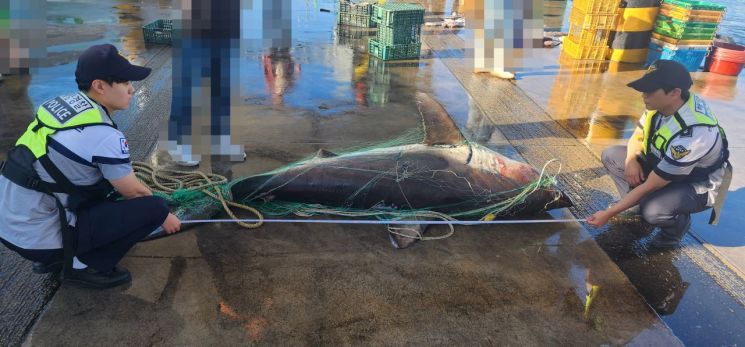
In April last year and June 2019, blue sharks were found in Goseong, Gangwon Province, and in 2017, a whale shark appeared in Yeongdeok, North Gyeongsang Province. Also, in September 2009, a great white shark appeared in Goseong, Gangwon Province, and in 2007, a whale shark was confirmed in Uljin, North Gyeongsang Province.
Although not reflected in the research report, on the 1st of this month, a highly aggressive shortfin mako shark appeared near Gangneung Port in Gangwon Province, prompting the coast guard to strengthen patrols. Last month, a 211 cm long sevengill shark was found dead, caught in a net in Samcheok, Gangwon Province.
The Fisheries Science Institute stated, "Large sharks can travel more than 200 km a day, so it is possible that their appearance is due to short-term movement, but it is true that the areas where they appear are gradually moving northward."
The institute believes that since the routes of warm currents such as the Yellow Sea Warm Current and the Tsushima Warm Current coincide with the shark appearance areas, the movement of warm currents is likely related to the distribution of sharks.
The institute explained, "There is a close relationship between the intensity of warm currents caused by global warming and the appearance of sharks," adding, "The recent rapid rise in summer surface water temperatures in the East Sea is also related to shark appearances."
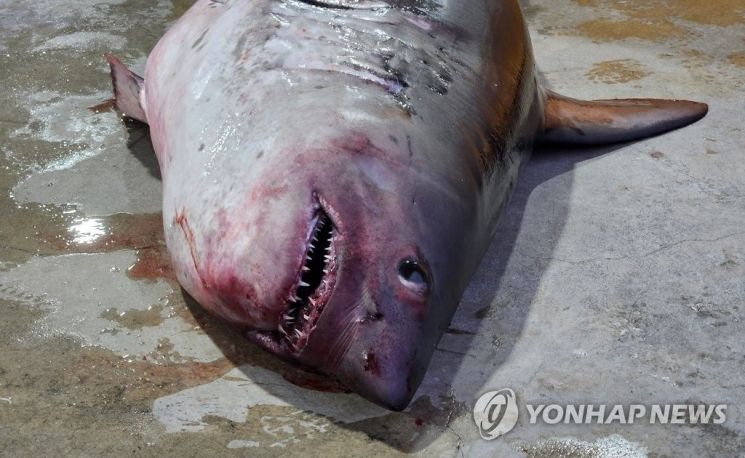 Last month, a 211 cm long goblin shark was found dead, caught in a net in Samcheok, Gangwon.
 [Photo by Donghae Coast Guard]
In domestic waters, since 2010, high summer water temperatures have occurred more frequently and with greater intensity. One of the causes is the strengthening of air masses around our seas during summer, such as the expansion of the North Pacific High pressure system over the past decade, which has increased the number of heatwave days.
The Tsushima Warm Current, which transports heat from lower latitudes, has shown a tendency to strengthen mainly during summer, creating favorable conditions for high water temperatures.
Not only in domestic seas but also globally, the number of days with high water temperatures doubled in the late 2010s compared to the early 1980s.
In Korea, a total of 49 shark species have been observed so far. In the collection survey conducted by the National Institute of Fisheries Science over 25 years since 1997, 4,743 sharks were caught.
Most of them were small sharks called 'Dutub sharks,' accounting for 92.9% or 4,373 individuals. Next were the goblin sharks, with 208 individuals making up 4.4%. Large sharks such as the white-spotted smooth-hound, brownbanded bamboo shark, and horn shark have also been caught before reaching adulthood.
© The Asia Business Daily(www.asiae.co.kr). All rights reserved.
![Clutching a Stolen Dior Bag, Saying "I Hate Being Poor but Real"... The Grotesque Con of a "Human Knockoff" [Slate]](https://cwcontent.asiae.co.kr/asiaresize/183/2026021902243444107_1771435474.jpg)

















