Democratic Peace Council Q2 Unification Survey
Only 29% Responded They Want a 'Single Nation'
73.7% Say Unification Is Necessary
More than half of the nation's population prefers a two-state system with free movement over a single state as the future vision for the Korean Peninsula.
According to the results of the second-quarter national unification opinion survey released on the 13th by the National Unification Advisory Council (hereinafter 'Minjupyeongtong'), 52.0% of general respondents chose "two states with free movement" as the desirable future for inter-Korean relations. Those who answered "single state" accounted for 28.5%, followed by "one state, two systems" and "two states as currently" at 9.8% and 7.9%, respectively.
Minjupyeongtong conducts quarterly unification opinion surveys composed of current issues and trend analysis questions, comparing and analyzing the results with those of experts and Minjupyeongtong advisory committee members.
A similar question format was introduced in Minjupyeongtong's regular unification opinion surveys starting from the third quarter of 2021. Until the first quarter of this year, the response rates were in the order of "a state of free economic exchange cooperation like the European Union" (33.6?40.1%), "a unified state like East and West Germany" (33.2?38.8%), and "good neighbors like the United States and Canada" (23.8?25.7%).
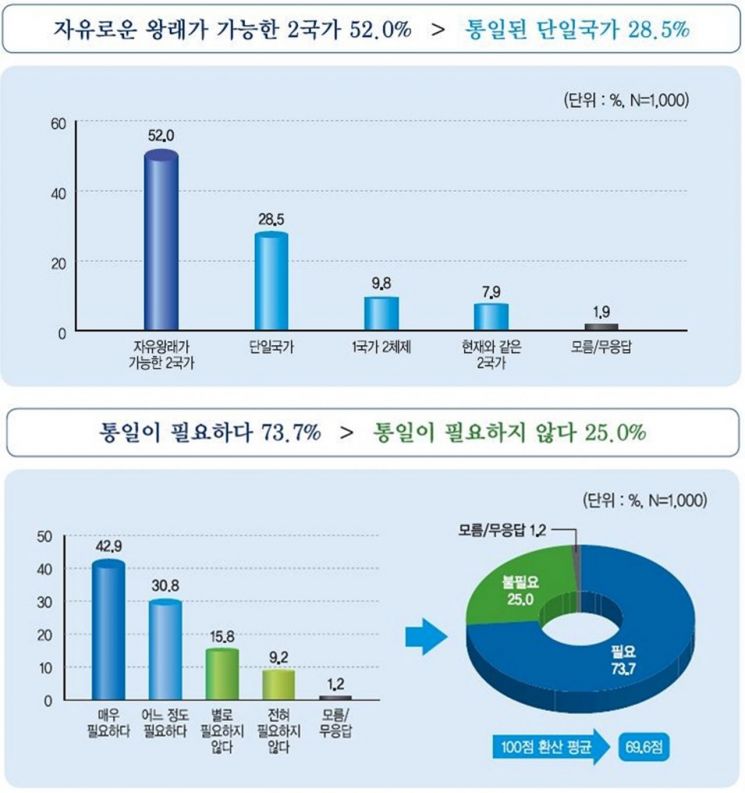 Democratic Peaceful Unification Advisory Council 2nd Quarter Unification Public Opinion Survey Graph [Image Source=Democratic Peaceful Unification Advisory Council, Yonhap News]
In the first quarter survey, the order was German model (38.8%), EU model (33.6%), and US-Canada model (24.6%), with the first and second places swapped. However, in the second quarter survey, when the response format was changed based on the number of states and systems, the preference for a two-state system became even more pronounced.
However, the majority of the public agreed on the necessity of unification. 73.4% of respondents said unification is necessary (38.4% very necessary, 35.4% somewhat necessary), while 25.4% said it is not necessary. The reasons for unification included "economic development" (30.9%), "elimination of war threats" (25.8%), "restoration of ethnic homogeneity" (17.8%), "strengthening international status" (12.4%), and "realization of freedom and human rights" (11.2%).
Minjupyeongtong analyzed, "Even among those who responded that unification is necessary, the preference for two states with free movement as the desirable future for inter-Korean relations approached a majority (48.6%), resulting in an overall high preference for two states. This indicates a change in the public perception of unification."
"North Korea seen as hostile and a target of vigilance" response at 42.1%... highest in 18 quarters
The number of people viewing North Korea as hostile and a target of vigilance has also increased. 42.1% of the public viewed North Korea as hostile and a target of vigilance, which is 5 percentage points less than those who see it as a partner for cooperation and support (47.1%), but it is the first time since the fourth quarter of 2017, when it was 42.5%, that the figure has exceeded 40%. Additionally, the vast majority (88.0%) perceive the human rights situation in North Korea as serious. The top priority for improving North Korean human rights was "urging improvement through inter-Korean dialogue" (32.8%), followed by "pressure through international cooperation" (27.1%), "recording and disclosure of North Korean human rights conditions" (18.3%), and "humanitarian aid to North Korea" (14.2%).
Regarding the impact of the North Korean Human Rights Report, which the government has emphasized to promote public discussion on North Korean human rights, 50.8% of the public (34.5% not much, 16.3% not at all) responded that it would not be helpful, while 40.2% (10.2% very, 31.9% somewhat) said it would be helpful.
Also, 47.1% responded that the Washington Declaration from the April Korea-US summit strengthened deterrence against North Korea, slightly higher than the 36.0% who said it weakened deterrence. 53.2% of the public viewed the strengthening of strategic cooperation among South Korea, the US, and Japan agreed upon at the G7 summit as having a "positive" impact on the situation on the Korean Peninsula.
This survey was conducted via telephone from June 9 to 11, targeting 1,000 adults aged 19 and older nationwide (80% mobile phones). The confidence level is 95%, with a sampling error of ±3.1 percentage points.
© The Asia Business Daily(www.asiae.co.kr). All rights reserved.
![Clutching a Stolen Dior Bag, Saying "I Hate Being Poor but Real"... The Grotesque Con of a "Human Knockoff" [Slate]](https://cwcontent.asiae.co.kr/asiaresize/183/2026021902243444107_1771435474.jpg)











