City Bus Base Fare Increased by 300 Won
Rising Transportation Costs Amid High Inflation
Subway Fares to Rise in October
Kim Seong-gwon (32), an office worker commuting in Seoul, uses public transportation every day. He was indifferent to the fare since he used a card when boarding and alighting buses or subways, but recently found out that the basic fare for city buses increased by 300 won. Kim said, "The government said it would stabilize prices, but didn't they lower the prices of ramen and snacks? In this situation, it's absurd to raise public transportation fares."
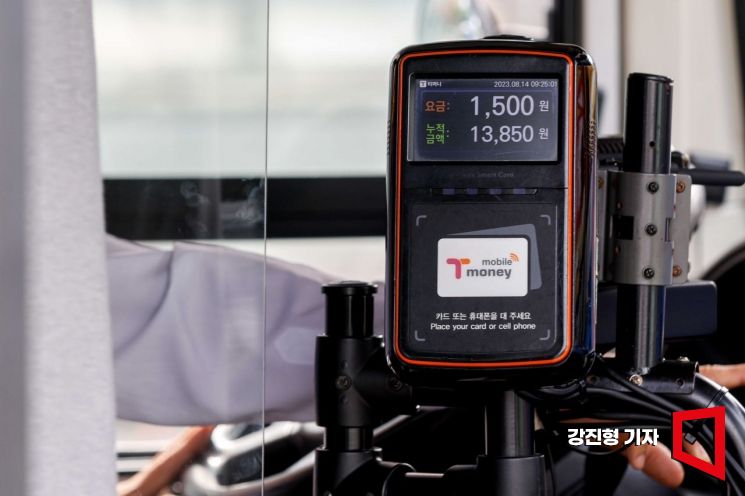 Since the 12th, city bus fares have increased by 300 won. The photo shows a city bus transportation card terminal at Seoul Station Bus Transfer Center on the 14th. Photo by Jinhyung Kang aymsdream@
All types of buses, including Seoul city buses, intercity buses, and village buses, have simultaneously raised their fares, causing citizens to sigh deeply. As high inflation continues, office workers' wallets have become thinner, and there are complaints that the burden of essential fixed costs like transportation expenses has increased.
On the morning of the 14th, Kang So-ri (37), whom we met in Gwanak-gu, Seoul, said, "My salary hasn't really increased, but lunch prices, transportation costs, everything is going up," adding, "It seems like the bus fare was raised too much at once. Now, even commuting costs have become quite burdensome." Park Yong-jun (34) also said, "It feels like it costs money just to breathe. Life has become very difficult," and added, "When the weather cools down, I think I should walk or ride a bicycle for nearby places as much as possible."
Seoul City adjusted the fares from 3 a.m. on the 12th, based on card payments: city buses on main and branch lines are 1,500 won, circular and differential buses 1,400 won, intercity buses 3,000 won, late-night buses 2,500 won, and village buses 1,200 won. The increase is 300 won for main and branch line buses, circular and differential buses, and village buses; 700 won for intercity buses; and 350 won for late-night buses.
Children and youth fares, which had been frozen for 16 years, were also raised. The basic fare for youth city buses increases from 720 won to 900 won, a 180 won (25%) rise. Children’s fares increase from 450 won to 550 won, a 100 won (22%) increase. The early morning discount, which gives a 20% discount on the basic fare for the first public transportation ride before 6:30 a.m., remains unchanged.
Seoul City finalized the public transportation fare adjustment after procedures including a public hearing (February), Seoul City Council opinion hearing (March), and Price Countermeasure Committee review (July). City and village buses have completed administrative procedures such as fare reporting and approval according to relevant laws. Seoul City states that the fare increase is inevitable to compensate for losses from free rides and to alleviate deficits of the Seoul Transportation Corporation.
With subway fare increases also expected in the future, the burden of transportation costs is anticipated to grow further. From October 7, the basic subway fare will increase from 1,250 won to 1,400 won, a 150 won (12%) rise. From July to December next year, it will increase by another 150 won to 1,550 won.
© The Asia Business Daily(www.asiae.co.kr). All rights reserved.

















