Lee Jae-myung "Reasonable conclusion after party discussions"
Ko Min-jung "Innovation Committee's move is forced without urgency on people's livelihood"
Seo Eun-sook "Opposition and resistance arise during organizational innovation"
The Democratic Party Innovation Committee announced an innovation plan that effectively nullifies the delegate system, intensifying factional conflicts within the party over whether to accept the plan.
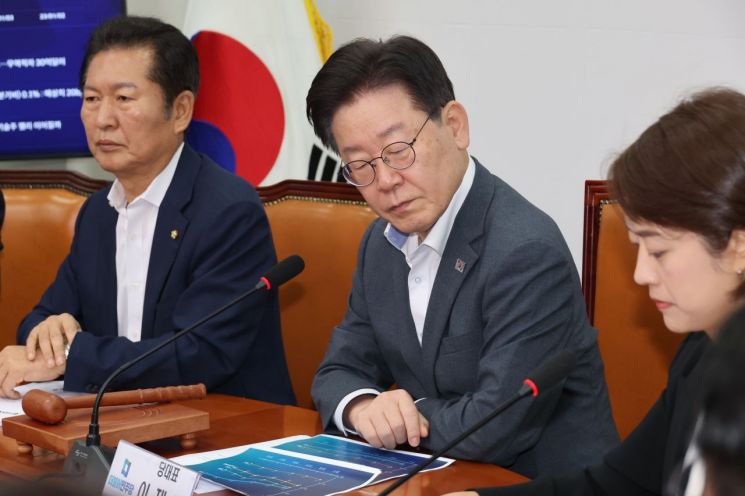 Lee Jae-myung, leader of the Democratic Party of Korea, is holding the Supreme Council meeting at the National Assembly on the 11th.
 [Photo by Yonhap News]
The conflict surrounding the innovation plan was evident during a public meeting.
On the morning of the 11th, at the Supreme Council meeting held at the National Assembly, Go Min-jung, a Supreme Council member of the Democratic Party, opposed the Innovation Committee’s third innovation plan announcement, saying, “Unless Representative Lee Jae-myung and the leadership resign en masse, the party convention will be held after next year’s general election. So what is the urgency to bring it forward now?” She added, “This is not something that affects the general election, which the people should elect, nor is it an urgent livelihood issue, so it is hard to find a reason to take such a reckless step to elect the leadership.”
Regarding changes to the nomination rules, Council member Go also criticized strongly, saying, “The Democratic Party has suffered various noises before every election, so former Representative Lee Hae-chan stipulated in special party regulations that the nomination rules be finalized by a vote of all party members one year before the general election to prevent side effects of nominations.” She added, “However, the Innovation Committee has made an announcement that completely ignores the Democratic Party’s nomination system.”
On the other hand, Seo Eun-sook, a Supreme Council member, countered, saying, “The dictionary definition of innovation is to change or fix old things to make them new.” She added, “There is no innovation that satisfies everyone.” Seo emphasized, “When innovating an organization or group, voices of opposition and resistance are inevitable,” and said, “I hope people realize that rejecting innovation just because it does not please them is a path to making themselves old-fashioned.”
Representative Lee showed a cautious stance regarding the innovation plan discussion. After the Supreme Council meeting ended that day, he told reporters, “The innovation plan is a proposal from the Innovation Committee, so it will go through internal party discussions to produce an appropriate result.”
The primary turning point in the innovation plan controversy is expected to be the parliamentary meeting on the 16th. Kang Seon-woo, a spokesperson for the Democratic Party, said, “Core innovation plan contents related to the delegate system and nomination rule changes require separate discussions by the leadership and will take a long time.” He added, “Since the innovation plan is a party matter, it will not be a topic at the parliamentary meeting, but members are expected to continue free remarks and discussions related to it.” Kang also said, “There will likely be various voices at the workshop scheduled for the 28th,” and added, “However, since the innovation plan is not something members can decide among themselves, a procedure to hear diverse opinions on the innovation plan must proceed first.” Matters such as revising the party constitution and regulations, including changes to the delegate system and nomination rules, must go through processes such as the Party Affairs Committee, Central Committee, and a vote of all party members.
The Innovation Committee held a press briefing at the National Assembly the previous afternoon and announced the third innovation plan, focusing on party organization restructuring and changes to the general election ‘nomination rules.’ The innovation plan includes a proposal to change the voting weight ratio for the party representative and Supreme Council member elections to ‘one vote per party member 70%, public opinion poll 30%.’ Currently, the Democratic Party’s party constitution and regulations stipulate that the voting weight ratio for the National Delegate Convention (party convention) is 40% for party members with voting rights, 30% for delegates, 25% for opinion polls, and 5% for general party members.
© The Asia Business Daily(www.asiae.co.kr). All rights reserved.

![A Woman with 50 Million Won Debt Clutches a Stolen Dior Bag and Jumps... A Monster Is Born [Slate]](https://cwcontent.asiae.co.kr/asiaresize/183/2026021902243444107_1771435474.jpg)















