Seoul Jongno Police Station Operation... Actress Jeong Jeong-a
Reveals Photos of Guestroom Turned into Garbage Dump
"Tip of the Iceberg"... Numerous Cases of Damage Reported
Actress Jung Jeong-ah, who runs a guesthouse in Jongno-gu, Seoul, revealed photos of a guest room that had turned into a garbage dump, exposing the misconduct of the guests.
On the 9th, Jung Jeong-ah posted a video on her social media with the message, "This is disgusting, so if you have a weak stomach, please do not watch." The video shows the interior of the room filled to the brim with various daily necessities, books, paper bags, clothes, empty bottles, and more, leaving no space to step on the floor or bed.
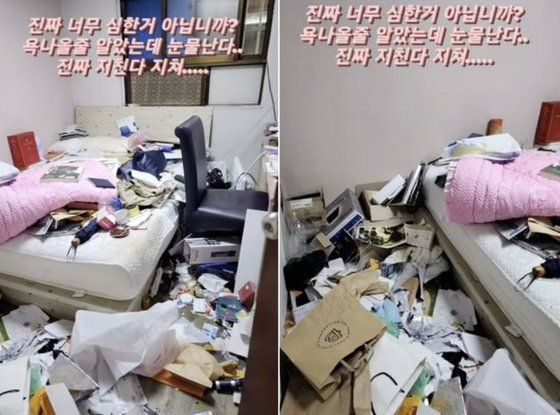
According to Jung, the room had been rented out to a guest for several months. She explained, "They said they were in a difficult situation, so during the COVID-19 pandemic, I reluctantly rented out a couple of rooms monthly, but this happened." She added, "It was even harder for me during an already tough time. You wouldn't even imagine it." She continued, "The room was used very dirtyly. If guests use the room cheaply and leave it clean, we feel good, but many people leave like this without paying."
Jung also listed other cases, including ▲a foreigner who did not pay rent for several months and fled in the middle of the night ▲guests who brought homeless people, claiming to rescue 'homeless,' housed them in empty rooms, held parties on the rooftop with homeless people, damaged tables, and caused loud disturbances ▲a guest who removed the bathroom mirror, stuck it to the wall, which then fell and tore the wallpaper and broke the mirror, then carelessly cleaned up and left without paying extra rent.
Regarding these incidents, Jung said, "This is just the tip of the iceberg," and added, "I feel so sorry and pitiful for my husband who has to deal with these kinds of people as soon as he sees the room that I cry instead of getting angry." She pleaded, "Please have some conscience. If you have difficulties, shouldn't you ask for understanding before leaving?"
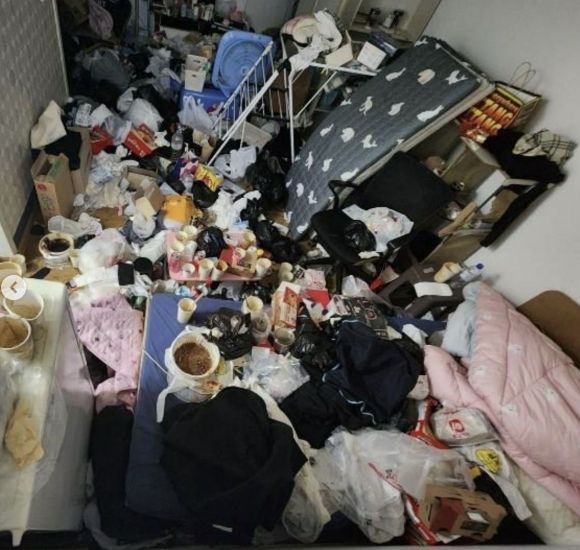 A photo of a garbage room posted by an officetel landlord in Busan.
 [Image source=Online community BobaeDream capture]
Such damage cases continue to appear. On the 19th of last month, a story was shared on an online community about a woman in her 20s who turned an officetel into a garbage dump and fled.
A person identified as A, who rents out officetels in Busan, wrote, "I recently received a report that the rented house smelled like a corpse," and added, "When I entered the house, it was full of trash everywhere. If you have a weak stomach, please do not look at the photos."
The photos posted by A also showed the house filled with trash with no space to step. Coffee cups were piled on one side, and black bags that appeared to contain garbage and leftover food waste were mixed with daily necessities.
According to A, the bathroom situation was even worse. The toilet was completely clogged and dried out, and there was excrement scattered on the floor in various places. A said, "I hesitated many times whether it was okay to post these photos because I was worried viewers might feel uncomfortable. But if you don't see it, you won't know. This is something that should be on the 9 o'clock news. It's nothing less than terrorism," she appealed.
Hard to Receive Compensation... Possible 'Hoarding Disorder'
Meanwhile, if a tenant leaves the house in a mess and runs away, it can legally be considered a 'unilateral contract termination,' and a damage compensation lawsuit can be filed. However, in Jung's case, even if a lawsuit is filed, it is pointed out that it is difficult to punish simply for throwing away trash.
Attorney Jung Gu-seung told the Chosun Ilbo, "In such cases, it is highly likely that the guest has a mental illness such as 'hoarding disorder,' and it is also difficult to prove intent," adding, "Even if you win the lawsuit, the legal fees may exceed the amount of compensation, resulting in a situation where the cost outweighs the benefit."
Hoarding disorder is a compulsive disorder characterized by continuously storing any items regardless of their use, and feeling unpleasant and uncomfortable if unable to do so. In severe cases, it is considered a behavioral disorder requiring treatment.
© The Asia Business Daily(www.asiae.co.kr). All rights reserved.


















