Entities Holding Risk Regulation, Those Transferring or Trusting to SPCs, etc.
Must Disclose Information on Securitized Assets, etc.
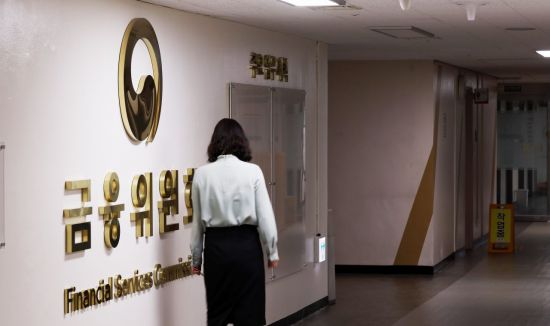 On the 9th, officials were busy moving in the corridor of the Financial Services Commission at the Government Seoul Office in Jongno-gu, Seoul, where financial authorities decided to include mortgage loans (Judaemae) in the 'debt refinancing' infrastructure scheduled to be launched in May by the end of the year. Financial authorities explained that they plan to build a debt refinancing platform that allows users to compare loan interest rates across the financial sector at a glance and switch loans, aiming to reduce the interest burden of mortgage loans. Photo by Yoon Dongju doso7@
To activate corporate financing through the issuance of asset-backed securities, credit rating restrictions will be abolished. Instead, qualifications have been specified for companies with assets of 50 billion KRW or more subject to external audits, with a capital impairment ratio of less than 50%, and with an unqualified audit opinion. Additionally, regarding the risk retention regulation obligation, the "risk retention entity" has been specified as those who have transferred or entrusted to special purpose companies (SPCs), etc.
On the 11th, the Financial Services Commission announced that it will give a 40-day legislative notice until the 20th of next month for the amendment to the Act on Asset-Backed Securitization containing these details.
After the legislative notice, the amendment is scheduled to be implemented from January 12, 2024, in line with the law enforcement date, following reviews by the Regulatory Reform Committee, the Ministry of Government Legislation, and resolutions at the Cabinet and Vice-Ministerial meetings.
Previously, the amendment abolished credit rating regulations for asset holders eligible to issue registered asset-backed securities to enable more companies to conveniently raise funds.
According to the subordinate legislation announced this time, instead of excluding credit rating from the requirements for companies that can issue registered asset-backed securities, the criteria have been specified as corporations subject to external audits with assets of 50 billion KRW or more, a capital impairment ratio below 50%, and an unqualified audit opinion.
Once the law is enforced, the number of asset holders among general companies eligible to issue registered asset-backed securities is expected to expand about 2.8 times, from approximately 3,000 companies currently to about 8,400 companies.
Along with this, the system has been improved to allow broad issuance of registered asset-backed securities across all sectors of mutual finance, regardless of central associations or unit cooperatives. Until now, only some mutual finance central associations and cooperatives (credit unions, Saemaeul Geumgo Central Association, agricultural and fishery cooperatives) were designated as asset holders.
Also, to reduce the risk of deterioration of underlying assets, asset holders and other financing entities are required to mandatorily hold 5% of the asset-backed securities equity.
Accordingly, the subordinate legislation specifies the risk retention entities as those who have transferred or entrusted to special purpose companies (SPCs), etc. However, asset-backed securities guaranteed or fully underwritten by the state, local governments, or public institutions for principal and interest payments, or asset-backed securities based on time deposits with low credit risk or conflict of interest potential, are exempted from the risk retention obligation.
The risk retention ratio is set at 5% or more of the issuance balance, and various holding methods such as vertical, horizontal, or mixed are permitted.
If the risk retention obligation is violated, a fine of up to 2 billion KRW may be imposed considering the degree of violation, and penalties for violating the obligation to disclose information related to risk retention are also stipulated.
Finally, to strengthen risk management of asset-backed securities, the amendment specifically regulates the expansion of information disclosure when issuing asset-backed securities. Due to the legal amendment, companies issuing asset-backed securities are now obligated to disclose detailed information about securitized assets and asset-backed specialized companies.
The subordinate legislation additionally stipulates matters such as outsourcing of securitization specialized companies’ operations and credit ratings of asset-backed securities, beyond the items prescribed by law (issuance details of asset-backed securities, information related to securitized assets and asset holders, etc.). Furthermore, to facilitate easy access to this information, it will be disclosed through the Korea Securities Depository website.
© The Asia Business Daily(www.asiae.co.kr). All rights reserved.
![Clutching a Stolen Dior Bag, Saying "I Hate Being Poor but Real"... The Grotesque Con of a "Human Knockoff" [Slate]](https://cwcontent.asiae.co.kr/asiaresize/183/2026021902243444107_1771435474.jpg)
















