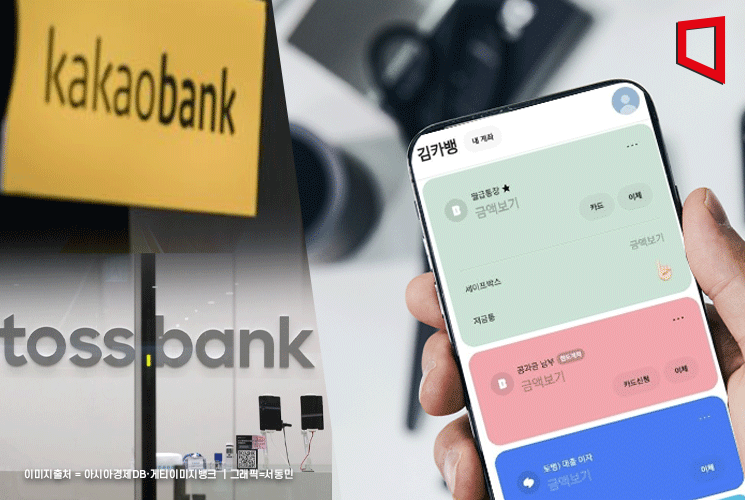
#30s office worker Lee Jisoo recently switched from using a major commercial bank as her salary account to KakaoBank. She said, "Since I even got a loan from KakaoBank, I find it convenient to manage everything at a glance, so I am using KakaoBank as my salary account." In the past, salary accounts were considered the exclusive domain of major commercial banks, but recently, more people in their 20s and 30s are using internet-only banks as their salary accounts.
Salary Accounts Also Moving to 'Internet Banks'
According to KakaoBank on the 11th, the number of salary account customers has been increasing by 32% annually. KakaoBank’s salary accounts are defined based on the memo (such as recipient or sender notes) containing the word 'salary.' In fact, KakaoBank’s demand deposit balance also increased by about 5 trillion won compared to the previous year, reaching 25 trillion won as of the second quarter. A KakaoBank official said, "Over the past three years, the average annual increase in demand deposit balances per person was 14%."
A similar trend is seen at K Bank. The number of customers who set K Bank as their salary account increased 2.5 times compared to 2020, and the amount in salary accounts increased fivefold. Like KakaoBank, this is based on memos containing words such as salary or monthly wage.
Typically, salary accounts are representative low-cost deposits with low interest rates, which serve as a source of funds for banks to provide loans. When low-cost deposits with low interest rates increase, banks can raise funds at a lower cost, which benefits their profits. For this reason, major commercial banks such as Shinhan’s 'my Salary Club,' KB Kookmin’s 'Preferred Comprehensive Account for Office Workers,' Woori Bank’s 'First Salary Woori Account,' and Hana Bank’s 'Salary Hana Account' even offer separate salary account products.
Moving salary accounts from commercial banks to internet-only banks is largely due to the lack of interest rate appeal in commercial banks’ accounts, which are around 0.1%, and the recent competitiveness of internet-only banks’ loan interest rates. An industry insider said, "Using commercial banks as salary accounts or main banks was largely influenced by preferential interest rate benefits when taking out loans, but recently, internet-only banks’ loan interest rates have dropped, so this advantage is no longer felt," adding, "This is why more people are moving their salaries to internet-only banks."
The Era of 40 Million Subscribers Is Also 'Within Sight'
Internet-only banks are also approaching the era of 40 million subscribers. KakaoBank recorded 21.74 million subscribers as of the second quarter this year, and K Bank and Toss Bank each surpassed 9 million and 7 million subscribers this month. The combined total of the three banks is 37.74 million, and they are expected to reach 40 million within the year. This rapid growth comes just over a year after surpassing 30 million cumulative customers in June last year.
Notably, while customers in their 20s and 30s used to dominate, the proportion of customers in their 40s and 50s has recently increased. For KakaoBank, as of the second quarter, the proportions of customers in their 40s and 50s or older were 24% and 22%, respectively, up 1% and 4% from the previous year. At K Bank, the proportion of customers aged 50 and older increased from about 16% at the end of 2021 to 21% as of the end of July.
The reason internet-only banks were able to attract customers rapidly in a short period is due to their competitive loan interest rates and various conveniences. They gained particular popularity with mortgage loans offering lower interest rates than commercial banks. According to the Bankers Association disclosure, the installment mortgage loan interest rate handled by KakaoBank in June was 4.02% per annum (for credit scores of 951 or higher), the lowest among all banks, followed by K Bank at 4.09%. The five major commercial banks?KB Kookmin, Shinhan, Hana, Woori, and NH Nonghyup?offer rates around 4.3% to 4.74%. Introducing deposit products that break away from traditional banking practices, such as 'group accounts' and 'early receipt time deposits,' also helped secure a diverse customer base.
© The Asia Business Daily(www.asiae.co.kr). All rights reserved.
![Clutching a Stolen Dior Bag, Saying "I Hate Being Poor but Real"... The Grotesque Con of a "Human Knockoff" [Slate]](https://cwcontent.asiae.co.kr/asiaresize/183/2026021902243444107_1771435474.jpg)

















