264 Trillion Won by 2040... Explosive Market Growth
New Competitors Keep Emerging... Battle for Dominance
"From Now On, 'Sorting the Wheat from the Chaff' Will Begin"
As the battery recycling market, which has just begun to blossom, sees new competitors continuously entering, the battle for dominance is intensifying. The competition is between small and medium-sized enterprises (SMEs) that have been developing technology for over a decade and large corporations recently entering the market with financial power as their weapon.
Battery recycling is a business that takes a long time to generate profits and establish a stable network, and it requires significant investment. The technology also needs to be advanced in an environmentally friendly manner.
The large corporation most actively engaged in the battery recycling business is POSCO Holdings. Within the group, secondary battery materials are fully supported to the extent that they are called the ‘Next Steel.’ In May 2021, POSCO HY Clean Metal was established in partnership with China’s Huayou Cobalt for the secondary battery recycling business. POSCO, which possesses smelting technology, is a company that other recycling firms are closely watching. In August last year, POSCO established a factory locally to collect scrap and waste batteries generated at LG Energy Solution’s battery production plant in Poland. The black powder (black powder) produced by grinding batteries at this plant is transported to the secondary battery recycling plant in Gwangyang, Jeollanam-do, where cathode material raw materials such as lithium, nickel, and cobalt are extracted.
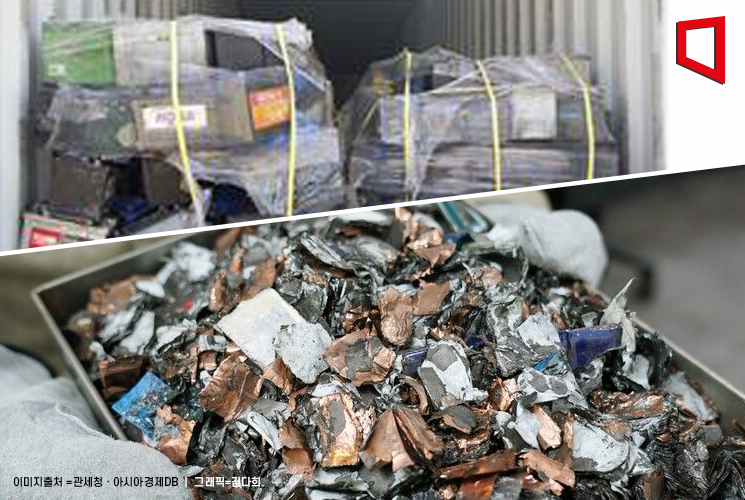
LG Energy Solution, Samsung SDI, and SK On, the three battery companies, have also entered the recycling market by establishing joint ventures or investing in shares. Doosan Enerbility established a recycling-specialized subsidiary, Doosan Recycle Solution, and GS Engineering & Construction is conducting battery recycling business through its wholly owned subsidiary Energy Materials. Kolon Industries signed a 4.5 billion KRW equity investment contract with secondary battery recycling startup R.D. Solution in April this year and plans to complete the mass production system as early as this year.
Unlike large corporations that have separate main businesses and are still conducting recycling as a side business, there are SMEs that have focused solely on recycling.
Sungil Hightech entered the secondary battery recycling market in 2008. Kim Hyung-deok, director of Sungil Hightech, said, “When we first started the business, secondary batteries were considered waste, so we thought it would be difficult for large corporations to enter this market.” He added, “As prices of key battery raw materials such as lithium have risen and recycling-related laws have been enacted worldwide, various companies are joining.” Recycling businesses that handle waste require complicated factory permits and are subject to many environmental regulations. The technical difficulty also creates high entry barriers.
Sungil Hightech began showing interest in battery materials from 2006, when lithium-ion batteries were first produced domestically, developed secondary battery scrap processing technology, and completed a physical pretreatment plant for separating secondary battery cathode active materials in 2011. It then completed the first wet smelting plant and started a production process from 2012 that recovers metals for use as precursor raw materials.
There are only a few companies that can recover all five major materials: cobalt, lithium, nickel, manganese, and copper. Sungil Hightech operates 10 factories locally in Malaysia, China, Hungary, India, and Poland, and plans to establish additional factories in the U.S., Germany, Spain, and Indonesia within two years. Currently, it is building a plant in Gunsan Saemangeum to produce raw materials capable of making 300,000 electric vehicle batteries. Director Kim said, “The technology to refine with high purity and operate continuous mass production processes is not something that can be achieved overnight or solved with money alone.” He added, “As a pioneer, we will continue to widen the gap with latecomers in terms of technology and overseas networks.”
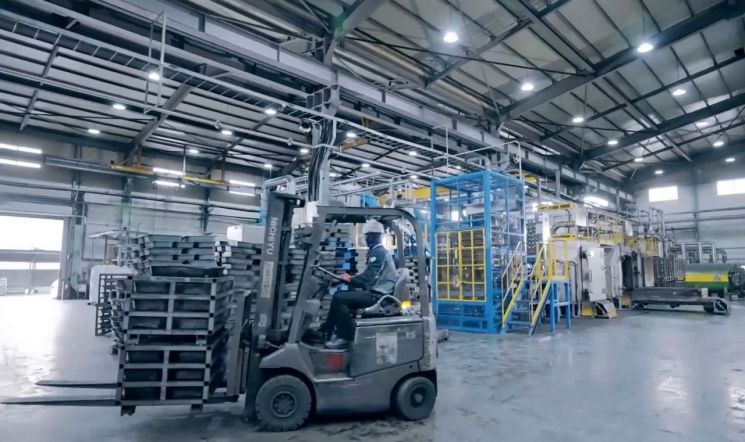
Another SME is Saevit Chem. It started developing secondary battery recycling technology in 2011 and launched its business in 2017. The following year, it expanded its secondary battery recycling plant, and in 2020, began commercial production of precursor composite solutions. Its major clients include POSCO Future M, LG Chem, and L&F.
Saevit Chem developed a multi-stage leaching technology that reuses the leaching process repeatedly, raising the recovery rate of high-purity precious metals to an industry-leading 95%. Although the process is simple, it developed a liquid-type precursor material with high manufacturing technology, achieving more than 20% cost reduction compared to peers. Saevit Chem recorded its highest-ever performance last year with sales of 48.1 billion KRW and operating profit of 10.2 billion KRW. Its operating profit margin reached 21.2%.
Kim Dae-gi, vice president of SNE Research, said, “Although many are rushing into the battery recycling market, which is expected to grow explosively, it is still in its early stages, and no major players have yet emerged.” He added, “Considering the entire battery market, domestic recycling companies’ factory production capacity is still small. Factory expansions and technological advancements will continue, and the process of separating the wheat from the chaff regarding which companies can handle this and survive will begin.”
Energy market research firm SNE Research forecasted that the battery recycling market will grow from $10.8 billion (about 14 trillion KRW) this year to $208.9 billion (about 264 trillion KRW) by 2040.
© The Asia Business Daily(www.asiae.co.kr). All rights reserved.
![Clutching a Stolen Dior Bag, Saying "I Hate Being Poor but Real"... The Grotesque Con of a "Human Knockoff" [Slate]](https://cwcontent.asiae.co.kr/asiaresize/183/2026021902243444107_1771435474.jpg)

















