The three major indices of the U.S. New York stock market showed mixed trends near the opening, hovering around flat as they awaited inflation indicators such as the Consumer Price Index (CPI) to be released later this week, along with remaining corporate earnings reports.
At around 10:01 a.m. on the New York Stock Exchange (NYSE), the Dow Jones Industrial Average, composed of blue-chip stocks, was trading at around 35,370, up 55.74 points (0.16%) from the previous close. Meanwhile, the large-cap-focused S&P 500 index was down 0.72 points (0.02%) at 4,498, and the tech-heavy Nasdaq index was down 46.40 points (0.33%) at 13,837.
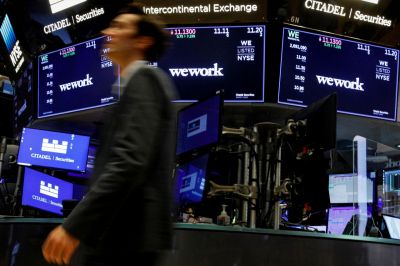
Currently, nine of the 11 sectors in the S&P 500, excluding technology, communication, and consumer discretionary stocks, are all rising. WeWork plunged over 35% following its mention of potential bankruptcy due to doubts about the company’s viability in documents submitted to the U.S. Securities and Exchange Commission (SEC). Gaming company Roblox fell nearly 20% after its second-quarter bookings missed expectations. Ride-sharing service Lyft declined 2.5% despite better-than-expected earnings per share, after announcing plans to lower prices. Rivian also dropped 7% despite beating earnings estimates. Major banks such as M&T Bank and BOK Financial, which fell the previous day due to Moody’s mass credit rating downgrades, showed slight declines. The SPDR S&P Bank ETF and SPDR S&P Regional Bank ETF also edged down. On the other hand, Penn Entertainment rose more than 12% on news of launching a sports betting site together with ESPN.
The previous day, the New York stock market closed lower across the board following Moody’s mass downgrade of credit ratings for 10 U.S. regional banks and warnings of possible downgrades for some large banks. Victoria Green, Chief Investment Officer at G Squared Private Wealth, appeared on CNBC’s Closing Bell and said, "The market is catching its breath," adding, "It is still overbought and there are many macroeconomic headwinds. This correction was inevitable."
Market attention is now focused on economic indicators scheduled for this week, including July’s CPI and Producer Price Index (PPI). The importance of inflation data has increased after last week’s mixed employment report. The U.S. July CPI, to be released on the 10th, is expected to rise 3.3% year-over-year and 0.2% month-over-month. The June CPI increase was the lowest in over two years at 3%, but the July figure is anticipated to rebound. The July PPI, to be announced the following day, is also expected to turn positive after a 0.1% year-over-year decline in the previous month.
On Wall Street, given recent disagreements among Federal Reserve (Fed) officials about whether to raise rates, market volatility may increase after the CPI release. Patrick Harker, President of the Philadelphia Fed, said the previous day, "Unless there is surprising new data between now and mid-September, we can be patient, hold rates steady, and allow our monetary policy actions to take effect," raising expectations for an end to rate hikes. In contrast, earlier Fed Governor Michelle Bowman emphasized the need for further rate increases.
Currently, the market largely expects the Fed to hold rates steady in September, buoyed by recent hopes for a soft landing. According to the Chicago Mercantile Exchange (CME) FedWatch tool, federal funds futures are pricing in over an 87% chance that the Fed will keep rates unchanged at the September FOMC meeting. This contrasts with the June dot plot, which had signaled one more rate hike by year-end; now, the hold scenario is dominant.
Corporate earnings announcements are also nearing completion. According to FactSet, 90% of S&P 500 companies have reported earnings so far, with about 80% beating Wall Street expectations. After the market closes today, Walt Disney and Wynn Resorts will release their results. Additionally, the Biden administration is expected to announce an executive order banning direct U.S. capital investment in Chinese companies in advanced industries such as artificial intelligence (AI) and semiconductors.
In the New York bond market, the yield on the 10-year U.S. Treasury note is around 4.01%, while the 2-year Treasury yield, sensitive to monetary policy, is near 4.76%. The dollar index, which measures the dollar’s value against six major currencies, is steady around 102.4. The Chicago Board Options Exchange (CBOE) Volatility Index (VIX), known as Wall Street’s “fear gauge,” has fallen nearly 3% to 15.5.
European stock markets rose. Germany’s DAX index was trading up 0.71%. The U.K.’s FTSE index rose 0.9%, and France’s CAC index gained 0.99%.
© The Asia Business Daily(www.asiae.co.kr). All rights reserved.

















