Polar Research Institute Fossil Study Results
Currently, the tiny animal known as the 'water bear' or 'gombeolle'?measuring less than 1mm?survives even in space, earning it the title of 'Earth's toughest survivor.' However, a domestic research team has revealed that it was about 1000 times larger 500 million years ago.
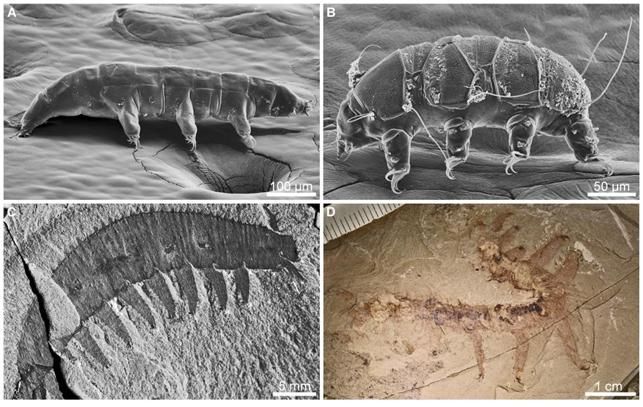
On the 9th, the Korea Polar Research Institute announced that Dr. Jihoon Kim's research team discovered the ancestor and evolutionary process of tardigrades through comparative studies with fossils from 500 million years ago.
Tardigrades, well known as water bears, have earned the nickname 'Earth's toughest survivor' due to research findings showing their ability to survive in extreme environments such as space and Antarctica, where life is generally difficult to sustain.
The research team, in collaboration with international teams from the United States and China, compared over 40 species of extant tardigrades with fossil forms of lobopodians from 500 million years ago and identified a type of lobopodian called 'Luolishaniid' as the ancestor of tardigrades. Lobopodians are worm-like animals with unsegmented legs that thrived during the Cambrian period 500 million years ago but are now extinct. They are known as ancestors of the extant Panarthropoda group (arthropods, onychophorans, and tardigrades).
The size of Luolishaniids confirmed from fossils ranged from 2 to 10 cm, approximately 50 to 1000 times larger than modern tardigrades, which generally do not exceed 1mm even when fully grown. Unlike tardigrades, Luolishaniids had long front legs, which are believed to have been used to gather or filter small prey with hairs on the legs. Based on common traits such as a pair of organs located in the middle of the head and two types of trunk legs, the research team inferred that Luolishaniids were ancestors of tardigrades. They also suggest that the loss of specific genes influenced the evolutionary process from the 500-million-year-old form to the present-day tardigrade.
This study is the world's first to empirically demonstrate the ancestor of tardigrades from 500 million years ago. The fusion of paleontology and modern biology research itself is a rare case, and thanks to Dr. Kim's unique background in both fields, the team succeeded in tracing the evolutionary process by comparing fossil animals from hundreds of millions of years ago with extant species.
The research results were published last month in the internationally renowned academic journal, Proceedings of the National Academy of Sciences of the United States of America (PNAS).
© The Asia Business Daily(www.asiae.co.kr). All rights reserved.
![Clutching a Stolen Dior Bag, Saying "I Hate Being Poor but Real"... The Grotesque Con of a "Human Knockoff" [Slate]](https://cwcontent.asiae.co.kr/asiaresize/183/2026021902243444107_1771435474.jpg)











