ETF Increases by 27 Trillion Won While General Public Offering Funds Rise by 7 Trillion Won
Losses Are First Absorbed by Financial Firms, Profits Are Prioritized for Customers
Demand Exists for Medium-Risk, Medium-Return Investments... "Direct Listing of Public Offering Funds Should Also Be Considered"
General public offering funds, which have been neglected due to the popularity of exchange-traded funds (ETFs), are gaining attention again with the launch of various strategic products by the industry. Public offering funds are products where financial companies manage funds on behalf of investors who find it burdensome to trade assets such as stocks and bonds directly. Although ETFs are also managed by asset managers, they are differentiated by the fact that individual investors decide the timing of buying and selling themselves.
According to the financial investment industry on the 10th, the 'Korea Investment Global New Growth Fund,' exclusively sold by Korea Investment & Securities since the 17th of last month, has raised 91.9 billion KRW and completed its establishment. Including the subordinated investment portion from Korea Investment Financial Group, the total managed scale is about 108 billion KRW.
This fund is a public offering product structured so that the financial company bears losses first and profits are allocated to customers first. It has succeeded in attracting financial consumers who want medium-risk, medium-return investments that offer higher returns than deposit interest rates but lower risk than general stock investments.
Looking at the product structure in detail, losses up to minus 15% are allocated first to subordinated investors such as Korea Investment Financial Holdings and its affiliates, while profits up to 10% are allocated first to senior investors, i.e., customers.
It is noteworthy that this public offering fund raised about 100 billion KRW in assets under management in the recently sluggish public offering fund market. The public offering fund market has been sluggish recently due to a combination of high interest rates, rapid growth of ETFs, and erosion of trust in fund managers.
A flood of public offering fund launches this year... What about the first half returns?
This year, public offering funds have begun to regain attention due to government policies to revitalize public offering funds and industry reconstruction efforts.
The first to signal a revival were value investment funds. Value investment management companies such as VIP Asset Management and The J Asset Management launched funds in the public market, introducing a profit and loss differential structure.
VIP Asset Management introduced the profit and loss differential structure for the first time in a public offering fund by raising 30 billion KRW from general investors and adding 3.4 billion KRW of the company's proprietary funds. In terms of returns, although not as dramatic as secondary battery stocks or ETFs, it shows stable returns.
VIP Asset Management's public offering fund VIP THE FIRST A Class, which sold out immediately after launch, recorded an 11% return over six months. The J Asset Management's public offering fund The Happiness Korea posted a 4.54% return over six months.
Theme-specific public offering funds such as semiconductors, space economy, and climate change achieved somewhat more noticeable returns, but their total assets under management were small.
Korea Investment Trust Management's public offering fund Korea Investment Global AI & Semiconductor TOP10, established in April, recorded a 21.57% return over the past three months. The Korea Investment Global Space Economy fund, established in March, posted a 7.29% return over the past three months.
Korea Investment MSCI US Climate Change recorded a 14.58% return over the past three months. However, the combined assets under management of these three funds barely exceeded 13 billion KRW.
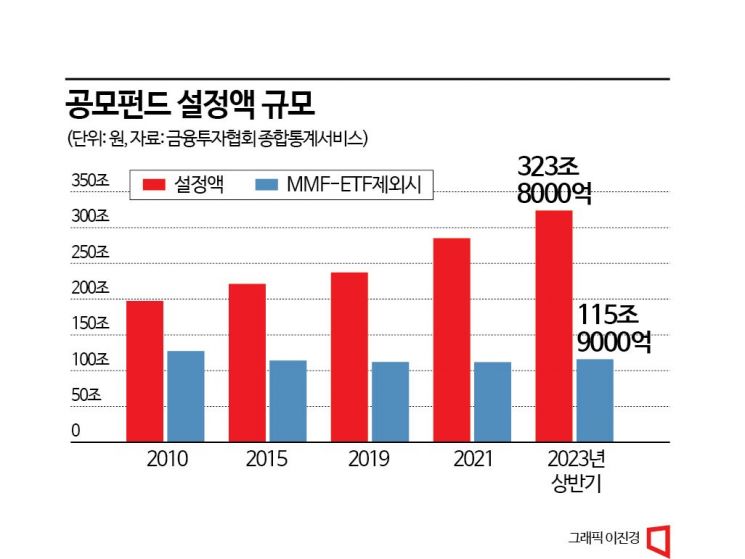
Looking at the total amount of public offering funds rather than individual products, it is still insufficient to talk about a full revival. According to the Korea Financial Investment Association's comprehensive statistical service, as of the first half of 2023, the assets under management of general public offering funds excluding short-term products such as money market funds (MMFs) and ETFs amounted to 115.881 trillion KRW.
Compared to the 127.2 trillion KRW scale of public offering fund assets under management in 2010, it has decreased significantly over the past decade. Even during the past year, when efforts to revitalize public offering funds were actively pursued, the amount increased by only about 7 trillion KRW compared to the previous year. This contrasts with ETFs, which increased by about 27 trillion KRW from 73.7339 trillion KRW to 100.7769 trillion KRW during the same period.
Experts point out that excessive concentration of funds in ETFs, which have high volatility, is undesirable from the perspective of risk management in the overall capital market, as it could collapse all at once in a crisis. There is a consistent call for offering various public offering funds managed by skilled fund managers to provide consumers with diverse choices and for portfolio diversification.
Hwang Se-woon, Senior Research Fellow at the Korea Capital Market Institute, said, "The biggest advantage of public offering funds is the portfolio method that diversifies investments across various stocks, making them relatively stable," adding, "It is necessary to increase the number of public offering fund products with risk management so that investors can consider them as part of their important investment assets."
Lee Chang-hwa, Head of Asset and Real Estate Division at the Korea Financial Investment Association, said, "There is always demand for medium-risk, medium-return investments that offer higher returns than deposits but lower risk than individual stocks or ETFs," adding, "The industry should launch various public offering funds that can absorb such demand, and from the perspective of convenience in subscription and redemption, direct listing of public offering funds could also be considered as a policy option."
© The Asia Business Daily(www.asiae.co.kr). All rights reserved.
![Clutching a Stolen Dior Bag, Saying "I Hate Being Poor but Real"... The Grotesque Con of a "Human Knockoff" [Slate]](https://cwcontent.asiae.co.kr/asiaresize/183/2026021902243444107_1771435474.jpg)











