Daily New Cases Exceed 60,000
Delay in Downgrading COVID-19 Infectious Disease Level
"Mask Wearing Must Be Maintained in Hospital Settings"
The number of daily new COVID-19 cases, which had been increasing even in midsummer, has surpassed 60,000 for the first time in seven months. With schools officially reopening this week, it is expected that the outbreak will continue for the time being. The health authorities have decided to postpone once again the planned mid-June downgrade of the COVID-19 infectious disease classification and the easing of quarantine measures.
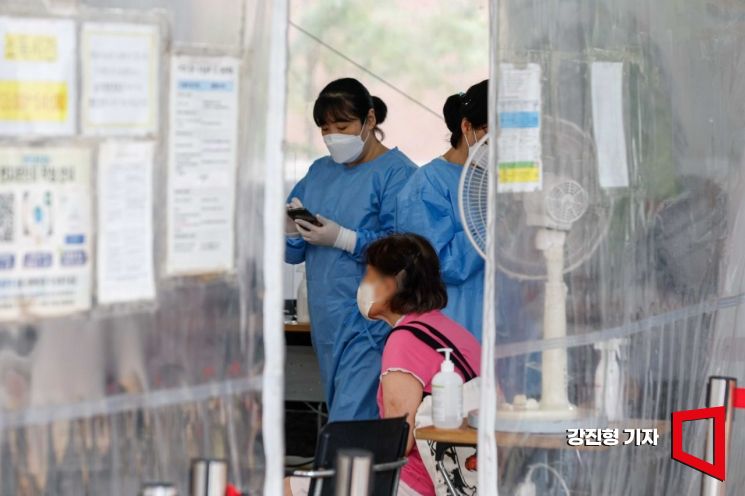 On the 8th, citizens who visited the screening clinic set up at Mapo-gu Public Health Center in Seoul, where COVID-19 confirmed cases have been increasing for six consecutive weeks, are waiting to get tested.
According to the Central Disease Control Headquarters on the 8th, the average daily number of new confirmed cases over the past week from the 1st to the previous day was 50,388, an increase of 10.7% compared to the previous week (45,524). This marks six consecutive weeks of increase. On the 2nd, there were 64,167 confirmed cases. The daily number of COVID-19 cases exceeding 60,000 is the first time since January 10 (60,019 cases). This level is comparable to the winter season when the 3Cs (closed spaces, crowded places, close-contact settings) conducive to COVID-19 transmission are created and the virus spreads.
During the same period, the average daily number of critically ill patients hospitalized was 185, up 11 from the previous week (174). The number of deaths over the week was 98, an increase of 1 compared to the same period.
Experts attribute the summer surge of COVID-19 to factors such as the removal of mask mandates and isolation requirements upon confirmation, the emergence of the XBB1.5 variant, and increased indoor activities due to the heatwave. The problem is that the peak of the COVID-19 outbreak has not yet arrived. The health authorities have even projected that daily cases could rise to 76,000 by mid-June.
Professor Kim Woo-joo of the Department of Infectious Diseases at Korea University Guro Hospital said, “Considering the government’s message that the COVID-19 risk has significantly decreased, many people no longer get tested or isolate, so the actual number of confirmed cases is likely two to three times higher than reported.” He also predicted, “In the worst case, following school reopening and the arrival of cooler weather, the COVID-19 outbreak will not subside and could continue into the winter season.”
As the spread of COVID-19 intensifies, the health authorities have decided to postpone the planned announcement on the 9th regarding the change in COVID-19 infectious disease classification. Originally, the plan was to lower the classification from level 2 to level 4, along with implementing charges for COVID-19 diagnosis and testing, and lifting mask mandates in hospital-level medical institutions and infection-vulnerable facilities. The medical and public health sectors had expressed concerns that easing quarantine measures during a resurgence could increase the number of ‘hidden infections’ in the community and weaken protection for high-risk groups.
An infectious disease specialist at a tertiary hospital said, “COVID-19 remains fatal for hospital patients such as cancer patients and organ transplant recipients,” adding, “It is still not possible to manage COVID-19 like influenza.”
The health authorities are leaning toward maintaining the indoor mask-wearing mandate in hospital-level and higher medical institutions and infection-vulnerable facilities for the time being, even if the COVID-19 infectious disease classification is lowered. A representative from the Korea Disease Control and Prevention Agency stated, “We will closely monitor the outbreak and quarantine situation, consult experts, and then establish a comprehensive and cautious adjustment plan.”
© The Asia Business Daily(www.asiae.co.kr). All rights reserved.
![Clutching a Stolen Dior Bag, Saying "I Hate Being Poor but Real"... The Grotesque Con of a "Human Knockoff" [Slate]](https://cwcontent.asiae.co.kr/asiaresize/183/2026021902243444107_1771435474.jpg)
















