23 Million Delivery App Users in July... 2.7% Increase from Previous Month
Effective in Major Delivery App Discount Competition Market
Did the 'Delivery Fee Discount Competition' Work?... User Numbers Rising Again
The effects of the heated competition among delivery applications (apps) for discounts, as intense as the midsummer heatwave, are becoming evident in the market. After the endemic phase (periodic outbreaks of infectious diseases), as users continued to leave, major delivery apps introduced various measures to reduce delivery fees starting from April and May. Although it took some time for the market to respond, overall user numbers began to rise again from last month.
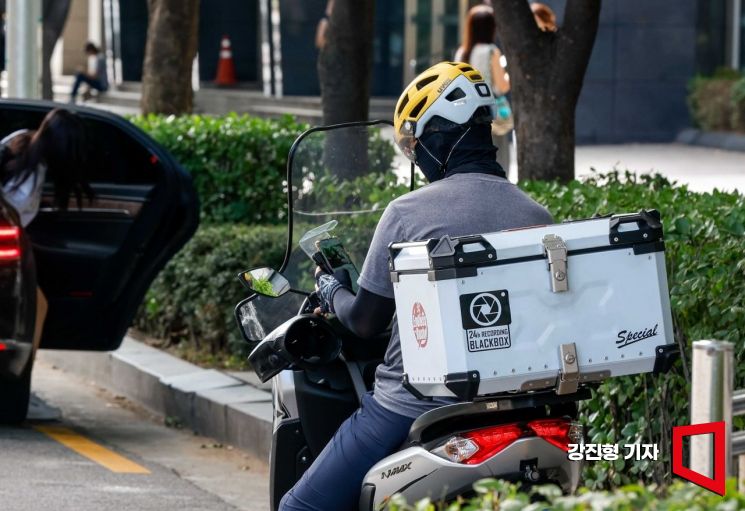 As major delivery app companies introduce measures to reduce delivery fees and the number of users begins to rise, a motorcycle delivery worker in Seoul is waiting for delivery calls early in the morning on the 8th. Photo by Jinhyung Kang aymsdream@
On the 8th, data company IGAWorks reported through Mobile Index that the total number of delivery app users (MAU) last month was 23,004,138. This is an increase of about 610,000 compared to the previous month. Recovering to the 23 million user level is the first time in seven months since December last year.
Seasonal factors such as summer heavy rain, heatwaves, and vacation season played a role, but above all, the main reason cited for user attrition with the endemic was the burden of delivery fees, and the companies’ efforts to offer discounts to alleviate this burden were effective. The market leader, Baedal Minjok (Baemin), has allowed anyone to receive and use a 10% discount coupon since May. This enables users to reduce the menu price by an amount equivalent to the delivery fee. In addition, Baemin launched the 'Altteul Baedal' (Budget Delivery) service, which lowers the delivery fee burden. This service delivers directly by Baemin, just like the existing single-order delivery, but optimizes bundled deliveries based on delivery routes. This is expected to reduce consumer costs to around 2,000 won. Baemin completed the application of this service to all 25 districts in Seoul in June. From last month, the service began expanding to major metropolitan cities such as Busan and Ulsan. Through this, Baemin recorded about 19.7 million users in July, a 2.8% increase compared to the previous month. It is notable that after two consecutive months of decline, the user count rebounded.
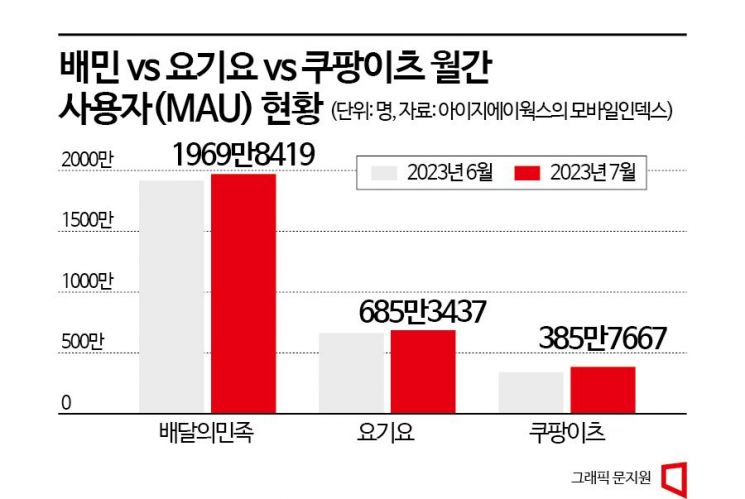
The second-ranked Yogiyo had 6.85 million users last month. This also increased by 3.4% compared to the previous month, marking the highest figure this year. In May, Yogiyo introduced a subscription service called 'YogipassX' that offers free delivery benefits. For a monthly fee of 9,900 won, users can enjoy free delivery at stores marked with the 'YogipassX' badge, provided they meet the minimum order amount. Yogiyo also started a promotion this month offering a 10% discount coupon that can be combined with other discounts.
The most remarkable growth was seen in third-ranked Coupang Eats. Since April this year, Coupang Eats has offered a 10% discount on delivery fees at designated restaurants for members of Coupang’s paid membership 'Rocket Wow.' This strategy aims to leverage the competitiveness of the Coupang Wow membership, which has about 11 million subscribers, in the delivery app market. Coupang Eats’ user numbers have increased for four consecutive months since April, showing the immediate effect of this strategy. During this period, the user base grew by 880,000. Moreover, Coupang Eats’ discounts are added benefits of the Wow membership, so they are expected to continue. This differs from coupon issuance, which can be stopped at any time.
Industry insiders view the recent fluctuations in user numbers as a process of finding an appropriate delivery fee amid a situation where consumers feel burdened by delivery fees due to high inflation. According to an analysis by the Korea Consumer Agency’s Price Monitoring Center last month on delivery fee changes at the same restaurants, 5.4% of places raised delivery fees compared to two months ago, while 6.5% lowered them. This atmosphere is quite different from last December, when 23.7% of restaurants raised delivery fees. An industry official said, "Delivery fees are a sensitive issue for all ecosystem participants, including consumers, business owners, and delivery drivers," adding, "Fairness and transparency must be guaranteed in the calculation and components of delivery fees."
© The Asia Business Daily(www.asiae.co.kr). All rights reserved.
![Clutching a Stolen Dior Bag, Saying "I Hate Being Poor but Real"... The Grotesque Con of a "Human Knockoff" [Slate]](https://cwcontent.asiae.co.kr/asiaresize/183/2026021902243444107_1771435474.jpg)

















