Sell Reports on Secondary Battery Stocks Miss the Mark
Domestic Securities Firms' Sell Report Ratio at 0.1%...Foreign Firms at 10-19%
Trust in Foreign Reports Declines Amid Growing Short Selling Suspicion
The influence of 'sell' reports from foreign securities firms is weakening compared to the past. When domestic securities firms rarely issue sell reports, sell reports from foreign securities firms had a significant impact. However, as the perception that sell reports from foreign securities firms are linked to short selling grows, their influence appears to be diminishing.
POSCO Holdings closed at 594,000 KRW on the 4th, up 0.34% from the previous day. It ended higher for two consecutive days.
Although the stock price fell for two consecutive days after Morgan Stanley downgraded POSCO Holdings' investment opinion on the 31st of last month, most secondary battery stocks also showed a downward trend during this period. Considering the overall market weakness due to the U.S. credit rating downgrade, it does not seem that the decline was solely due to the report.
In this report, Morgan Stanley downgraded POSCO Holdings from 'Equal Weight' to 'Underweight.' The target price was raised from 400,000 KRW to 440,000 KRW, but this is still significantly below the current stock price. Morgan Stanley stated, "POSCO Holdings is the most expensive stock among global lithium-related stocks," and forecasted that "there is an 80% probability that POSCO Holdings' stock price will fall within the next 15 days."
On the 24th of last month (local time), Goldman Sachs issued a sell report on POSCO Future M. POSCO Future M's stock price rose more than 10% on the 25th, then fell sharply along with other secondary battery stocks on the 26th and 27th, but quickly rebounded afterward. Earlier in June, Goldman Sachs had issued a 'sell' opinion on EcoPro BM, whose stock price was in the 260,000 KRW range at the time but is now 385,000 KRW.
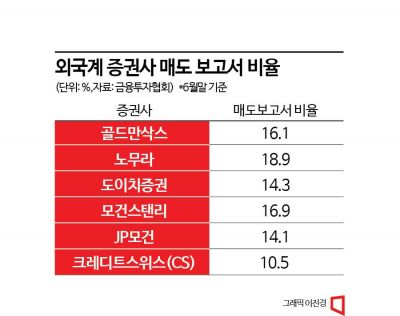
The strong impact of sell reports from foreign securities firms in the past was largely due to the near absence of sell reports from domestic securities firms. According to the Financial Investment Association's disclosure of securities firms' report investment ratings, as of the end of June, the proportion of sell reports from Goldman Sachs was 16.1%. Nomura was 18.9%, Deutsche Securities 14.3%, Morgan Stanley 16.9%, JP Morgan 14.1%, and Credit Suisse (CS) 10.5%. Domestic securities firms were at about 0.1%. In the domestic market, sell opinion reports are very rare, so they naturally attract more attention when they do appear.
Additionally, reports from foreign securities firms influence foreign investors, who are major players in the domestic stock market, which also amplifies their impact. A securities firm official said, "There was a strong perception that domestic securities firms hardly issue sell reports because they are cautious about companies, and in that context, sell reports from foreign securities firms were accepted as providing objective analytical information." He added, "Also, the fact that foreign securities firms' reports can influence foreign pension funds or hedge funds played a role."
The weakening influence of sell reports from foreign securities firms seems to be linked to suspicions related to short selling. After sell reports from foreign securities firms are issued, short selling of the relevant stocks tends to increase, leading to ongoing criticism that foreign securities firms profit from short selling through their sell reports.
In October last year, Naver's stock price plunged, influenced by reports from Citi and JP Morgan. Citi downgraded Naver's investment opinion to 'sell' and halved the target price from 328,000 KRW to 170,000 KRW. JP Morgan lowered the target price from 270,000 KRW to 220,000 KRW. On the day the reports were released, short selling of Naver increased more than tenfold compared to the previous trading day, ranking first in short selling transaction volume.
A similar situation occurred earlier with Celltrion. The short selling balance of POSCO Holdings has also recently increased significantly. The short selling balance amount of POSCO Holdings grew from 168.3 billion KRW on the 3rd of last month to 1.2418 trillion KRW on the 1st of this month. An industry insider explained, "As the phenomenon of a significant increase in short selling of related stocks after foreign securities firms issue sell reports repeats, suspicions that foreign securities firms' sell reports are linked to short selling are growing, which negatively affects trust in foreign securities firms' reports."
© The Asia Business Daily(www.asiae.co.kr). All rights reserved.
![Clutching a Stolen Dior Bag, Saying "I Hate Being Poor but Real"... The Grotesque Con of a "Human Knockoff" [Slate]](https://cwcontent.asiae.co.kr/asiaresize/183/2026021902243444107_1771435474.jpg)
















