Over 20 Suspected Heat-Related Deaths Since Late May
Eight Amendments to the Industrial Safety and Health Act Pending in the National Assembly
Following Legislation to Prevent Harm, Calls for 'Climate Finance' Also Arise
On June 19th, a 29-year-old man named Kim died while working at a supermarket in Gyeonggi Province. On that day, when the daytime high temperature reached 35 degrees Celsius, Kim lost consciousness and collapsed while continuously managing carts in a parking lot without air conditioning. He was transported to a hospital and was pronounced dead. The cause of death was determined to be "pulmonary embolism and excessive dehydration due to heat."
Amid a sharp increase in deaths and heat-related illnesses caused by recent heatwaves, calls for countermeasures at the National Assembly level are growing louder. From May 20th of this year until the end of last month, the estimated number of deaths due to heat-related illnesses reached 21, which is three times the number during the same period last year (7). Following Kim's death, politicians have pledged to expedite the passage of eight bills currently pending in the National Assembly. Some argue that fundamental legislation is needed to respond to the already normalized climate crisis.
Eight Amendments to the Industrial Safety and Health Act on 'Work Suspension During Heatwaves' Pending
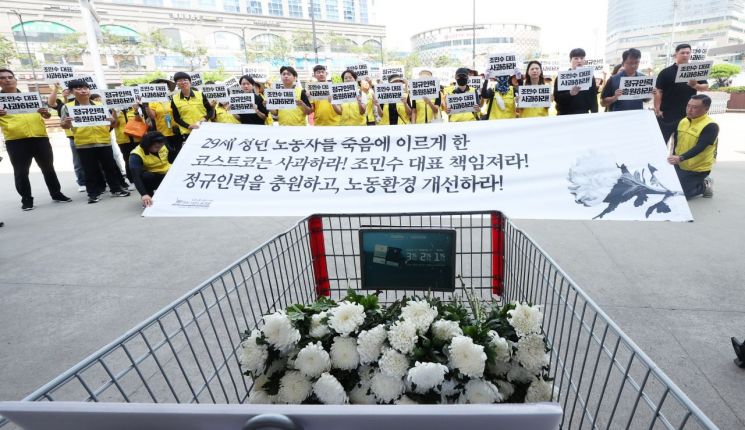
Park Kwang-on, floor leader of the Democratic Party of Korea, visited the East Seoul Postal Logistics Center on the 1st and said, "The Industrial Safety and Health Act (ISHA), which mandates work suspension during heatwaves exceeding the standard, is pending in the National Assembly," adding, "We should have handled this before the heat arrived, but we have not yet, and I apologize to the workers. We will strive to process it within this month."
According to the National Assembly's legislative information system on the 6th, there are eight ISHA amendment bills pending in the National Assembly. These bills were submitted by Kim Seong-won and Park Dae-su of the People Power Party, Lee So-young, Lee Yong-bin, Jeon Yong-gi, and Hong Young-pyo of the Democratic Party, Lee Eun-ju of the Justice Party, and independent lawmaker Yoon Mi-hyang. Although the "Regulations on Industrial Safety and Health Standards" already stipulate measures such as providing appropriate rest when working in high heat, cold, or humid conditions or in outdoor locations directly exposed to heatwaves, these are only recommendations and have been criticized for lacking practicality. The bills aim to strengthen these provisions.
The bills by Kim Seong-won and Lee So-young allow local government heads to order work suspension to employers during heatwaves and cold spells. There are also provisions to impose fines on workplaces that do not comply. Kim's bill specifies fines up to 30 million KRW, while Lee's bill specifies fines up to 50 million KRW. Some bills also include provisions to support wage loss compensation during work suspension due to heatwaves. Besides Kim and Lee's bills, those by Lee Yong-bin, Lee Eun-ju, and Hong Young-pyo include such provisions.
Lee Eun-ju's bill particularly specifies that employers must take measures to prevent workers' health hazards, including "installing necessary facilities according to weather or work conditions." This means that if heat-related illnesses are a concern due to heatwaves, employers must install cooling devices such as air conditioners. This provision could have applied to Kim's case, who died in June. Yoon Mi-hyang's bill includes a clause that makes it mandatory for supervisors to report the measures taken to the Ministry of Employment and Labor to ensure that work suspension orders for workers are not merely "recommendations."
These bills were first introduced as early as three years ago (Lee So-young's bill in July 2020) but have only been discussed once or so in the Environment and Labor Committee subcommittee, which has jurisdiction. In May last year, Park Hwa-jin, then Vice Minister of Employment and Labor, said at a bill subcommittee meeting, "We believe that work suspension due to abnormal weather and reporting obligations for measures are already covered by existing regulations," adding, "We see no practical benefit in amending this provision." Regarding the clause allowing local government heads to issue work suspension orders, he said, "Since a new player is entering, we want to consider it more carefully."
In response, lawmaker Yoon argued, "Although the law exists, the problem is that in the labor field, due to burdens such as wage reduction or extended construction periods, workers' rights to suspend work are not properly guaranteed, which is why these bills were created."
The ruling party's stance on the opposition's proposal to pass related laws by August is that "administrative measures by the government should come first." Yoon Jae-ok, floor leader of the People Power Party, said to reporters after a floor strategy meeting on the 1st, "We will gather opinions through the relevant standing committee secretaries on matters that require ISHA amendments," but added, "However, since the heatwave is expected to be most severe until August 10th, and there are no matters that can be promptly addressed through legal amendments, we will prioritize administrative measures by the government."
Normalization of Disasters... Emergence of Need for 'Fundamental Countermeasures'
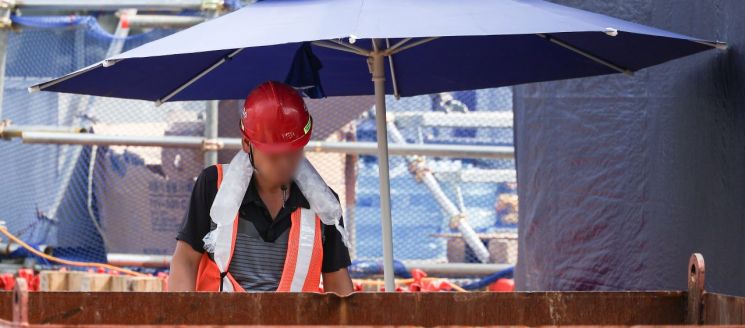
As climate disasters such as heatwaves, cold spells, and heavy rains become normalized, voices are also calling for legislation to fundamentally prevent damage beyond just improving working conditions.
On the 1st, Yong Hye-in of the Basic Income Party said at a National Assembly press conference, "The extreme heavy rain that took the lives of about 50 citizens and the extreme heatwave over the weekend that claimed 15 lives were moments of climate disaster," adding, "In recent weeks, we have clearly confirmed that establishing a response system to protect the safety and lives of citizens from climate disasters is an urgent national task." She proposed ▲imposing a carbon tax ▲using carbon tax revenue for basic income ▲expanding public investment for sustainable production.
There were also opinions that a "climate finance" system should be established to respond to the climate crisis. On the 27th of last month, Jang Hye-young of the Justice Party emphasized in a plenary session speech, "The state needs extraordinary measures to respond to the climate crisis," adding, "If our government fails to respond timely to the climate crisis due to budget shortages, the irreversible damage that will occur will be unimaginable." She also added that the 1% reduction in all corporate tax brackets and corporate investment tax credits passed by the National Assembly this year should be withdrawn. Jang urged both the People Power Party and the Democratic Party to pass the Carbon Tax Act as a supplementary budget bill this year to establish appropriate carbon pricing and secure funding for climate response.
A report titled "Improvement Measures for Protecting Vulnerable Groups from the Climate Crisis," published by the National Assembly Research Service, pointed out that "current laws only provide measures for homeless people and outdoor workers," indicating that protection measures for vulnerable groups during heatwaves and cold spells are insufficient. Although the Carbon Neutrality Basic Act was enacted in 2021, protection measures for vulnerable groups in the climate crisis remain inadequate. The report suggested that new legislation or amendments to the Carbon Neutrality Basic Act are needed to legally define and specify the scope of vulnerable groups in the climate crisis and to establish the basis for related national plans and budget support.
© The Asia Business Daily(www.asiae.co.kr). All rights reserved.
![Clutching a Stolen Dior Bag, Saying "I Hate Being Poor but Real"... The Grotesque Con of a "Human Knockoff" [Slate]](https://cwcontent.asiae.co.kr/asiaresize/183/2026021902243444107_1771435474.jpg)

















