"Scientific Revolution Transcends Borders and Ethnicities"
Chinese Researchers Also Claim Reproduction of Superconductivity
Chinese state media has showered praise on the 'room-temperature, ambient-pressure superconductor' claimed to be invented by domestic researchers, drawing significant attention.
On the 3rd (local time), the English edition of China's state-run newspaper Global Times introduced the presumed room-temperature, ambient-pressure superconductor material LK-99 developed by domestic researchers, stating, "Amid the noise of geopolitical clashes and confrontations, the world has for the first time in a while gained an exciting new focus."
The media emphasized, "News of (LK-99) has spread rapidly beyond the scientific community, sparking heated debates in several countries. It has also triggered a chain reaction in international capital markets, causing stocks related to superconducting technology to surge," adding, "The physics community has not been this lively for a long time."
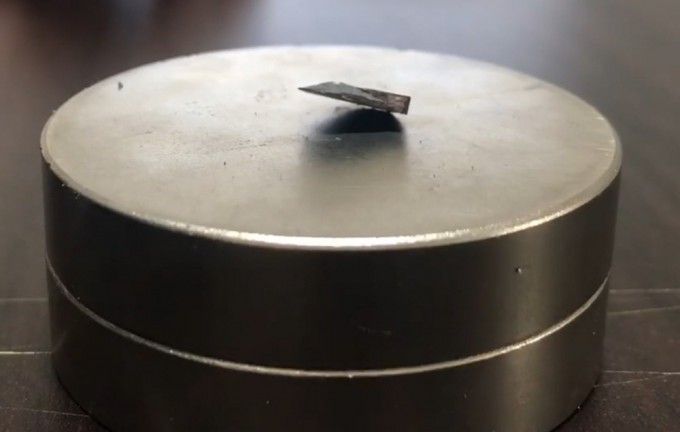 A material presumed to be a room-temperature superconductor LK-99, claimed to be developed by domestic researchers. [Image source=Yonhap News]
It went on to say, "Superconductivity is one of the greatest discoveries," and predicted, "Until now, superconductivity has been limited by the requirement of extremely low temperatures, making commercialization difficult. However, if room-temperature superconductors are realized, they will bring revolutionary changes in various fields such as energy, transportation, computing, and medical testing."
Global Times expressed mixed views on whether LK-99 is truly a superconducting material, stating, "On one hand, we are skeptical, but on the other, we hope it is true," and reiterated, "The expectation for a revolutionary breakthrough in human technology is buried in almost everyone's heart, waiting to be ignited. (That desire) transcends borders and ethnicities."
Earlier, on the 2nd, a research team led by Professor Qinghaixin from the Department of Materials Engineering at Huazhong University of Science and Technology in China posted a video on the Chinese video-sharing platform Bilibili, claiming to have reproduced the superconductivity of LK-99.
In the video released by the research team, small black dots repeatedly stand up and lie down. The team explained that this indicates the appearance of a 'diamagnetic phenomenon' regardless of polarity such as N-pole or S-pole, claiming, "We have succeeded in realizing LK-99 and verified the Meissner effect (diamagnetic effect)." The Meissner effect is known as one of the phenomena that occur when entering a superconducting state.
However, actual superconductors must also exhibit a drop in electrical resistance to zero along with the Meissner effect. The research team has not yet confirmed whether the electrical resistance of LK-99 decreases to zero like a true superconductor.
Meanwhile, LK-99 is the name given by the representative research team led by Lee Seok-bae of the Quantum Energy Research Institute, who discovered the material. Lee’s team recently published pre-prints claiming to have observed the superconductivity of the material and disclosed the synthesis method on social networking services (SNS) such as LinkedIn. Several international research institutes are now focused on reproducing experiments and verification.
© The Asia Business Daily(www.asiae.co.kr). All rights reserved.

















