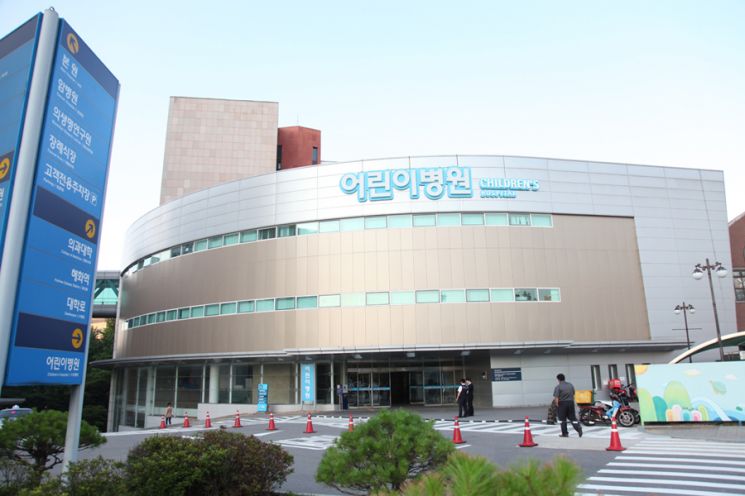
Professor Kim Ki-beom of the Department of Pediatrics and Adolescents at Seoul National University Children's Hospital informed medical students wearing surgical gowns and masks about the patient's condition while watching a video in the hospital's cardiovascular angiography room on the afternoon of the 3rd. Professor Kim carefully explained where the blockage was while looking at the patient's coronary artery. The students participating in the pediatric cardiology field training focused intently on Professor Kim's words.
There are three medical students undergoing field training in the pediatric cardiology department at Seoul National University Hospital. Since 2021, the Ministry of Health and Welfare has been conducting a support project for mandatory medical training for medical students. Medical students interested in essential medical fields such as pediatric cardiology and neurosurgery undergo field training during their vacations at 18 institutions, including university hospitals. This year, 255 trainees were selected across six fields: neurosurgery, pediatric cardiology, trauma, infectious diseases, public healthcare, and primary care. The competition rate was 2 to 1. Currently, 123 medical students are undergoing training during the summer vacation. The Ministry of Health and Welfare provides approximately 5 million KRW per student in training expenses to both the participating institutions and the medical students.
Ryu Yoon-sik, a second-year medical student at Chonnam National University Medical School, said, "I am very interested in pediatrics and adolescents, but people around me discouraged me," adding, "After doing field training, I developed a stronger sense of mission, and it was helpful for my life." Professor Kwak Jae-geon of the Department of Pediatric Thoracic Surgery said, "More than 90% of medical students do not get to do field training," and added, "Experiencing the training support system will help medical students understand various fields."
The Ministry of Health and Welfare supports the medical student training project to alleviate the manpower shortage in essential medical fields, even if only slightly. The recruitment rate of residents in essential medical fields has been declining every year. The recruitment rates for residents in essential medical specialties such as internal medicine, surgery, obstetrics and gynecology, pediatrics and adolescents, thoracic surgery, urology, and neurosurgery dropped from 95.1% in 2017 to 82.9% in 2021, and further down to 78.5% last year. Especially, few residents apply for pediatrics and adolescents. According to the Korean Pediatric Society, only 33 out of 199 total positions were filled in the first half of this year's resident recruitment for pediatrics and adolescents. Even Seoul National University Children's Hospital, which was selected as the number one medical institution in the pediatric and adolescent field in Newsweek's "Asia-Pacific Best Hospitals Ranking," struggles with manpower shortages. Professor Kwak said, "There is a lot of concern about the shortage of medical staff as more specialists are approaching retirement." The aging of specialists is accelerating. Among specialists in essential medical fields, those in their 70s increased by 136%, from 686 in 2013 to 1,621 last year. Those in their 60s increased by 86%, from 1,960 to 3,656, and those in their 50s increased by 35%, from 4,450 to 6,034. Conversely, those under 30 decreased by 6%, from 3,988 to 3,024, and those in their 40s decreased by 24%, from 5,961 to 5,604.
An Jun-hyung, a fourth-year medical student at Keimyung University Medical School, said frankly, "When I said I wanted to go into thoracic surgery, acquaintances advised me to go into lung and esophagus fields," adding, "Still, if I want to specialize in the heart, they told me pediatric cardiology is not recommended." He continued, "I observed the heart surgery of a one-month-old baby performed by Professor Kim Woong-hwan, a master of pediatric heart surgery, at Seoul National University Hospital," adding, "I watched from a distance on the screen, and it was truly a precious experience."
The number of specialists leaving university hospitals is also increasing. Young doctors who prioritize work-life balance (WLB) and income prefer opening private clinics over working at university hospitals. Professor Kim Ki-beom said, "Even now, I leave work after 10 p.m. on weekdays and come to work on weekends," adding, "If compensation is increased and working conditions improved, more specialists would want to work at university hospitals."
© The Asia Business Daily(www.asiae.co.kr). All rights reserved.
![Clutching a Stolen Dior Bag, Saying "I Hate Being Poor but Real"... The Grotesque Con of a "Human Knockoff" [Slate]](https://cwcontent.asiae.co.kr/asiaresize/183/2026021902243444107_1771435474.jpg)











