Refrigerated and Frozen Food Sales Growth
"Cold Chain Delivery Effective Amid Heatwave"
Homeplus announced on the 3rd that online sales of refrigerated and frozen foods have been on the rise thanks to 'cold chain' delivery amid the heatwave.
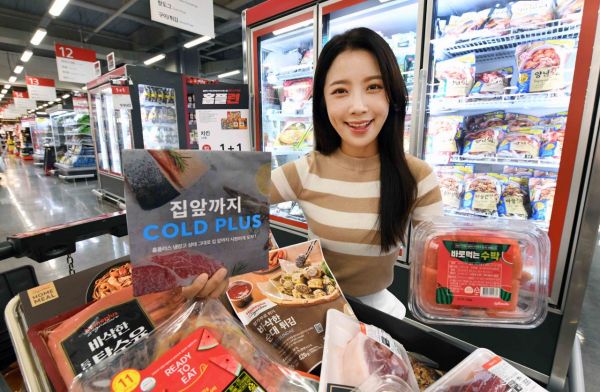 A model is promoting cold chain delivery at Homeplus Mega Food Market Gangseo branch in Gangseo-gu, Seoul.
 [Photo by Homeplus].
From May to July this year, Homeplus online sales in the refrigerated and frozen category increased by 18% compared to the same period last year. The fresh refrigerated category for livestock and seafood grew by 22%, and the number of customers using these categories also rose by 12% and 14%, respectively, during the same period. Among frozen categories, the 'livestock ready-to-eat meals' that can be easily enjoyed saw sales increase by 210%, and ice cream products enjoyed as desserts also grew by 30%. The refrigerated categories of seafood and side dishes also jumped by 42% and 39%, respectively.
The company attributed the rising demand for refrigerated and frozen food delivery to the continued demand for home-cooked meals amid high inflation, along with Homeplus Online’s cold chain delivery system that maintains refrigerated and frozen conditions even during the heatwave.
Homeplus Online utilizes its cold chain delivery infrastructure to ensure products arrive at customers’ doorsteps as fresh and cool as they are in the store refrigerators. Dedicated online delivery pickers pick products into online delivery carts wrapped with cooling packs, then pack the picked products with dry ice and ice packs inside cooling packs. These are stored in refrigerated and frozen storage exclusively for online orders until just before departure, and then delivered to customers using cold chain-equipped vehicles.
Homeplus Online’s cold chain delivery system began in 2005 with the opening of Korea’s first fresh logistics center with three temperature zones (1℃, 10℃, -21℃) in Haman, Gyeongnam, and the special production and application of trailers with three temperature zones for delivery vehicles. Since the second half of last year, the refrigerated and frozen storage space of newly introduced delivery vehicles has been expanded by more than 40% compared to existing vehicles.
As a result, the usage rate of frozen food categories among customers in their 20s and 30s, who prefer convenience, has also increased. In July alone, the overall usage rate of frozen foods by customers in their 20s rose by 23%, with livestock ready-to-eat meals and dumplings increasing by 117% and 63%, respectively.
© The Asia Business Daily(www.asiae.co.kr). All rights reserved.
![Clutching a Stolen Dior Bag, Saying "I Hate Being Poor but Real"... The Grotesque Con of a "Human Knockoff" [Slate]](https://cwcontent.asiae.co.kr/asiaresize/183/2026021902243444107_1771435474.jpg)
















