Our Neighborhood Tips - Private Building Attached Parking Lots
Jung-gu Opens Parking Lots Secured at Shilla Hotel and Dongguk University
Shinsegae Training Center Parking Lot Completed Near Jokbal Mecca Also Available
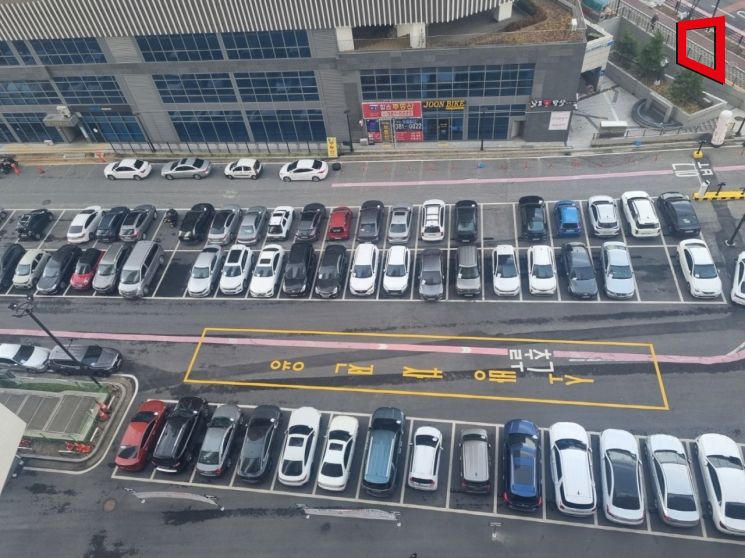 Autonomous districts are carrying out various types of parking lot securing projects, including private building attached parking lots and publicly accessible parking lots. (Photo by Asia Economy DB)
Residents living in old multi-family or multiplex houses (villas) often face parking difficulties. This problem is even more severe in urban areas. However, using private parking lots that cost over 200,000 won per month is not easy either. In the heart of Seoul’s downtown, where many office facilities are concentrated, even finding such parking spaces is difficult. Im Hyun-sik (51, pseudonym), who rents a unit in a commercial-residential building in Jung-gu, is in this situation. Most of the affordable options are mechanical parking lots. Driving a sports utility vehicle (SUV) further limits the choices.
He also checked out the Namsan Square Building parking lot operated by Hi-Parking near Chungmuro Station and the Dongguk University Chungmuro Video Center parking lot managed by KakaoT, but paying money did not guarantee securing a parking space. The Namsan Square parking lot only accepts applications for monthly parking over 250,000 won from employees of the building, and the Chungmuro Video Center parking lot requires an indefinite waiting period.
To alleviate such inconveniences for residents, local governments compete to build public parking lots or secure leftover land to create parking spaces, but securing land in downtown areas is not easy.
Some areas actively implement the ‘Home Parking Lot Creation Project,’ which involves demolishing fences of single-family, multiplex, or multi-family houses to create parking spaces. Gangseo-gu has secured 1,964 spaces (1,236 households) over 19 years from 2004 to last year. They support construction costs of 9 million won per parking space and provide an additional 1.5 million won if an extra space is added at the same location. Converted to current prices, about 13 billion won has been spent on this budget over 19 years.
In Jung-gu, where many office facilities are located downtown, they operate ‘private building attached parking lots’ to serve residents. Starting with the Korean Freedom Federation parking lot in Jangchung-dong (70 open spaces) in October 2021, they have secured a total of 12 locations and 370 spaces over 1 year and 8 months until last May, including Doosan Tower in Gwanghui-dong (40 spaces), Shilla Hotel (30 spaces), Dongguk University attached parking lot in Pildong (100 spaces), and Seoul History in Hoehyeon-dong (30 spaces).
Jung-gu rents parking spaces from building owners at 110,000 won per space per month and rents them out to Jung-gu residents for only 40,000 won per month. Since attached parking lots have a basis for budget support, a subsidy of 70,000 won per space per month is possible. Although the scale and conditions vary slightly, other districts such as Mapo-gu and Seongdong-gu also have attached parking lots.
Parking allocation is not on a first-come, first-served basis. Scores are calculated based on criteria for resident-priority parking allocation, including length of residence in the area, past allocation history of other public parking lots, whether the vehicle is a compact or low-emission vehicle, and whether the resident qualifies as a national merit recipient or disabled person. High scorers are assigned spaces on a yearly basis. Jung-gu’s Parking Management Division staff conduct a full survey of private attached parking lots in the district to identify idle parking spaces and secure parking lots by negotiating and signing agreements with building owners. Since the parking lots must operate 24 hours, persuading building owners is not easy, according to the officials.
This project became possible due to the establishment of Article 19 of the Parking Lot Act in 2020. In the same year, the ordinance on parking lot installation and management was revised, providing a basis for subsidies to private attached parking lots open to the public.
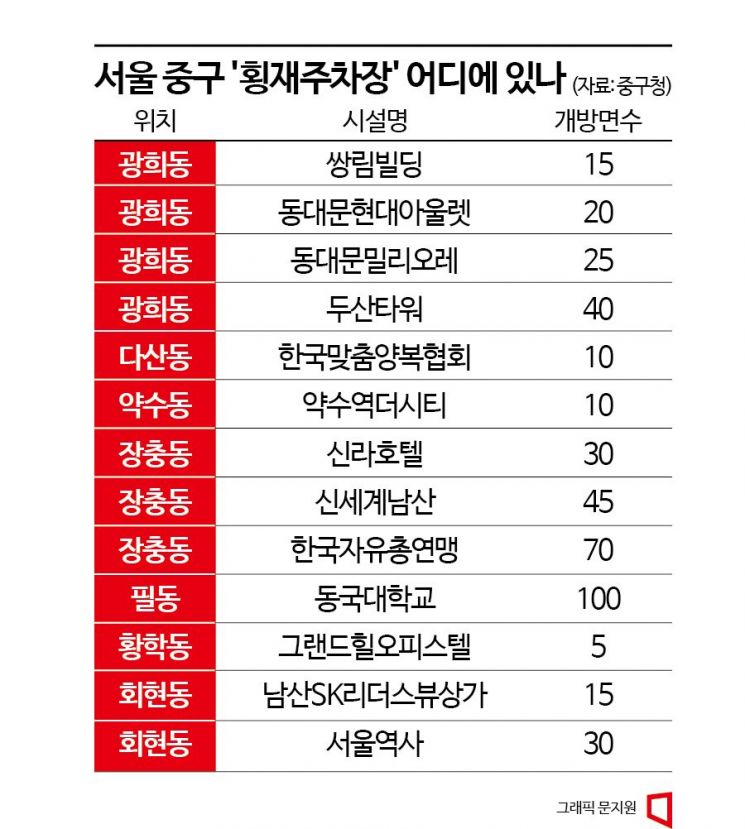
Recently, Jung-gu signed an agreement with Shinsaegae Group to use 45 parking spaces in the basement level 3 parking lot of the Shinsaegae Downtown Training Center (Shinsaegae Namsan) in Jangchung-dong, known as the ‘Jokbal Mecca,’ for residents. This training center, close to Dongguk University Station on Subway Line 3, was built by Shinsaegae by purchasing the Shinsaegae Construction headquarters and nearby jokbal restaurants, with a size of basement 5 floors to ground 6 floors (total floor area 28,886㎡).
On the 2nd, Jung-gu issued a press release announcing that residents can use the parking lot 24 hours a day for one year starting this October by paying only 70,000 won per month. A representative from Jung-gu Facilities Management Corporation said, “Applications have been accepted on the corporation’s website since the 1st, and inquiries have been pouring in,” and explained, “The resident-priority parking allocation criteria will be applied equally, and spaces will be assigned in order of highest scores.”
Jung-gu expects that securing this parking lot will help alleviate parking difficulties in Jangchung-dong and parts of Dasan-dong, where single-family, multiplex, and commercial-residential buildings are densely located. The parking fee of 70,000 won per month is due to a different installation basis than private attached parking lots, which affects budget support. The Shinsaegae Namsan parking lot is a ‘public open parking lot,’ created as a result of Jung-gu’s condition during the building’s architectural review approval, requiring the provision of resident convenience facilities. Public open parking lots charge parking fees at the level of public parking lots, and public parking fees vary by zone.
Whether private attached parking lots or public open parking lots, residents benefit from finding ‘lucky parking lots’ near their homes, and local governments can efficiently secure parking lots to improve public services. Building owners or companies in the area receive relatively small financial compensation but can find meaning in contributing to community coexistence.
Then, what about residents from other districts commuting to Jung-gu? They may find opportunities if there is a shortage in private attached parking lots.
© The Asia Business Daily(www.asiae.co.kr). All rights reserved.


















