MFDS Releases New Reference Values for Food Consumption Periods
The Ministry of Food and Drug Safety (MFDS) has found that ramen can be safely consumed up to about 100 days past its expiration date.
On the 2nd, the MFDS set and disclosed reference values for the consumption period for the first time for 58 items across 17 food categories, including fried noodles like ramen and braised foods. Including this, reference values for the consumption period for 120 items across 39 food categories were additionally presented following the announcement made in January.
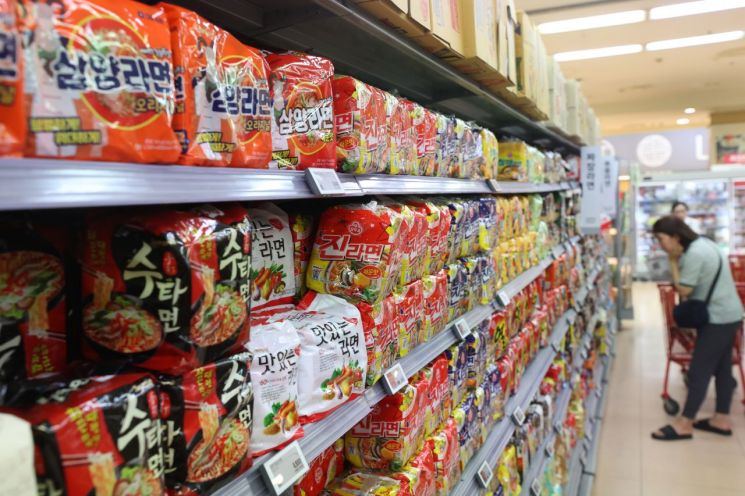 According to a survey by the Ministry of Food and Drug Safety (MFDS), it is safe to eat ramen up to about 100 days past its expiration date. [Photo by Yonhap News]
While the existing expiration date indicates the period during which distribution and sale to consumers are permitted, the consumption period refers to the timeframe during which consumption is safe for consumers.
The non-expiration reference values are provisional consumption periods established by the MFDS based on experiments conducted for each food type. Food business operators can determine the consumption period within the range of these reference values by selecting the most similar item from the consumption period setting report, considering the product’s characteristics, packaging method, and distribution environment.
 In the case of the product with the largest difference between the expiration date and the consumption date, the expiration date was 183 days, while the consumption date was 291 days. For fish sausage (2 products), the expiration date was 90 days, but the consumption date ranged from 112 to 180 days. For seasoned laver (1 product), the expiration date was 183 days, and the consumption date was 207 days.
 [Photo by Ministry of Food and Drug Safety]
The newly established reference values for the consumption period are as follows: fried noodles (8 types) 104?291 days; braised foods (7 types) 4?21 days; pickled foods (5 types) 5?13 days; natural cheese (2 types) 34?46 days; seasoned laver 207 days; processed fruit and vegetable products (6 types) 7?10 days; processed legume products (3 types) 19 days; other processed seafood products (3 types) 46 days; processed meat-containing products (5 types) 4?6 days; seasoned meat (5 types) 4?13 days; raw ham (4 types) 69?140 days; fish sausage (2 types) 112?180 days; fermented sausage 210 days; mixed sausage 355 days; yuba (2 types) 174?273 days; liquid tea 8 days; natural spices (2 types) 31?42 days, etc.
For the product with the largest difference between expiration and consumption periods, the expiration date was 183 days, while the consumption period was 291 days. For fish sausage (2 products), the expiration date was 90 days, but the consumption period ranged from 112 to 180 days. For seasoned laver (1 product), the expiration date was 183 days, and the consumption period was 207 days.
Expiration Date and Consumption Period Differ... Safe to Consume for a Certain Period After Expiration Date
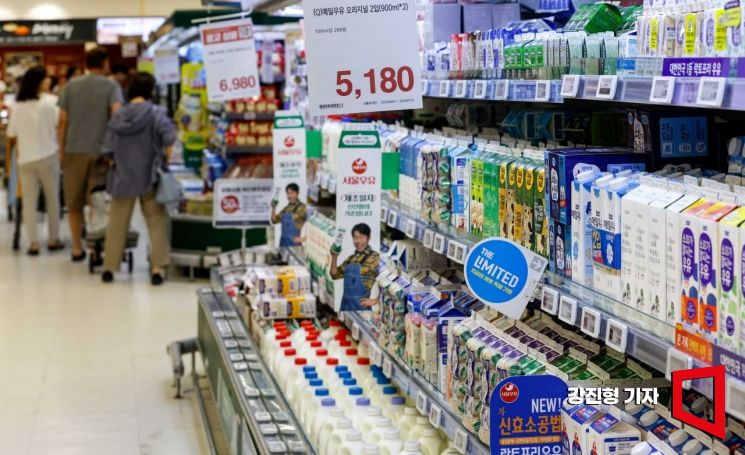 This year will be a guidance period for the application of the consumption period, and for milk products (excluding fortified milk such as vitamin-enriched milk or processed milk like banana-flavored milk), the consumption period will be indicated starting from 2031. The consumption period will be displayed in the same way as the existing expiration date.
 [Photo by Jinhyung Kang aymsdream@]
In the case of food, it is possible to consume it for a certain period after the expiration date, but consumers often perceive that food cannot be eaten once the expiration date has passed. Consequently, there have been ongoing concerns that many foods are discarded due to misunderstandings about expiration dates.
In response, the MFDS decided to display the consumption period instead of the expiration date starting from January this year.
However, this year will serve as a guidance period for applying the consumption period, and for dairy products (excluding fortified milk such as vitamin-added milk or processed milk like banana-flavored milk), the consumption period labeling will begin in 2031. The consumption period labeling method is the same as the existing expiration date labeling method.
The consumption period reference values released by the MFDS on this day are provisional consumption periods based on experiments for each food. The MFDS investigates bacterial counts, coliform bacteria, moisture, acidity, appearance, and odor of the food to establish the 'quality safety limit period.'
Typically, the consumption period is set at 80?90% of the quality safety limit period, while the expiration date is set at 60?70%.
According to MFDS notifications, business operators can either conduct their own consumption period setting experiments or determine their product’s consumption period within the range of the reference values provided by the MFDS.
An MFDS official stated, "The consumption period is shorter than the quality safety limit period, but consuming food past the consumption period may result in changes in taste and quality, and if storage conditions are not properly maintained, the risk of food poisoning increases. Therefore, it is best to avoid consuming food past its consumption period whenever possible."
© The Asia Business Daily(www.asiae.co.kr). All rights reserved.
![Clutching a Stolen Dior Bag, Saying "I Hate Being Poor but Real"... The Grotesque Con of a "Human Knockoff" [Slate]](https://cwcontent.asiae.co.kr/asiaresize/183/2026021902243444107_1771435474.jpg)


















