Advanced Measures for Supply and Demand Management of Horticultural Agricultural Products
Expansion of Contract Farming Area for Major Vegetables to 35% by 2027
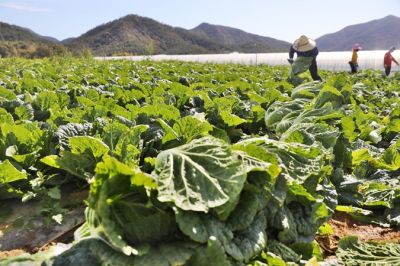
The government has decided to enhance the effectiveness of supply and demand policies, focusing on open-field vegetables such as summer cabbage, garlic, and onions, which repeatedly experience price instability due to over- and under-cultivation. To enable proactive supply management, it will establish and operate a 'Pre-management System for Appropriate Cultivation Area.' The contract cultivation area for key supply-demand items such as summer and winter cabbage and radish is planned to be increased to 35% by 2027.
On the 31st, the Ministry of Agriculture, Food and Rural Affairs announced the 'Advanced Supply and Demand Management Plan for Horticultural Agricultural Products,' which includes these measures.
First, the government will establish a pre-management system for appropriate cultivation areas through public-private cooperation. For open-field vegetables where pre-management of cultivation areas is not yet implemented, the Korea Rural Economic Institute (KREI) will recently propose the appropriate cultivation area (draft) for the relevant year by synthesizing observation data, consumption information, import-export trends, cultivation registration areas from self-help fund organizations, and cultivation intention surveys. This proposal will undergo agreement and consensus processes among producer organizations (self-help fund organizations), local governments, and the government to set the supply and demand management direction for the year.
The price risk management function against supply instability will also be strengthened. The Vegetable Price Stabilization System (for open-field vegetables) will be completely revamped in terms of business structure and support conditions to establish itself as a practical price risk management tool for farmers. Target items will be classified into key supply-demand items (summer and winter cabbage, radish, etc.) and items of interest (spring and autumn cabbage, radish, etc.), and the burden ratio for producer organizations (NongHyup) will be lowered from 20% to 10%. Additionally, by introducing an evaluation system, the enrollment rate of the Vegetable Price Stabilization System, which was about 17% compared to 2022 production volume, is planned to increase to 35% by 2027. To guarantee income for enrolled farmers and prevent overproduction, compensation for area adjustment (field disposal) will be minimized to the level of management costs, shifting the focus to 'price difference compensation.'
Furthermore, to enable continuous shipment control of open-field vegetables, the number of private shipment control facilities, which was seven last year, will be steadily expanded to 18 by 2027. To mitigate price volatility, government purchase and stockpiling will also be expanded. For cabbage and radish, dedicated public stockpiling bases will be secured to improve storage methods and strengthen management to enhance storability. Support will be reinforced to activate self-stockpiling by large-volume demand companies such as kimchi manufacturers and other open-field vegetable buyers.
Alongside this, to strengthen proactive supply management functions, the 'Supply and Demand Management Guidelines' and the 'Agricultural Product Self-Help Fund System' will be improved. The criteria for judging supply and demand crises in the guidelines will be improved to use 'average price' and will be updated annually (currently every five years) to reflect reality. The Agricultural Product Supply and Demand Adjustment Committee will also be regularized (quarterly plus ad hoc meetings) to establish a system that responds quickly and systematically when supply instability occurs.
To clarify the public role of self-help fund organizations, the legal status of non-profit corporations under civil law will be converted to special corporations under the Self-Help Fund Act. The scope of members, which currently mixes production and distribution stages, will be reorganized according to the characteristics of each item. A support system based on the implementation performance of mid- to long-term plans autonomously established by each organization will also be prepared. Additionally, for items without self-help funds but with high regional concentration or cropping patterns, a 'Regional Self-Help Fund' system will be newly introduced to regulate supply and demand and strengthen competitiveness at the regional level.
Kim Jong-gu, Director of Distribution and Consumption Policy at the Ministry of Agriculture, Food and Rural Affairs, said, "With this measure, agricultural product price volatility will be alleviated, making it a highly effective policy for stabilizing farmers' management and consumer prices. We will continuously promote institutional improvements through field opinion gathering."
© The Asia Business Daily(www.asiae.co.kr). All rights reserved.
![Clutching a Stolen Dior Bag, Saying "I Hate Being Poor but Real"... The Grotesque Con of a "Human Knockoff" [Slate]](https://cwcontent.asiae.co.kr/asiaresize/183/2026021902243444107_1771435474.jpg)
















