UN "Era of Global Tropicalization... A Frightening Situation"
Heatwaves During Day and Tropical Nights at Night Persist on the Korean Peninsula
"High Temperature and Humidity Due to Heat Dome Phenomenon"
Climate change caused by global warming is being felt on the skin. The Earth's average temperature is rising sharply to the point where it is described as "boiling," and the Korean Peninsula is also experiencing extreme weather anomalies such as repeated heavy rains and heatwaves.
On the 27th (local time), Ant?nio Guterres, the UN Secretary-General, declared at the United Nations Headquarters in New York, USA, that "the era of global warming has ended and the era of Earth's tropicalization has begun." He warned, "Climate change is currently underway and the situation is terrifying," adding, "This is only the beginning."
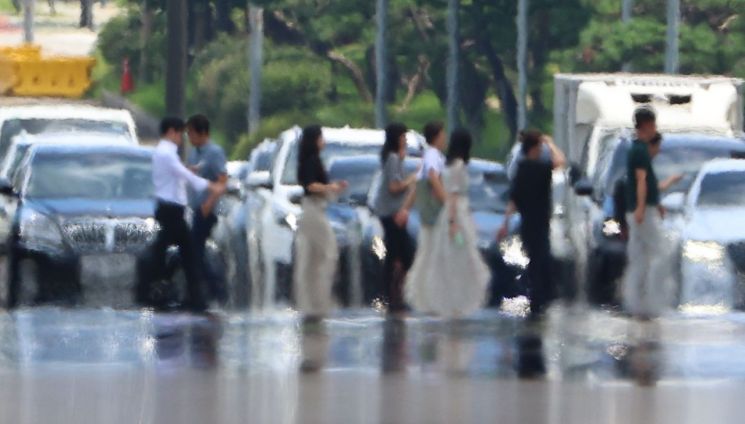 On the 27th, after the rainy season ended and the intense heat began, heat haze caused by ground heat is rising above Yeouidaero in Seoul. Photo by Yonhap News
Earlier, the Copernicus Climate Change Service (C3S), the EU's climate change monitoring agency, reported that temperatures up to July 15 this year were the highest since observations began in 1940, forecasting that this July would be the hottest on record. Last month was also the hottest June ever recorded, with C3S announcing that the global average temperature was 0.53 degrees higher than the June average from 1991 to 2020.
The warming Earth is also affecting the Korean Peninsula. Especially during summer, when heavy rains·heatwaves alternate, the effects of global warming are felt more intensely. The rainfall patterns during the monsoon season have also changed from traditional patterns, with heavy rain pouring down in a short time or sunny weather occurring even during the monsoon period.
Additionally, strong localized heavy rains frequently occur after the monsoon season. Reflecting these weather phenomena, the term "monsoon," which has been used for 500 years, is being replaced with the term "rainy season" used in subtropical regions. The Korea Meteorological Administration defined the rainy season in a monsoon white paper published in October last year as a period during which the average precipitation exceeds 4mm continuously. The period of rainfall around July lasting about a month is classified as the monsoon season or the first rainy season, and the period when the rain stops for a while and then rainfall exceeding 7mm occurs again is classified as the second rainy season.
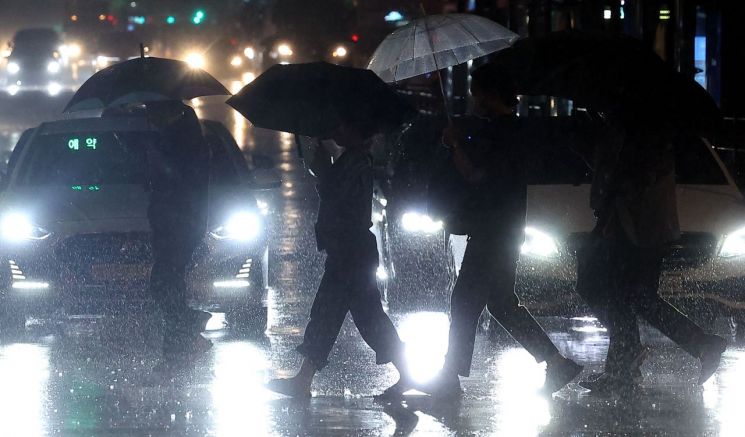 On the afternoon of the 4th, when a heavy rain advisory was in effect throughout Seoul, citizens are walking with umbrellas in Gwanghwamun Square, Seoul. Photo by Yonhap News
Currently, Korea's monsoon season has ended, and the heatwave has begun. Heatwave warnings have been issued nationwide, and tropical nights (nighttime minimum temperature above 25 degrees Celsius) continue mainly in the metropolitan and coastal areas. On the east coast of Gangwon Province, tropical nights have persisted for six consecutive days as of the 28th.
There are also forecasts that this summer's heat could surpass the worst heatwave in 2018. On August 1 of that year, Seoul recorded 39.6 degrees Celsius, and Hongcheon County in Gangwon Province recorded 41.0 degrees Celsius, setting the highest temperature since weather observations began, and the number of heatwave days also broke the record. Maeng Soyoung, CEO of Weather Communications, said, "This summer in Korea is also expected to be challenging due to the heat dome phenomenon, where high humidity and temperature persist."
On the 28th, Maeng explained on YTN Radio's "News King with Park Jihoon," "This year, the El Ni?o is a super El Ni?o about three to four times stronger than usual," adding, "While the Earth's average temperature is rising due to global warming, the heat dome phenomenon is occurring as the Earth is trapped in a massive heat pocket caused by the temperature rise from El Ni?o."
There are also predictions that extreme heatwaves and heavy rains will repeat every year. On the 28th, Son Seokwoo, a professor in the Department of Earth and Environmental Sciences at Seoul National University, said on SBS Radio's "Kim Taehyun's Political Show," "Heavy rains and dry spells alternate, but the overall trend is upward, and extremes will repeat," adding, "Overall, temperatures are expected to warm, and rainfall is expected to increase."
© The Asia Business Daily(www.asiae.co.kr). All rights reserved.


















