AJ Networks and Doosan Secure Demand Exceeding 2-3 Times Issuance Amount
High Demand for Priority Allotment of IPO Stocks Amid Market Recovery
Limited to Some Companies with Improved Credit Ratings... Polarization Persists
Following the Legoland incident, bond issuances by companies with credit ratings at BBB level (BBB+, BBB, BBB-) or below, which had faced extreme difficulties in raising funds, are being successfully completed one after another. It is interpreted that high-yield fund capital, which invests in high-interest bonds, is flocking to BBB-level bonds. High-yield funds have been growing recently as they offer tax benefits and the right to receive new shares of listed companies preferentially during initial public offerings (IPOs).
Entering the Public Bond Market and Securing Excess Demand One After Another
Recently, BBB-level companies have consecutively entered the public market and secured investment demand exceeding the issuance amount. AJ Networks (BBB+) conducted a demand forecast (bidding) to issue 30 billion KRW worth of corporate bonds and gathered institutional investor demand worth 85 billion KRW at the desired interest rate. Thanks to the overwhelming investment demand, the company was able to raise funds by increasing the issuance amount to 35 billion KRW at an interest rate lower than initially proposed. The bond issuance was jointly underwritten by Eugene Investment & Securities, NH Investment & Securities, and SK Securities.
Earlier, Doosan (BBB), the holding company of the Doosan Group, received bids worth 93 billion KRW, about three times the planned issuance amount (30 billion KRW), during its corporate bond demand forecast. Doosan succeeded in issuing 43 billion KRW of bonds at 5.741%, which is 80 basis points lower than the average market interest rate evaluated by private bond rating agencies. The issuance was underwritten by Korea Investment & Securities, KB Securities, Kiwoom Securities, and Mirae Asset Securities.
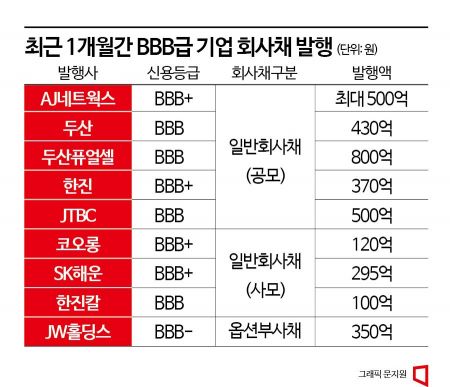
Prior to this, Hanjin (BBB+) and Doosan Fuel Cell (BBB), which conducted corporate bond demand forecasts, also succeeded in securing the desired amount of funds by attracting investment demand twice and six times their target amounts, respectively. Kolon, SK Shipping, and Hanjin Kal issued private placement bonds worth 12 billion KRW, 29.5 billion KRW, and 10 billion KRW, respectively, by finding investment demand in the market without going through public offering procedures such as demand forecasts. JW Holdings raised 35 billion KRW by issuing privately placed option bonds with early redemption rights (call options).
Tax and IPO Share Priority Benefits Boost High-Yield Fund Impact
The investment banking (IB) industry views that most of the investment demand flocking to BBB-level corporate bonds comes from high-yield funds. High-yield funds are funds that invest in relatively low-credit, high-interest bonds to generate returns. To facilitate the smooth circulation of funds for low-credit companies, the government decided to provide tax benefits on interest and dividend income for high-yield funds starting this year. To qualify for tax benefits, the fund must hold at least 60% domestic bonds and at least 45% corporate bonds rated 'BBB+ or below.'
In addition to tax benefits, preferential allocation of IPO shares is also granted. Listed companies and IPO underwriters must allocate up to 5% of IPO shares preferentially to high-yield funds. Starting next year, the preferential allocation of KOSDAQ IPO shares is expected to increase from the current 5% to 10%. An IB industry official said, "As IPO volumes gradually increase due to rising stock prices, high-yield fund capital aiming for IPO share allocations is also increasing," adding, "They are playing a liquidity role like rain in a drought for BBB-level companies."
However, there is also an assessment that the warmth of high-yield funds is limited to some BBB-level companies. It is pointed out that investment demand is concentrated only on companies within the BBB level whose performance or financial structure is improving. Companies that do not meet these criteria find it difficult to issue corporate bonds and resort to other means such as secured bonds. An industry insider said, "Even within the BBB level, companies whose credit ratings continue to deteriorate or are lower find high-yield fund capital to be 'a pie in the sky,'" adding, "Companies without sufficient collateral have no choice but to turn to the ultra-short-term finance market."
© The Asia Business Daily(www.asiae.co.kr). All rights reserved.
![Clutching a Stolen Dior Bag, Saying "I Hate Being Poor but Real"... The Grotesque Con of a "Human Knockoff" [Slate]](https://cwcontent.asiae.co.kr/asiaresize/183/2026021902243444107_1771435474.jpg)
















