The three major indices of the U.S. New York stock market showed an upward trend in early trading on the 27th (local time) as they digested the results of the Federal Open Market Committee (FOMC) regular meeting, better-than-expected second-quarter economic growth rate, and major corporate earnings. The Nasdaq index, centered on technology stocks, rallied around 1.5% on expectations that the Federal Reserve's (Fed) rate hike the previous day might be the last.
At around 10 a.m. at the New York Stock Exchange (NYSE), the Dow Jones Industrial Average, composed of blue-chip stocks, was trading at around 35,590, up 70.72 points (0.2%) from the previous close. If it closes the day higher, it will mark a 14-trading-day consecutive rally, the longest since the Dow was created in 1897. The large-cap S&P 500 index rose 35.07 points (0.77%) to 4,601, while the tech-heavy Nasdaq index was up 201.31 points (1.42%) at 14,328.
Currently, within the S&P 500, stocks related to telecommunications, technology, discretionary consumer goods, real estate, and staples are rising, while financials, energy, industrials, and utilities are declining. Telecommunications stocks are up more than 3%. Technology and discretionary consumer goods stocks also rose more than 1%. Meta Platforms, which reported better-than-expected Q2 earnings and guidance after the previous day's close, surged over 8%. Alphabet (Google) rose 2%, and Nvidia increased more than 3%. McDonald's and Comcast also posted better-than-expected earnings, rising about 1.7% and 7.7%, respectively. On the other hand, Chipotle Mexican Grill fell more than 9% due to disappointing earnings released the previous day.
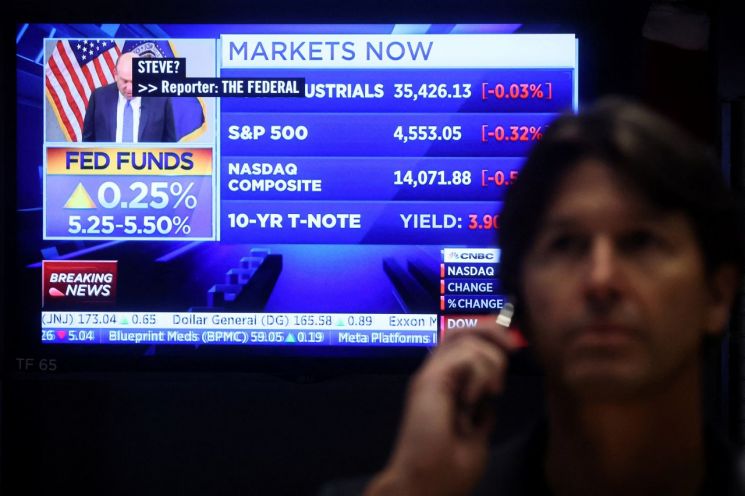
Investors are closely watching the results of the FOMC regular meeting and Chairman Jerome Powell's press conference from the previous afternoon, as well as the U.S. second-quarter gross domestic product (GDP) growth rate released that morning. The Fed raised interest rates by 0.25 percentage points from 5.0-5.25% to 5.25-5.5%. This resumption of rate hikes came just one month after a pause for a 'breather.' In the subsequent press conference, Chairman Powell left open the possibility of both a rate hike and a pause in September. When asked about the possibility of holding rates steady in September, he said, "No decisions have been made regarding the pace of rate hikes or future meetings," adding, "If the data supports it, raising rates at the September meeting is possible. Maintaining rates depending on the data is also possible." There are only three remaining FOMC meetings this year: September, November, and December, with the next meeting scheduled for September 19-20.
Despite Powell's ambiguous remarks, the market largely expects the Fed not to raise rates further this year. According to the Chicago Mercantile Exchange (CME) FedWatch tool, the federal funds (FF) futures market currently prices in a 76% chance that the Fed will hold rates steady at the September FOMC meeting. Following the Fed, the European Central Bank (ECB) raised its policy rate by 0.25 percentage points from 4.00% to 4.25%, marking its ninth consecutive hike. Unlike before, the ECB did not clearly signal further rate hikes, leading to analysis that the pace of ECB rate increases may slow down.
The U.S. second-quarter GDP growth rate released that day was 2.4% annualized, exceeding both the first quarter's 2.0% and market expectations of 2.0%. The U.S. Department of Commerce cited increased consumer spending, non-residential fixed investment by businesses, and federal and local government spending as contributing factors. The second-quarter personal consumption expenditures (PCE) price index rose 2.6%, significantly below the market forecast of 3.2%, indicating easing inflationary pressures. The first quarter's increase was 4.1%.
Despite over a year of tightening, strong U.S. economic indicators have eased concerns about a recession this year. Economic media CNBC reported, "The GDP data signals that the U.S. economy is more resilient than expected, and signs of sustained inflation easing suggest a recession can be avoided." Jeremy Siegel, professor at the University of Pennsylvania's Wharton School, appeared on CNBC's Squawk Box and said, "The very high rates that surprised me and the market earlier this year do not seem to have had as negative an impact as I feared," adding, "This is very positive for the market." Chairman Powell also reaffirmed the possibility of a soft landing for the U.S. economy the previous day.
The unemployment data released the same day also indicated a robust U.S. labor market. According to the U.S. Department of Labor, initial jobless claims for the week of July 16-22 fell by 7,000 to 221,000, marking a third consecutive weekly decline and the lowest level in five months since February. Continuing claims, for those receiving unemployment benefits for at least two weeks, decreased by 59,000 to 1.69 million, the lowest since January.
The personal consumption expenditures (PCE) price index, the Fed's preferred inflation gauge, will be released the following day. The U.S. core PCE price index for June is expected to have risen 4.2% year-over-year, down from 4.6% the previous month. Earnings reports from major companies are also ongoing. According to FactSet, 81% of S&P 500 companies that have reported so far have exceeded analysts' expectations.
In the New York bond market, Treasury yields are rising. The 10-year U.S. Treasury yield is around 3.93%, and the 2-year Treasury yield, sensitive to monetary policy, is around 4.91%. The dollar index, which measures the value of the U.S. dollar against six major currencies, is up more than 0.8% from the previous close at 101.7.
European stock markets are also rising. Germany's DAX index is up 1.61%, France's CAC index has risen more than 2%, and the UK's FTSE is trading slightly higher.
© The Asia Business Daily(www.asiae.co.kr). All rights reserved.

















