First Reconstruction Project in Godeok Housing Site and Myeonildong Area
Seoul City Establishes Long-term Comprehensive Plan to Promote Reconstruction
The 38-year-old Godeok Hyundai Apartment in Myeongil-dong, Gangdong-gu, Seoul, will be reborn as a new apartment complex with around 940 households in approximately 50-story buildings. This is the first redevelopment project in the Godeok housing site area of Myeongil-dong, developed in the 1980s, and the Seoul Metropolitan Government plans to establish a long-term comprehensive plan for systematic redevelopment in this area.
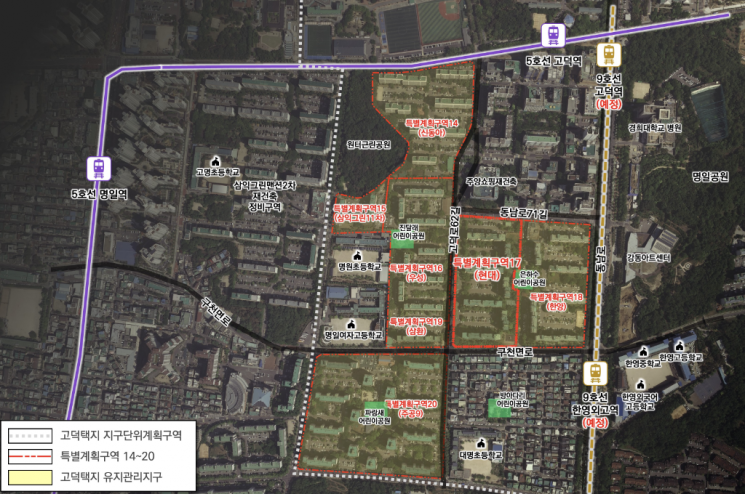
On the 28th, Seoul announced the confirmation of the rapid integrated planning for the redevelopment of Godeok Hyundai Apartment. Although redevelopment has been pursued since 2018, progress was delayed due to conflicts among residents regarding whether to integrate redevelopment with the adjacent Hanyang Apartment. By presenting planning guidelines that consider both ‘individual redevelopment’ and ‘integrated redevelopment’ alternatives, the redevelopment project has now been put on the right track.
According to the rapid integrated planning proposal, Godeok Hyundai Apartment will be redeveloped into approximately 940 households in buildings around 50 stories high, harmonizing pedestrian spaces and green areas.
First, to ensure harmonious development at the district level of the Godeok housing site, integrated planning guidelines including the adjacent Hanyang Apartment were prepared. A public pedestrian passageway shared between Hyundai Apartment and Hanyang Apartment, which are adjacent along the site boundary, will be arranged, and infrastructure such as roads and pedestrian facilities, as well as building skylines, will be planned comprehensively.
In particular, the city plans to apply relaxed building regulations, such as easing sunlight restriction conditions on adjacent sites when residents of the two complexes agree, so that even if the two complexes pursue individual redevelopment, they can still enjoy the benefits of integrated development. As a result, despite the limited site conditions, ultra-high-rise development (from 35 floors to around 50 floors) has become possible for Godeok Hyundai Apartment.
Secondly, the residential complex, which was previously centered on vehicles and parking lots, will be transformed into a pedestrian-centered, safe, and vibrant residential area. The city plans to apply flexible height planning to create abundant green spaces within the complex and connect them by pedestrian pathways to activate the resident community.
Since the opening of Hanyeong Foreign Language High School Station on Subway Line 9 is scheduled near the site, a change in the status of the area as a station district is expected. Thirdly, in preparation for the potential of the new station district and the increase in floating population, the city plans to relocate Eunhasu Park to the station district area in connection with the redevelopment of the adjacent Hanyang Apartment and utilize it as a space for various activities.
Meanwhile, besides Godeok Hyundai Apartment, there are several complexes in the Myeongil 2-dong area built in the mid-1980s that have reached the time for redevelopment. Accordingly, the city is also establishing a long-term comprehensive plan for systematic residential area maintenance. Along with the establishment of the rapid integrated planning for Godeok Hyundai Apartment, preparatory procedures for revising the district unit plan of the Godeok housing development district are also underway.
Jo Nam-jun, Director of the Seoul Metropolitan Government’s Urban Planning Bureau, said, “Apartments in housing development districts created in the 1980s, such as Godeok (Myeongil), Mok-dong, and Sanggye, have reached their redevelopment time,” and added, “Through rapid integrated planning, we will reorganize the vehicle-centered urban structure of the past and create a new urban blueprint that harmonizes pedestrian spaces and green areas.”
© The Asia Business Daily(www.asiae.co.kr). All rights reserved.
![User Who Sold Erroneously Deposited Bitcoins to Repay Debt and Fund Entertainment... What Did the Supreme Court Decide in 2021? [Legal Issue Check]](https://cwcontent.asiae.co.kr/asiaresize/183/2026020910431234020_1770601391.png)