Digital therapeutics (DTx) and artificial intelligence (AI) imaging diagnostic medical devices will be covered by the National Health Insurance (NHI). DTx took its first step toward NHI coverage just over five months after the approval of the 'first domestic DTx' in February, while AI medical devices are making their debut in NHI coverage more than five years after the first domestic AI medical device was approved in May 2018.
On the afternoon of the 26th, the Ministry of Health and Welfare held the '13th Health Insurance Policy Deliberation Committee in 2023' to discuss the 'DTx·AI provisional listing plan' and announced that it will prepare a plan for NHI coverage of these technologies by September.
Currently, although domestic regulations for approval of DTx and AI medical devices are becoming international standards, concerns have persisted that the lack of proper commercialization regulations could hinder industry growth. In fact, despite five years having passed since the first approval of AI medical devices, some devices are still used as non-reimbursed in Korea. Consequently, most AI medical device companies have focused on overseas markets with established regulations rather than domestic ones, resulting in a distorted structure where overseas sales account for a larger share.
Covered under 'Selective Benefits' with 10% support or Non-Reimbursed
However, with the release of provisional listing guidelines for DTx and AI medical devices, these concerns are expected to be resolved for the time being.
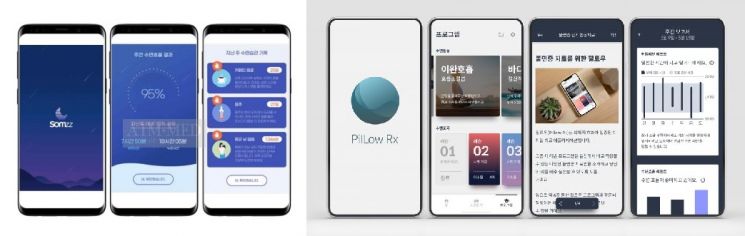 The Ministry of Food and Drug Safety approved digital therapeutic devices (DTx), Aimmed's 'Somz' and Welt's 'PillowRx' (from left)
 [Photo by each company]
The Ministry of Health and Welfare has allowed non-reimbursed use for medical devices recognized through the 'Integrated Review and Evaluation of Innovative Medical Devices' system for digital healthcare technologies such as AI and DTx since October last year. However, as demands for NHI coverage have continued, the plan is to temporarily assign health insurance codes to provisionally list these devices under NHI for up to three years, after which formal listing will be decided through health technology assessments.
For DTx, companies will be given the option to choose between non-reimbursed or selective benefits (10%) for fee determination. Selective benefits is a system that reimburses with a higher patient co-payment rate when treatment effectiveness or cost-effectiveness is uncertain. Since real-world data (RWD) for DTx has not yet been secured, applying selective benefits is intended to encourage proof of effectiveness.
A Ministry of Health and Welfare official explained, "Since innovative medical technologies have existing alternative medical technologies, we will apply health insurance fees in the form of selective benefits, but if companies want to be evaluated in the market, they will be given the opportunity to choose non-reimbursed." However, to prevent potential misuse when choosing non-reimbursed, plans are in place to monitor and manage this through mandatory claims and reporting of non-reimbursed amounts.
The DTx industry, considering that the industry is still in its early stages, views inclusion in the NHI as a priority to gain public trust and expand its base, showing a stronger preference for selective benefits. An industry representative said, "Since it is recognized by the government, it can have credibility, and patients can reduce their cost burden by receiving even 10% support. However, medical institutions may prefer non-reimbursed, so the debate is ongoing."
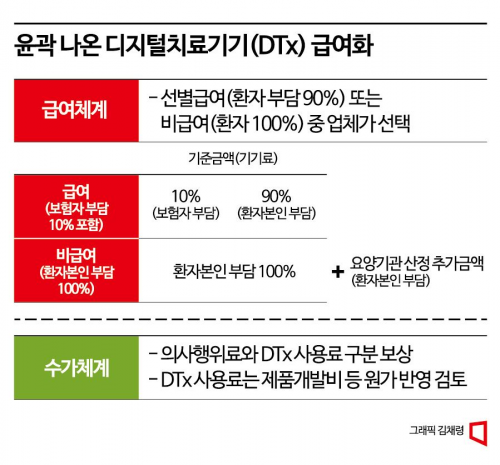
The fees are composed of medical service fees such as prescription and education (prescription fee), post-use evaluation (effectiveness evaluation fee), and DTx usage fees. The service fees are likely to be set at a similar level to overseas prices, which are around 10,000 to mid-10,000 KRW. The application (app) usage fee will be determined based on product development costs, the amount requested by the developer, and foreign cases.
The Ministry of Health and Welfare plans to establish and distribute detailed guidelines for NHI coverage, including basic principles for provisional listing and fee calculation methods, by next month.
AI Fees as 'Add-on Fees'
AI medical devices will also be given the option of non-reimbursed or selective benefits like DTx, and when covered, fees will be applied as add-ons to existing fees by categorizing fields into similar categories. This method is already used in Japan, which has a public insurance system similar to Korea’s.
For example, in Japan, if the fee for X-ray imaging is 10,000 KRW, an additional 3,000 to 4,000 KRW is added when AI is used for diagnosis. The patient’s co-payment remains the same as for general X-ray imaging.
An AI medical device company official said, "Previously, AI medical devices were mostly used for research purposes domestically. If fees are applied, it is expected that the devices will be widely distributed for diagnostic medical purposes in actual clinical settings, thereby expanding the base."
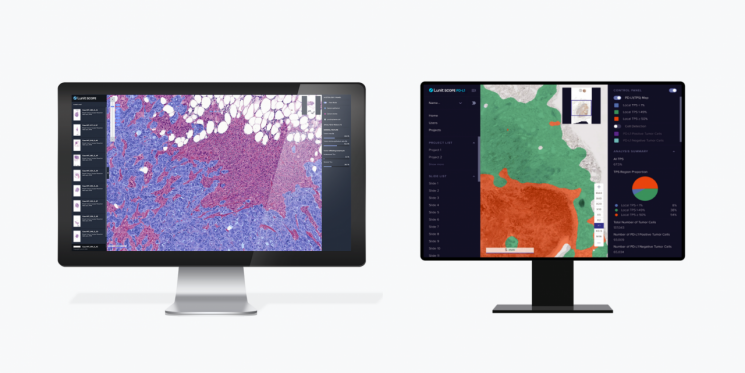 Lunit's AI biomarker platform 'Lunit Scope IO (left)' and AI pathology analysis solution 'Lunit Scope PD-L1'
 [Photo by Lunit]
Additionally, it is expected to become easier to inform patients that AI enables more accurate diagnoses and to allow AI testing and diagnosis under non-reimbursed coverage. However, since this could lead to provider-centered overuse, measures to prevent excessive non-reimbursed use are also being considered.
A Ministry of Health and Welfare official said, "While considering the principles of health insurance, we expect to establish a virtuous cycle that provides various opportunities in the field of innovative medical technologies. We will continue to collect and supplement policy outcomes and field opinions in the future."
© The Asia Business Daily(www.asiae.co.kr). All rights reserved.
![Clutching a Stolen Dior Bag, Saying "I Hate Being Poor but Real"... The Grotesque Con of a "Human Knockoff" [Slate]](https://cwcontent.asiae.co.kr/asiaresize/183/2026021902243444107_1771435474.jpg)


















