Concerns Over Russian Attacks on Black Sea Merchant Ships Lead to Alternative Export Routes
Eastern European Countries Oppose Amid Domestic Grain Price Collapse
The European Union (EU) has announced that it is considering rerouting all Ukrainian grain exports, which have been blocked after Russia's termination of the Black Sea Grain Initiative, through land routes passing through EU member states, sparking controversy. Although this measure is unavoidable to prevent a global food crisis, significant difficulties are expected as Eastern European countries, concerned about the huge costs of replacing maritime transport with land transport and the risk of a collapse in domestic grain prices, have expressed opposition.
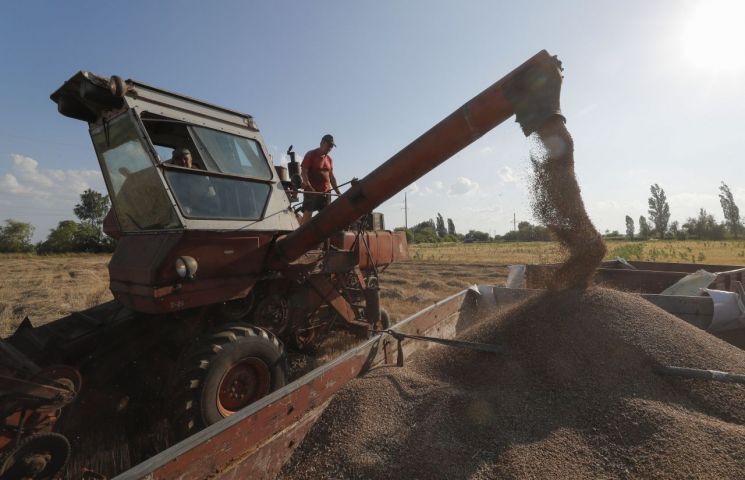
According to Euronews on the 25th (local time), Janusz Wojciechowski, the EU Commissioner for Agriculture, said at a press conference after the EU Agriculture Ministers' meeting held in Brussels, Belgium, "We are ready to export almost all Ukrainian export volumes through the 'Solidarity Lanes.' Until just before Russia terminated the Black Sea Grain Initiative, 60% of Ukraine's total export volume was exported through the Solidarity Lanes, with the remaining 40% exported via the Black Sea as before."
He added, "If all Ukrainian grain is exported through the Solidarity Lanes, it would amount to about 4 million tons per month, and there was already a case last November where 4 million tons passed through EU territory." This statement emphasizes that it is possible to transport the entire volume of Ukrainian grain using the land-based rerouting route.
The Solidarity Lanes emphasized by him refer to the rerouting routes established to export some Ukrainian grain through Eastern European EU member states bordering Ukraine and then through Baltic Sea ports instead of the Black Sea. Since the war in Ukraine, as Russia has bombed major grain export ports in the Black Sea, the proportion of grain exports via the Solidarity Lanes has gradually increased.
However, to implement this plan, the consent of the Eastern European countries along the Solidarity Lanes must be obtained, but these countries strongly oppose it, making difficulties expected. The Eastern European countries located along the main sections of the Solidarity Lanes include Poland, Slovakia, Hungary, Romania, and Bulgaria.
The reason these Eastern European countries oppose using the grain export rerouting routes is that the subsidies for changing the grain transport routes must be handled through the EU budget, and there is also a high risk of a collapse in domestic grain prices. Eastern European countries, including Poland, have repeatedly conveyed their opposition to the EU, citing a sharp decline in domestic grain prices and growing protests from local farmers.
These countries previously requested, starting in April, a temporary measure to ban the direct import of some Ukrainian grain into their countries and only allow transit of volumes exported to third countries. The EU accepted this on the condition of a five-month term. At this EU Agriculture Ministers' meeting, these five countries also requested an extension of the ban on direct imports of Ukrainian grain until the end of the year.
© The Asia Business Daily(www.asiae.co.kr). All rights reserved.
![Clutching a Stolen Dior Bag, Saying "I Hate Being Poor but Real"... The Grotesque Con of a "Human Knockoff" [Slate]](https://cwcontent.asiae.co.kr/asiaresize/183/2026021902243444107_1771435474.jpg)
















