[Electric Vehicle Golden Egg Waste Battery]②
Securing Stable Waste Batteries
Overcoming Technical Limitations Needed
Confirming Complete Discharge Required
Securing a stable supply of used batteries is a priority to generate profits in the battery recycling business. Cost-effectiveness must be maximized through mass production. However, even if a sufficient quantity of batteries is available, there is a problem. The first recycling process involves manually unscrewing the screws embedded in the battery’s metal case to dismantle it, and the labor costs for this manual work pose a burden for recycling companies.
It is difficult to automate this process because battery shapes and sizes vary greatly. Hyungdeok Kim, Director at Sungil Hightech, recently stated at a battery-related seminar, "As the volume of used batteries increases, more personnel must be hired to dismantle the batteries accordingly," adding, "Rising labor costs make it difficult to maintain cost competitiveness."
Overcoming technical limitations is also necessary. While increasing metal recovery rates, safety must also be ensured, which is not easy with current technology. The key is recovering lithium, the core material of ternary lithium-ion batteries. Lithium is difficult to handle because it explodes when exposed to fire and dissolves in water.
Recycling technology for LFP batteries, which global automakers like Tesla and Mercedes-Benz are increasingly adopting to lower electric vehicle prices, is also required. Director Kim said, "As the price of lithium iron phosphate rises, the recycling value of LFP batteries is expected to increase," adding, "Since LFP batteries have lower metal value than ternary batteries, developing economically viable processes is important."
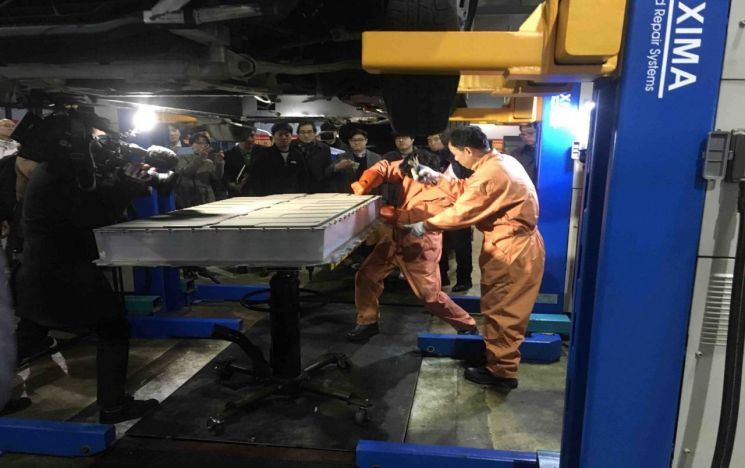
To prevent fires and explosions, it is also necessary to confirm complete discharge. If even a small amount of electricity remains in used battery cells, there is a risk of explosion during the crushing process in recycling. The simplest discharge method is 'brine discharge,' where cells are immersed in saltwater. However, this method takes a long time.
Batteries separated into units such as packs, modules, and cells are submerged in saltwater for three days to discharge them. Even after complete discharge, extracting metals is difficult when the batteries are wet, so drying is required, which can take up to ten days. As electric vehicle adoption increases, using brine discharge becomes more challenging.
A method that reduces processing time compared to brine discharge is electrical discharge. This involves applying electrical resistance to generate heat and eliminate the electricity inside the cell. A simpler method is physical discharge, which punctures the cell with a sharp object. Director Kim explained, "Physical discharge carries the risk of sparks during the shock process if even a small amount of electricity remains," adding, "Usually, a combination of these three methods is used for discharge."
Wastewater discharge is also an issue, drawing protests from residents near recycling plants. Director Kim said, "How to treat wastewater inevitably generated from chemical wet processes remains a challenge." Currently, recycling centers equipped with wastewater treatment facilities are being constructed. Among domestic companies, Sungil Hightech and Young Poong are developing recycling technologies that do not produce wastewater and are preparing to apply these processes.
© The Asia Business Daily(www.asiae.co.kr). All rights reserved.
![Clutching a Stolen Dior Bag, Saying "I Hate Being Poor but Real"... The Grotesque Con of a "Human Knockoff" [Slate]](https://cwcontent.asiae.co.kr/asiaresize/183/2026021902243444107_1771435474.jpg)
















