OECD 'Government at a Glance 2023'
The public trust in the Korean government was found to exceed the average level of OECD countries. Satisfaction with public services was also high. In particular, the satisfaction of Korean citizens with medical services ranked third highest among the surveyed countries.
According to the OECD's "Government at a Glance" report published on the 26th, a survey on trust in national governments was conducted in 2021 among citizens of 22 OECD countries. On average, 4 out of 10 people (41%) responded that they had high or moderate trust in their national government. Korea scored higher than this. Nearly half of the citizens (48.8%) responded that their trust in the government was high or moderate.
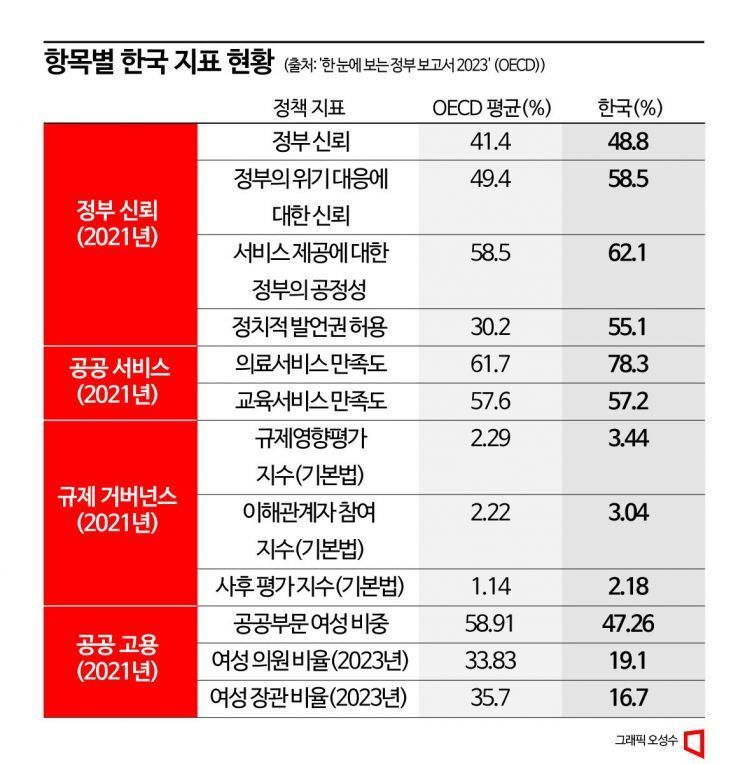
In particular, the degree to which people felt they had political voice in government affairs (55.1%) greatly exceeded the OECD average (30.1%). This was the highest score among the 22 countries surveyed. Satisfaction with the government's responsiveness to public grievances (57.7%) and the possibility of reflecting public opinions through open consultations (48.5%) also ranked highest among all surveyed countries. The OECD averages were only 40.2% and 32.9%, respectively. Trust in the government's crisis response (58.1%) and belief in the fairness of government service delivery (62.1%) were also higher than the OECD averages.
Public Service Satisfaction Also Higher Than Average
Satisfaction with public services such as healthcare, education, and judiciary among Korean citizens was also higher than the average. In particular, most citizens (78.3%) were satisfied with healthcare services, which is more than 10 percentage points higher than the OECD average (61.7%). Korea ranked third in satisfaction among the 21 countries surveyed. The country with the highest satisfaction in healthcare services was Switzerland (92%). Despite relatively high out-of-pocket expenses, Switzerland scored high in accessibility and quality. Satisfaction with education services was similar to the OECD average (57.6%) at 57.2%. Satisfaction with administrative services was 75.1%, which is 12.1 percentage points higher than the OECD average (63.0%).
The level at which the government gathers stakeholders' opinions when making policies also exceeded the OECD average. The "Stakeholder Participation Index" (for basic law development), which evaluates whether sufficient opportunities are provided for businesses, citizens, and stakeholders to raise objections during the regulatory design process, was 3.44. The OECD average was 2.29.
The report analyzed, "Both the early stage (when the government collects data and ideas for problem-solving) and the later stage (consultation on draft regulations) can involve stakeholders in regulatory development. Among the 38 OECD countries with available data, only 7 countries (18%) and the EU systematically communicate with stakeholders from the early stage." The "Regulatory Impact Assessment Index," which indicates whether specific information on potential budgetary, financial, and administrative costs arising from regulations is provided, also recorded 3.44, exceeding the average (2.29).
The proportion of women in public employment fell short of the OECD average. The share of women in Korea's public sector was 47.26%, about 10 percentage points lower than the average (58.91%). Among the 40 countries surveyed, Korea ranked fifth lowest in the proportion of women in the public sector. The proportion of female lawmakers this year was also below the average (33.83%), at 19.1%. The proportion of female ministers was similarly low. The OECD average was 35.7%, but Korea recorded only 16.7%.
© The Asia Business Daily(www.asiae.co.kr). All rights reserved.

















