Commercialization of Autonomous Navigation Technology in Shipbuilding Industry Approaching
Operating Ships Without Crew Deemed 'Illegal'
Legal Liability and Insurance Systems Lagging Behind
Ships equipped with advanced autonomous navigation technology that allows remote operation without crew members on board are expected to soon navigate rivers and seas. Shipbuilders are accelerating the development of autonomous vessels, viewing them as a future growth engine.
However, under current laws, operating a ship without a certain number of crew members on board is illegal. There are calls to expedite institutional preparations regarding the roles, legal responsibilities, and insurance systems for autonomous operators before autonomous vessels become widespread.
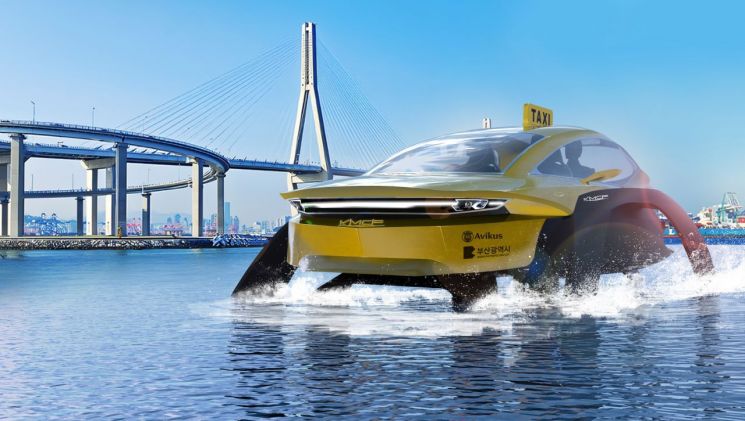 Perspective rendering of a future maritime taxi equipped with HD Hyundai Abicus' autonomous navigation solution
The shipbuilding industry is developing autonomous navigation technology at Level 3 of the International Maritime Organization (IMO) standards, which enables remote operation without crew on board. Level 1 autonomy assists crew members by supporting perception and decision-making, while Level 2 systems handle perception, decision-making, and control but the navigator remains responsible. Levels 3 to 4 involve systems managing perception, decision-making, and control, with human intervention only in emergencies. These are essentially unmanned vessels without crew on board.
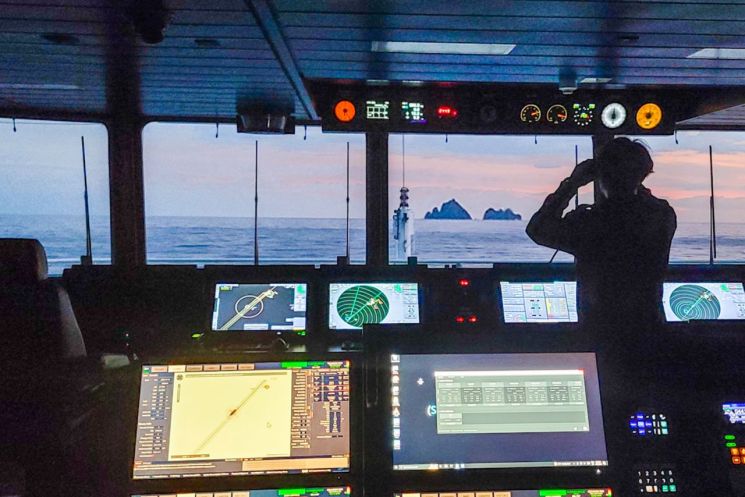
Shipbuilders plan to complete the development of fully autonomous navigation technology and launch unmanned vessels at sea as early as next year. HD Hyundai Avikus has developed the large commercial vessel autonomous navigation solution 'HiNAS' and entered the practical application phase.
In June last year, Avikus conducted the world's first Pacific crossing test using HiNAS control. By 2025, it plans to introduce solutions at Level 3 or higher. Recently, Avikus signed a memorandum of understanding (MOU) with Busan Metropolitan City's maritime taxi operator (KMCP) to operate autonomous maritime taxis in Busan starting in 2025.
Samsung Heavy Industries developed the remote autonomous navigation system 'SAS' and successfully demonstrated autonomous navigation at sea with a 9,000-ton vessel from Mokpo to Dokdo last year. In March, it signed a joint development agreement (JDA) with Norway's Kongsberg to collaborate on autonomous vessel development.
Hanwha Ocean aims to secure fully autonomous navigation technology by next year. It recently completed technical verification of its autonomous navigation solution and achieved technology levels up to Level 3 according to Lloyd’s Register standards.
Autonomous vessels are also gaining attention as a solution to the crew shortage problem currently troubling the shipping industry. A shipbuilding industry official said, "Over 90% of global logistics are handled by ships, but the crew shortage problem remains unresolved," adding, "More than half of the crew on coastal vessels are over 50 years old, and by 2025, there will be a 20% global shortage of seafarers."
Market research firm MarketsandMarkets forecasts that the global autonomous vessel market will grow from $7.1 billion (approximately 9.1 trillion KRW) in 2019 to $14.3 billion (approximately 18.3 trillion KRW) by 2030, nearly doubling in size.
However, institutional preparations such as defining the roles and legal responsibilities of autonomous vessel operators and developing related insurance are lagging. There is a need to promptly establish definitions, roles, and responsibilities for remote operators. Although the "Act on the Development and Commercialization of Autonomous Vessels" was proposed in the National Assembly last November, further discussions have not progressed. Regulatory improvements, such as minimum crew requirements based on autonomous technology levels, are also essential.
Liability in the event of accidents remains unclear. Traditionally, shipowners, captains, or crew members have borne most responsibility for maritime accidents. However, with autonomous vessels, there is a growing argument that liability should extend to ship or system manufacturers as well.
A shipbuilding industry representative explained, "From Level 3 onwards, responsibility for perception, decision-making, and control lies with the system, so product liability principles should apply, and related insurance is necessary," adding, "While the system handles perception, decision-making, and control, we are developing technology under the assumption that operational responsibility will be assigned to the human operator in case of accidents."
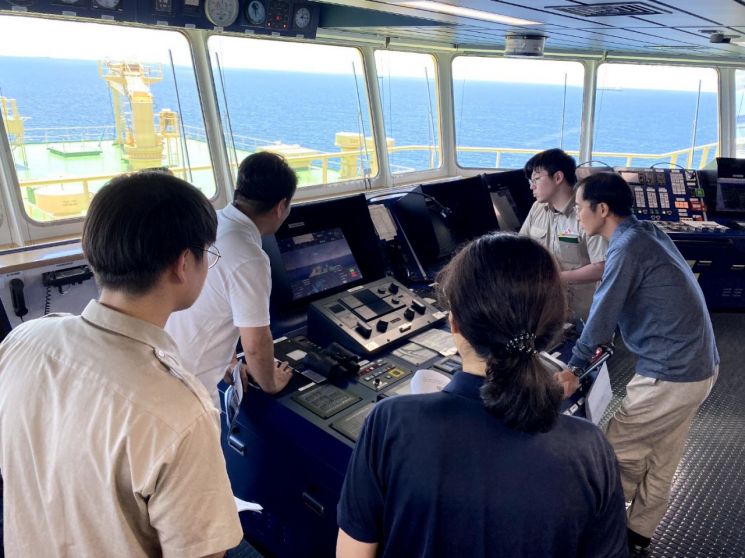 HD Hyundai Abicus and SK Shipping have successfully completed the autonomous ocean crossing of a large commercial vessel. The photo shows the captain and navigator examining Abicus's Hynas 2.0 system.
© The Asia Business Daily(www.asiae.co.kr). All rights reserved.
![Clutching a Stolen Dior Bag, Saying "I Hate Being Poor but Real"... The Grotesque Con of a "Human Knockoff" [Slate]](https://cwcontent.asiae.co.kr/asiaresize/183/2026021902243444107_1771435474.jpg)


















