Compensation for Floods, Heavy Rain, Earthquakes, etc.
Government and Local Authorities Pay Insurance Premiums for 'Pungsuhae Insurance'
Notable Increase in Enrollment of Small Business Shops and Factories
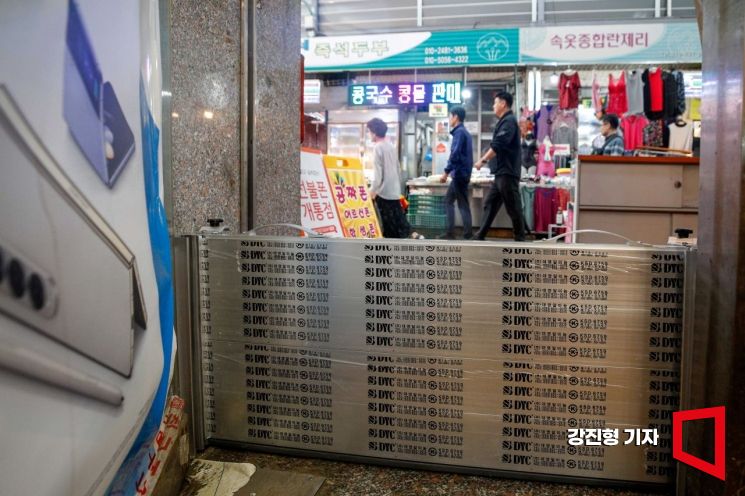 Water barriers have been installed at shops in Sinsa Market, Gwanak-gu, Seoul, which suffered flood damage last year. Photo by Jinhyung Kang aymsdream@
Recently, unprecedented summer monsoon rains have caused massive damage nationwide. Natural disasters caused by heavy rain bring damage to each household every year, but if you properly prepare in advance by utilizing government and local government-supported programs, you can at least cover the cost of damage recovery. You can prepare for risks at the cost of a few meals out, but many bear the economic damage and burden because they are unaware of such programs.
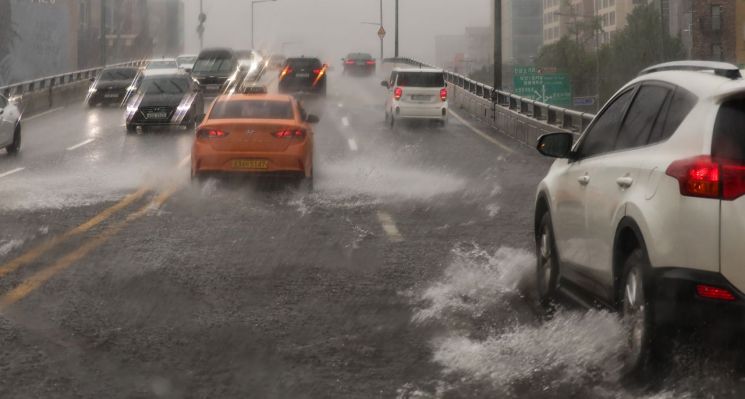
On the afternoon of the 23rd, heavy rain warnings were issued for southern Gyeonggi, the Chungcheong region, Jeonbuk, and the Jeonnam coast, and on the morning of the 24th, strong and heavy rain is expected mainly in the central region, Jeolla region, Chungcheong region, and southern region, raising concerns about damage. Even after the summer monsoon ends, thorough preparation is necessary as typhoons are frequent in August and September.
In this context, the ‘Fengshui Disaster Insurance’ is a useful tool to prepare for risks with a small amount. For an annual cost ranging from 20,000 to 70,000 KRW per year, you can receive compensation for eight types of natural disaster damages including typhoons, floods, heavy rain, tidal waves, strong winds, high seas, heavy snow, and earthquakes. The insurance premium is low compared to the compensation because it is a policy insurance subsidized by the government and local governments covering 70% of the premium (up to 100% for low-income groups).
The fixed-rate plan, which costs about 21,000 KRW per year (standard type), compensates up to 4 million KRW for house flooding and 22.5 to 45 million KRW for damage to houses (including movable property). Even for the same product, if you inquire at the Eup, Myeon, or Dong office (community center) and join as a group insurance, you can save a few thousand KRW more on premiums compared to individual enrollment. There is also a fixed-percentage plan, which unlike disaster relief funds that only partially support a fixed amount depending on the damage scale, can compensate up to 90% of the insured amount depending on the damage. When joining as a group through local governments, low-income groups such as near-poverty households or basic livelihood security recipients, and small merchants in traditional markets can also join for free through third-party donations.
Not only houses but also greenhouses (including vinyl houses) are eligible for enrollment. Since 2020, small business owners (stores and factories) have also been included. Both owners and tenants can enroll.
The enrollment rate among small business owners is rapidly increasing. According to the Ministry of the Interior and Safety, the enrollment rate for small business stores and factories was only 1.0% in the first year of sales in 2020, but it increased to 31.9% last year and rose to 42.9% as of July this year. The enrollment rate for greenhouses increased from 10.3% in 2020 to 15.4% in July this year, and the enrollment rate for houses increased from 20.1% in 2020 to 28.9% in July this year.
Due to the increase in enrollment rates, the Fengshui Disaster Insurance budget, which was 25.1 billion KRW last year, has increased by 11 billion KRW this year to 36.1 billion KRW, according to the Ministry of the Interior and Safety. Kim Young-ae, an official in the Disaster Insurance Division of the Ministry of the Interior and Safety, explained, “Due to steady promotion, enrollment is increasing to the extent that the related budget is exhausted before the end of the year, and even if the budget runs out, enrollment continues,” adding, “The increase in enrollment is particularly noticeable in cities and provinces with a history of Fengshui disaster damage.”
For stores and factories operated by small business owners, enrollment is rapidly increasing because the damage is significant when flooding occurs. In Seongbuk-gu, Seoul, the number of Fengshui Disaster Insurance subscribers was 1,999 cases last year (59 houses, 1,940 stores and factories), but as of July 20 this year, 3,513 cases (45 houses, 3,466 stores and factories) have enrolled, already exceeding 1.5 times last year’s annual subscribers.
When damage actually occurs, you might think the compensation amount is insufficient. However, considering the insurance premiums paid, it is a considerable amount. Especially for residents living in disaster-prone areas, it is worth carefully considering.
© The Asia Business Daily(www.asiae.co.kr). All rights reserved.


















