Baby Boomers "Prefer Not to Arrive Exactly on Time or 1-2 Minutes Early"
MZ Generation "Do Not Prefer to Arrive 20-30 Minutes Early"
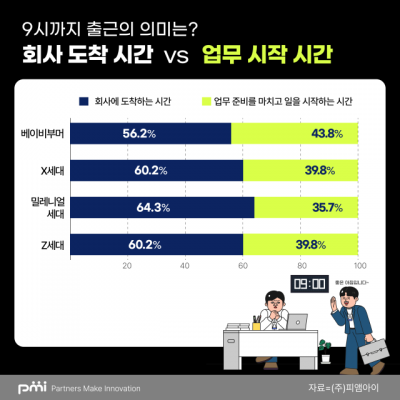
A survey revealed that 6 out of 10 office workers perceive "commuting time" as the time they arrive at the company. In contrast, only 4 out of 10 responded that "commuting time" is the time they start work. Additionally, perceptions of appropriate commuting times differed between younger generations and older generations.
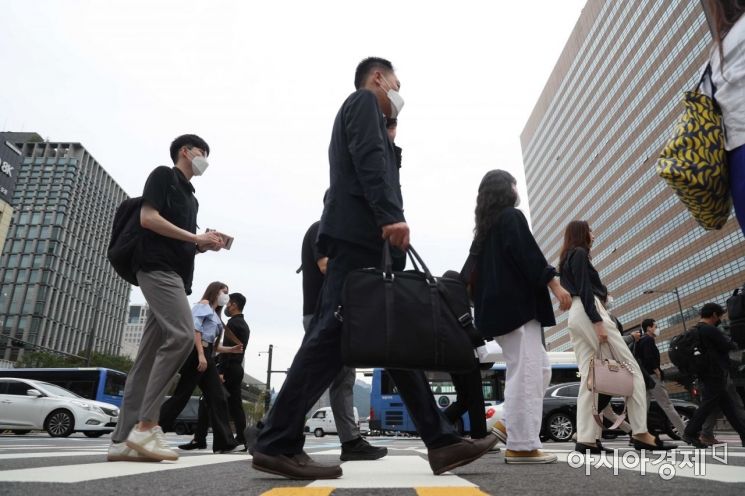 Office workers are hurrying on their way to work at the Gwanghwamun intersection in Seoul. Photo by Moon Honam munonam@
On the 21st, PMi, an online research specialist company, conducted a planned survey on generational perception differences in the workplace targeting 3,000 adults nationwide aged 20 to 69.
The survey results showed that 61% of all respondents answered that commuting time is "the time of arrival at the company." This response accounted for more than half in every generation.
However, there were some differences by generation. Among the so-called "Baby Boomer generation," the older generation, 56.2% responded that commuting time is the time of arrival at the company. On the other hand, 43.8% answered that it is "the time to finish preparing for work and start working," the highest proportion among all generations.
Respondents from Generation X, younger than Baby Boomers, answered 60.2% for "time of arrival at the company" and 39.8% for "time to start work."
The Millennial generation had the lowest proportion answering "time to start work." Only 35.7% of respondents recognized commuting time as "time to start work," while 64.3% answered "time of arrival at the company." The youngest Generation Z had response rates identical to Generation X.
When asked, "If the standard commuting time is 9 a.m., by what time is it desirable to arrive at the company?" all generations showed a preference of over 30% for "arriving 10 minutes early." Baby Boomers and Generation X answered that they did not prefer "arriving exactly on time" or "arriving 1-2 minutes early." In contrast, Millennials and Generation Z did not prefer "arriving 20-30 minutes early."
For Baby Boomers, "arriving 10 minutes early" was the most preferred at 33.6%, followed by "arriving 30 minutes early" at 15.1%, "arriving 20 minutes early" at 14.8%, "arriving 5 minutes early" at 14.0%, and "arriving exactly at 9 a.m." at 12.1%. Generation X showed the highest preference for "arriving 10 minutes early" at 34% among all generations.
Millennials preferred "arriving 10 minutes early" at 31.2%, "arriving 5 minutes early" at 21.7%, "arriving exactly at 9 a.m." at 16.6%, "arriving 1-2 minutes early" at 10.9%, "arriving 20 minutes early" at 9.9%, and "arriving 30 minutes early" at 3.1% in that order.
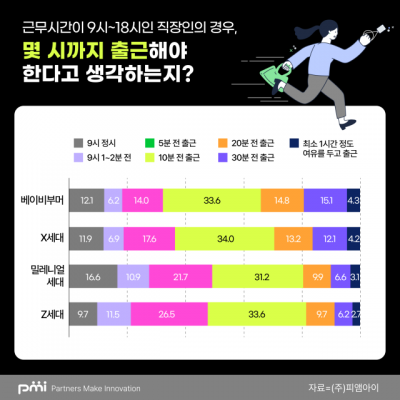
Generation Z also preferred "arriving 10 minutes early" at 33.6%, the same as Baby Boomers. However, the combined proportion of "arriving exactly at 9 a.m.," "arriving 1-2 minutes early," and "arriving 5 minutes early" was 47.8%, accounting for nearly half, the second highest after Millennials.
Meanwhile, more than half of the respondents reported experiencing conflicts at work due to commuting times. 22.3% stated they had "directly experienced" such conflicts, while 36.1% said they had "indirectly experienced" them through colleagues or acquaintances.
In response, Professor Lee Yoon-seok of the Department of Urban Sociology at the University of Seoul said, "Differences in values and behaviors between generations should be recognized as differences rather than conflicts," and added, "At the same time, communication within organizations mediated by understanding, respect, and consideration for individuals should be emphasized."
© The Asia Business Daily(www.asiae.co.kr). All rights reserved.
![Clutching a Stolen Dior Bag, Saying "I Hate Being Poor but Real"... The Grotesque Con of a "Human Knockoff" [Slate]](https://cwcontent.asiae.co.kr/asiaresize/183/2026021902243444107_1771435474.jpg)


















