Ministry of Industry to Announce Business Guidelines Early Next Month
Convenience Store Industry: "Must Consider Costs, Traffic Flow, and Efficiency"
Supermarkets: Environmental Awareness and Energy Saving Costs Are Ideal
Starting next month, the 'Refrigerator Door Installation' project will be fully implemented, eliciting mixed reactions from the distribution industry. While large supermarkets are actively considering adoption due to energy cost reduction and consumer perception, convenience stores are taking a wait-and-see approach, citing store size, traffic flow efficiency, and costs.
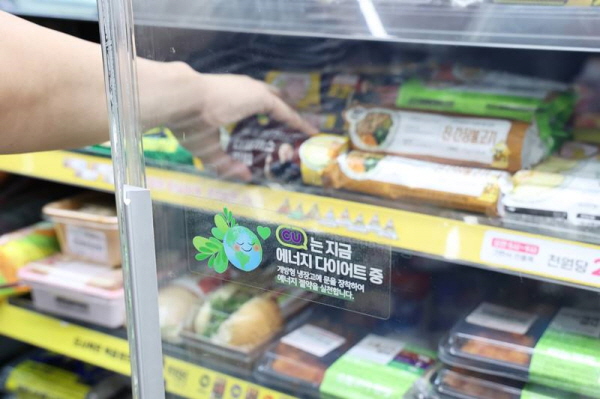
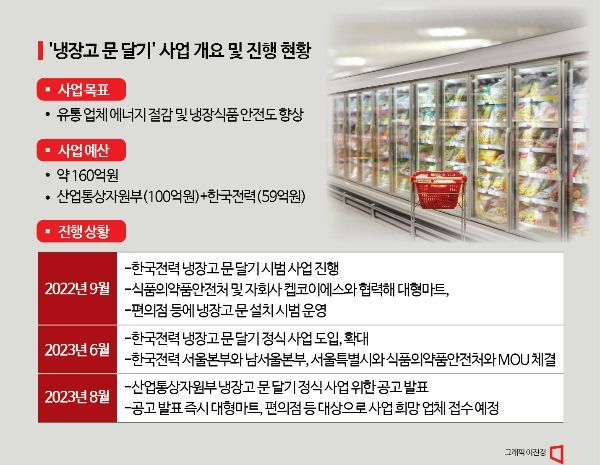
According to industry sources on the 22nd, the Ministry of Trade, Industry and Energy plans to announce guidelines for the refrigerator door installation project as early as the first week of next month. These guidelines will officially specify the refrigerator specifications and types eligible for installation, as well as the scale of subsidies, before the project is fully launched. They are expected to include minimum standards regarding refrigerator safety, insulation, and visibility. Since early this year, the ministry has been conducting a pilot project targeting large supermarkets and convenience stores willing to participate. The results showed that when the refrigerated temperature was set at 5.0℃, the electricity consumption of refrigerators with doors was about one-third that of open refrigerators.
For this project, the ministry nearly doubled the budget for the Strategic Efficiency Improvement Project from 51.8 billion KRW to 96.8 billion KRW. The budget allocated specifically for the refrigerator door installation project is around 10 billion KRW. Starting in August until the budget is exhausted, the ministry plans to support small business owners who install refrigerators with doors that meet the specified requirements by covering 40% of installation costs. Priority support will be given to small supermarkets and convenience store franchises, while voluntary participation will be encouraged among large supermarkets and department stores.
Despite the government's 'unprecedented' support, the convenience store industry is adopting a cautious stance. Unlike large supermarkets, which have large store sizes and multiple floors, convenience stores are smaller, which may cause difficulties in product display when installing refrigerators with doors and could disrupt customer traffic flow. In fact, the average size of domestic convenience stores is about 70㎡ (approximately 21 pyeong), which is very small compared to the typical 300㎡ (about 90 pyeong) size of stores in the US and Japan.
An industry insider from a convenience store said, "If refrigerator doors are installed, during peak hours when customers are crowded, a bottleneck could occur where one customer selects items while another waits behind." They added, "Regardless of government support, there are many practical considerations from the perspectives of store owners and customers, so the prevailing mood in the convenience store industry is to observe and wait."
There are also voices expressing skepticism about applying the energy savings announced by the ministry to real-world situations. They argue that investing expensive costs to participate in the project might result in wasted expenses if the actual energy efficiency is not as significant as announced. A representative from the Korea Convenience Store Industry Association said, "This project involves installing doors on existing refrigerators that have been used for 5 to 6 years, not on new refrigerators, so it is difficult to expect the energy savings announced by the ministry to be fully felt on site." They criticized, "It's like comparing the fuel efficiency of a new car driving on the highway to that of a used car driving in the city, but the ministry is treating these two situations as the same."
On the other hand, large supermarkets view this project as an excellent fit for ESG (Environmental, Social, and Governance) management, considering heightened environmental awareness and energy cost savings. Major large supermarkets (Emart, Lotte Mart, Homeplus) are actively considering expanding the use of refrigerators with doors, which they had been operating on a pilot basis in some stores.
Lotte Mart, which started installing refrigerators with doors at its Cheongnyangni branch in 2021 and had installed them in 60 stores including Zeta Plex as of July this year, plans to add door-type refrigerators to 15 more stores by the end of this year. Emart, which introduced refrigerators with doors for the first time at its Jayang branch in April, also plans to install the same type of hinged doors at its Yeouido branch on the 23rd. Lotte Mart reports that electricity consumption has been reduced by about 30% compared to before with the installation of these refrigerators with doors.
An Emart representative said, "The hinged doors installed on refrigerators are already used in existing frozen fruit refrigerators, so we understand that there is no inconvenience for customers or employees." They added, "We will monitor the situation at the Yeouido branch where the new refrigerators with doors are being installed and, after comprehensively considering environmental and energy costs, there is a high possibility of further expansion and adoption."
© The Asia Business Daily(www.asiae.co.kr). All rights reserved.


















