Institute for Basic Science, Paper Published in International Journal Science
Domestic researchers have captured the appearance of a transient intermediate that briefly appears and disappears during a chemical reaction for the first time in the world.
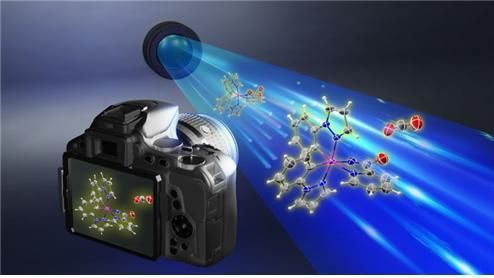 <Capture of Key Intermediate in Amination Reaction> The Institute for Basic Science (IBS) Molecular Active Catalyst Reaction Group has experimentally confirmed for the first time in the world the structure and properties of the intermediate 'transition metal-nitrene' formed during the amination reaction that produces useful nitrogen compounds. Image source=Provided by IBS.
The Institute for Basic Science (IBS) announced on the 21st that the research team led by Jang Seok-bok, head of the Molecular Active Catalysis Research Center (Distinguished Professor of Chemistry at KAIST), has for the first time in the world identified the structure and reactivity of a ‘transition metal-nitrene’ intermediate that forms and disappears during a chemical reaction converting naturally abundant hydrocarbons into high value-added nitrogen compounds.
Children grow into adults through adolescence. Similarly, chemical reactions involve a kind of growth process where intermediates are formed as transitional stages between reactants and products. Unlike human adolescence, which can be recorded through photos and videos, capturing the fleeting existence of intermediates that rapidly form and vanish during chemical reactions is extremely difficult.
For example, nitrogen compounds are crucial molecules involved in biological activity, included in about 90% of pharmaceuticals. They also serve as important frameworks in materials and manufacturing fields. This is why modern chemists are devoted to developing catalysts that can efficiently carry out amination reactions (nitrogen incorporation reactions) that convert naturally abundant hydrocarbons such as petroleum and natural gas into nitrogen compounds.
In 2018, the research team developed a catalytic reaction synthesizing lactams, which are raw materials for pharmaceuticals, from hydrocarbons using dioxazolone reagents and a transition metal (iridium) catalyst. At that time, they proposed that the key intermediate inducing the amination reaction was a transition metal-nitrene, and since then, over 120 research teams worldwide have continued studying amination reactions using dioxazolone reagents. However, the transition metal-nitrene intermediate had only been characterized computationally, and its direct observation had never been achieved. Identifying which catalytic intermediates are involved during catalytic chemical reactions is crucial for thoroughly understanding reaction pathways and developing next-generation catalysts with higher efficiency.
Most catalytic reactions occur in solution. Because molecules in solution constantly interact with others, identifying rapidly reacting and disappearing intermediates like transition metal-nitrenes was very challenging. To overcome this limitation, the research team proposed using photocrystallography, which involves irradiating solid-state samples with light and observing structural changes at the molecular level through single-crystal X-ray diffraction analysis.
The team newly developed a rhodium (Rh)-based catalyst that responds to light. They anticipated that the complex formed by this catalyst and the dioxazolone reagent would generate a transition metal-nitrene during the process of introducing an amine group into hydrocarbons upon light irradiation. Using photocrystallography at the Pohang Accelerator Laboratory’s synchrotron radiation facility, they analyzed this process and for the first time in the world confirmed the structure and properties of a previously unobserved ‘rhodium-acyl nitrene’ intermediate.
Furthermore, the team analyzed the reaction process of the rhodium-acyl nitrene intermediate with other molecules using photocrystallography. In other words, they captured the entire process in a solid sample as chemical bonds break to form the intermediate, which then reacts with another substance to form new chemical bonds, much like a camera taking pictures.
Director Jang said, “We have revealed for the first time the appearance of the key intermediate in the amination reaction, which had only been proposed but never proven,” adding, “Based on the structure and electrophilic reactivity of the rhodium-acyl nitrene intermediate we have now identified, it will be possible to develop next-generation catalytic reactions used in various industries.”
The research results were published online in the international journal Science (IF 56.9) on the same day.
© The Asia Business Daily(www.asiae.co.kr). All rights reserved.

















