Compensated 380 Million Won Including Interest Ahead of 60th Birthday
A man in his 50s who lost sight in one eye after being hit by a tear gas canister while participating in a protest as a university student in 1986 has been awarded compensation by the state after 37 years.
On the 20th, according to the Korea Legal Aid Corporation (Chairman Kim Jin-su), Judge Shin Heon-gi of the Busan District Court Eastern Branch ruled in a partial victory for the plaintiff in a damages claim lawsuit filed by Mr. Jeong (59) against the Republic of Korea, ordering the state to pay Jeong 140 million won plus delayed interest.
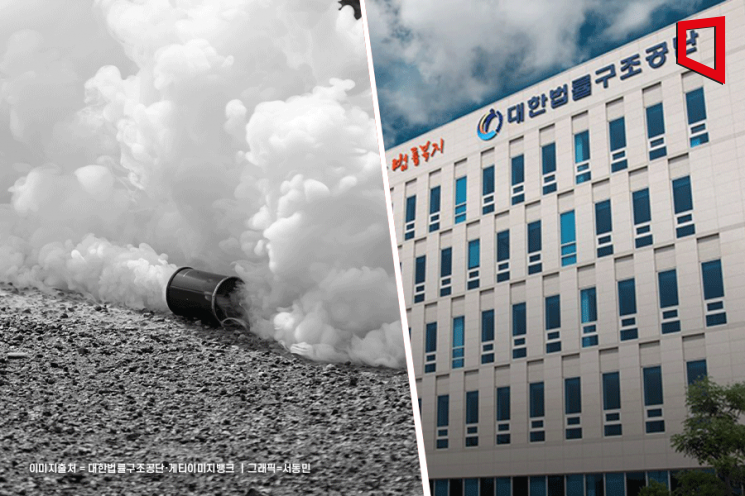
The court recognized the property damage compensation payable to Jeong as 130 million won and the mental damages (consolation money) as 10 million won, ordering payment of approximately 380 million won including delayed interest. The first-instance ruling was finalized on the 13th as the government did not appeal within the appeal period.
In November 1986, when demands for a direct presidential election and democratization movements were intense, Jeong, who was attending a university in Busan, participated in a protest and was injured by fragments of a tear gas canister fired by police during the crackdown, resulting in blindness in his left eye. At the time, Jeong filed a complaint seeking compensation, but six months later, the Busan City Police Bureau (now Busan Metropolitan Police Agency) notified him that while they acknowledged the injury caused by the tear gas, compensation was not within the police’s jurisdiction and the investigation was closed. After the regime changed through direct presidential elections in July 1988, Jeong filed another complaint, but was told that the case had already been closed and no further investigation would be conducted.
Since losing sight, Jeong has had to move between more than 20 jobs to make a living, facing significant difficulties in employment and daily life. At one hard-won job, he was dismissed immediately after the probation period because "safe work was impossible with vision in only one eye." In December 2020, 34 years after the accident, Jeong’s father submitted a truth verification request to the Truth and Reconciliation Commission on Past Affairs.
In July 2022, the Truth and Reconciliation Commission recommended that "the state apologize to Jeong and his family for failing to take prompt and appropriate measures at the time of his left eye injury caused by police tear gas during the protest crackdown, despite acknowledging the injury in the police investigation, and for not taking specific actions." The commission also recommended that "appropriate measures such as compensation should be taken considering Jeong’s medical expenses, treatment period, and the degree of blindness caused by the tear gas injury."
Based on this recommendation, Jeong sought help from the Korea Legal Aid Corporation. The corporation filed a lawsuit last November claiming about 244 million won plus delayed interest. During the trial, the government argued that Jeong’s claim for damages had expired due to the statute of limitations. According to the Civil Act and the State Finance Act, the statute of limitations for state compensation claims is three years from the date the damage and perpetrator are known, and five years from the date of the unlawful act. The government claimed that Jeong should be considered to have known the damage and perpetrator on May 29, 1987, when he received the police’s notification of the complaint handling results, and that more than five years had passed since the accident occurred.
However, the court’s judgment differed. The court first cited the 2018 Constitutional Court decision that the statute of limitations provisions of the Civil Act cannot be directly applied to cases subject to the Past Affairs Settlement Act’s truth verification. The Constitutional Court ruled that applying the Civil Act’s statute of limitations to such cases excessively prioritizes legal stability and protection of perpetrators, ignoring the need to guarantee state compensation claims for these types of cases, thus violating the Constitution.
The court stated, "This case falls under the 'serious human rights violation cases' under the Past Affairs Settlement Act, so the effect of the above unconstitutional ruling applies here as well. Therefore, the long-term statute of limitations based on the objective starting point under the Civil Act does not apply to the plaintiff’s claim for damages. Furthermore, provisions in the State Finance Act or Budget and Accounting Act that set a five-year statute of limitations for monetary claims against the state are also excluded. Only the short-term statute of limitations based on the subjective starting point under Article 766, Paragraph 1 of the Civil Act applies."
Ultimately, the key issue was when Jeong should be considered to have "known the damage and perpetrator."
The court concluded, "The mere fact that Jeong was informed about the victim compensation system does not necessarily mean there was no legal obstacle to exercising his rights. Regarding the short-term statute of limitations under Article 766, Paragraph 1 of the Civil Act for victims and their families after a truth verification decision by the Truth and Reconciliation Commission, the 'date of knowing the damage and perpetrator' means the date the notification of the truth verification decision was delivered, not the date of the decision itself."
The court judged that although Jeong received the victim compensation system notice and results from the police in May 1987, given the circumstances at the time, it was almost certain he would not receive compensation, so a legal obstacle effectively existed. The Supreme Court previously ruled that if a victim’s claim for damages was practically impossible and had no real benefit, it cannot be considered that the victim knew of the damage. The court assessed Jeong’s property damage at about 194 million won but limited the amount to 130 million won considering that Jeong did not maintain consistent claims about the accident from the beginning and that the delay in compensation was partly due to this.
Attorney Kang Cheong-hyun of the Korea Legal Aid Corporation, who represented Jeong in the lawsuit, said, "It is fortunate that the victim, who has lived in pain for many years, is finally receiving an apology and compensation from the state."
© The Asia Business Daily(www.asiae.co.kr). All rights reserved.

















