Compensation and Livelihood Support Planned
Some Raise the Need for Supplementary Budget
The government has prioritized declaring 13 local governments, including Yecheon-gun in Gyeongbuk, Gongju-si and Nonsan-si in Chungnam, Cheongju-si in Chungbuk, and Iksan-si in Jeonbuk, as special disaster zones due to heavy rain damage, enabling disaster victims in these areas to receive government support.
According to political circles on the 20th, President Yoon Suk-yeol declared the related areas as special disaster zones the day before and instructed Han Chang-seop, Vice Minister of the Ministry of the Interior and Safety, to "provide prompt support for damage recovery and for related agencies to respond with full force to prevent casualties as the heavy rain continues."
In political circles, there are calls to prepare a supplementary budget as the scale of this flood damage is larger than expected and there is a possibility of further disasters occurring within this year. Accordingly, the government's declaration of special disaster zones is expected to lead to controversy over the supplementary budget.
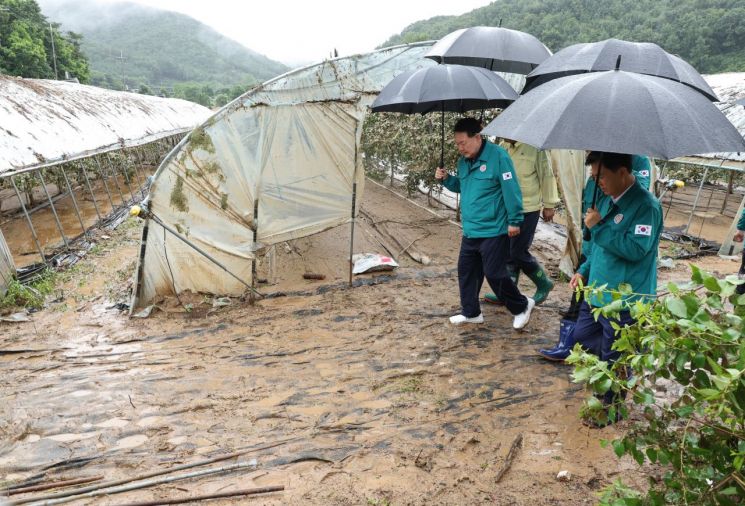 President Yoon Seok-yeol, who visited the site of heavy rain damage, is inspecting a vinyl greenhouse farm in Tancheon-myeon, Gongju-si, Chungnam on the 18th. Photo by Yonhap News
Possible Support of 20 Million KRW for Deaths and 1.62 Million KRW for Livelihood Expenses of 4-Person Households
A special disaster zone is declared by the president to provide emergency recovery support for areas affected by major accidents or natural disasters. It can only be designated when it is recognized that recovery is difficult with the capacity of local governments alone and national-level support is necessary.
Once declared a special disaster zone, the area receives support in administration, finance, banking, and taxation necessary for emergency measures, disaster relief, and recovery. Additionally, 50-80% of the damage recovery costs are supported by national funds. Since the launch of the Yoon Suk-yeol administration, special disaster zones have been declared for natural disasters such as heavy rain in August last year, Typhoon Hinnamnor in September, and heavy snow in January this year.
Initially, areas declared as special disaster zones receive 30 types of indirect support in administration, finance, banking, and medical care to stabilize the livelihoods of affected residents. Along with this, direct financial support is also provided to disaster victims. According to the Ministry of the Interior and Safety's administrative regulation on 'Standards for Calculating Natural Disaster Recovery Costs,' up to 20 million KRW is provided for the deceased or missing persons. Injured persons receive support based on their grade: 10 million KRW for grades 1 to 7, and 5 million KRW for grades 8 to 14. Funeral expenses can also be supported by national funds based on the same Disaster and Safety Act; for example, 15 million KRW was provided during the Itaewon tragedy.
Especially from this summer, if houses are damaged or destroyed by wind and flood disasters, differentiated support ranging from a minimum of 20 million KRW to a maximum of 36 million KRW will be provided depending on the damaged area. Previously, a uniform 16 million KRW was provided when houses were completely destroyed, which caused fairness issues. Additionally, reductions in health insurance, electricity, telecommunications, city gas, and local heating fees are also implemented.
Livelihood support funds amount to 1.62 million KRW for a four-person household. For a single-person household, it is 623,600 KRW; for a two-person household, 1,036,800 KRW; and for a three-person household, 1,330,400 KRW.
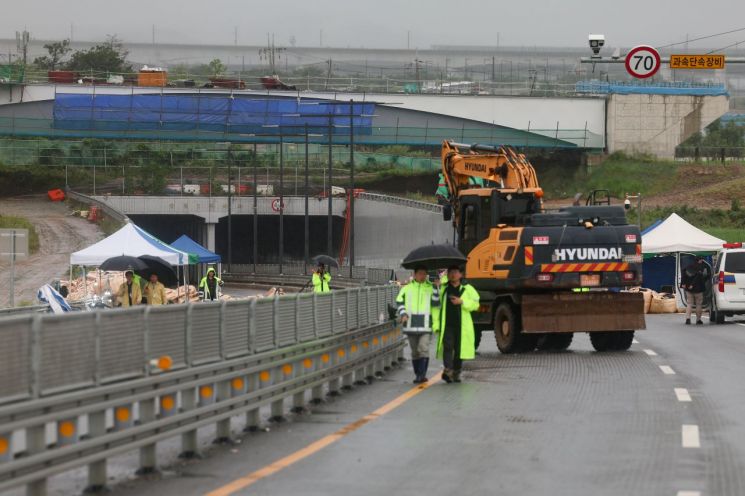 On the morning of the 18th, officials from the fire department, police, and other related agencies are conducting internal cleanup and searching for belongings at the search and rescue site of Gungpyeong 2 Underpass in Osong-eup, Cheongju-si, Chungbuk, which was flooded due to the collapse of the Miho River embankment. Photo by Yonhap News
Disaster Contingency Fund of 4.2 Trillion KRW... Calls for 'Supplementary Budget'
The government has several budget items prepared for disaster response this year. According to the fiscal information disclosure system 'Open Finance,' the Ministry of the Interior and Safety has 150 billion KRW for disaster countermeasures, the Ministry of Agriculture, Food and Rural Affairs has 200 billion KRW, the Ministry of Oceans and Fisheries has 8 billion KRW for aquaculture disaster countermeasures, and the Korea Forest Service has 20 billion KRW for forest disaster countermeasures, totaling 400 billion KRW in disaster countermeasure funds across ministries. These funds will be used first, and if insufficient, 1 trillion KRW from the Ministry of the Interior and Safety's special disaster management grant will be mobilized.
Additionally, the Ministry of Economy and Finance has prepared 2.8 trillion KRW for disasters. Including the general contingency fund, the total resources increase to 4.6 trillion KRW. Up to about 6 trillion KRW in budget can be mobilized. However, generally, considering the remaining period of the year, about 4.2 trillion KRW excluding the general contingency fund is regarded as the maximum amount that can be mobilized.
The problem is that this flood damage is record-breaking, and there are concerns that the contingency fund may be insufficient for recovery costs. Some political circles are demanding a 'flood supplementary budget,' arguing that contingency fund execution alone is insufficient. In fact, for the heavy rain in 2020, which recorded 46 deaths and 12 missing persons, recovery costs amounted to 3.4277 trillion KRW according to the 'e-Nara Index.' In 2020, the annual recovery cost was 4.1615 trillion KRW. Considering the intensifying climate change and typhoons and heavy snow, this year's recovery costs may exceed those of 2020.
President Yoon Suk-yeol said, "All subsidies to interest cartels and corruption cartels must be abolished, and those resources should be invested in flood recovery and damage compensation." However, this is currently unrealistic in terms of the scale of the amount and the timing of execution. The presidential office announced that a comprehensive audit of government subsidies to private organizations last month revealed 1,865 cases of fraud and corruption in projects worth 1.1 trillion KRW, with fraudulent use amounting to 31.4 billion KRW. Although the government has instructed a 500 billion KRW cut in subsidy budgets for civic groups in next year's preliminary budget, flood recovery budgets are urgently needed.
The government is drawing a line on the possibility of a supplementary budget, stating, "Currently, there is sufficient financial capacity." However, experts advise that although the government emphasizes fiscal austerity, the possibility of a supplementary budget should also be kept open.
Professor Sung Tae-yoon of Yonsei University's Department of Economics said, "Supporting citizens when they suffer damage is one of the important purposes of fiscal policy," adding, "We should utilize contingency funds as much as possible, but it is also a time to always consider the possibility of a supplementary budget."
© The Asia Business Daily(www.asiae.co.kr). All rights reserved.
![Clutching a Stolen Dior Bag, Saying "I Hate Being Poor but Real"... The Grotesque Con of a "Human Knockoff" [Slate]](https://cwcontent.asiae.co.kr/asiaresize/183/2026021902243444107_1771435474.jpg)

















