Wages Already Exceed 10,000 Won per Hour on Site
Employment Reduction and Unmanned Stores Accelerate
Survival Measures Demanded from Government and Headquarters
Next year's minimum wage has been set at 9,860 won per hour, a 2.5% increase from this year, prompting strong opposition from convenience store owners who say it will lead to reduced employment. Convenience stores, typically operating 24 hours a day, are considered one of the industries most sensitive to minimum wage hikes.
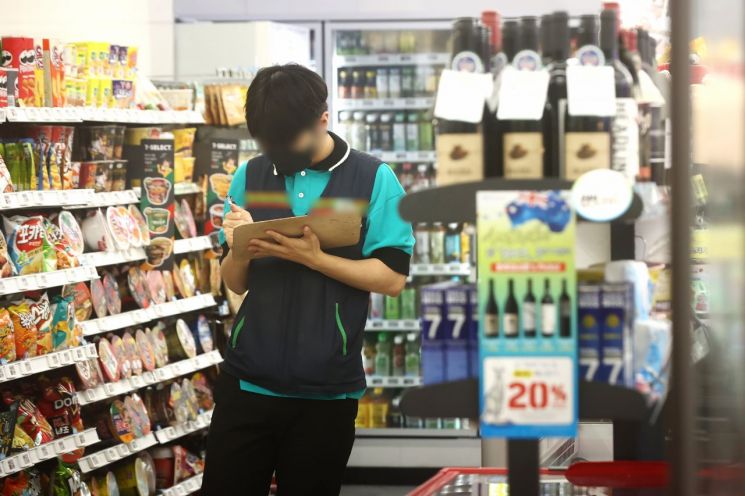
On the 19th, Kye Sang-hyuk, representative of the National Convenience Store Owners Association, spoke to this publication immediately after the Minimum Wage Commission's decision to raise the 2024 minimum wage by 2.5%, saying, "In South Korea, it has become almost impossible to run a small business now." He sighed, adding, "If the minimum wage is 9,860 won, considering weekly holiday allowances and other factors, the actual hourly wage should be about 13,000 won. Even now, it should be around 10,500 won..."
This 2.5% increase in the minimum wage is the second lowest ever, following the 1.5% rise in 2021. Despite this, convenience store owners complain about labor cost burdens because sales have essentially stagnated. According to the Ministry of Trade, Industry and Energy, the average purchase price per person at convenience stores rose 20.1%, from 5,619 won in 2019 to 6,754 won as of April 2023. However, during the same period, sales per store increased by only 2.2%, from 50.19 million won to 51.33 million won.
The convenience store industry estimates that this minimum wage increase has resulted in an additional monthly burden of over 200,000 won per store. After deducting labor costs, rent, franchise fees, and card fees, convenience store owners reportedly have to work more than 10 hours a day just to break even. A representative from the Korea Convenience Store Industry Association said, "It is fortunate that the minimum wage did not exceed 10,000 won, but the burden of difficulties has not been alleviated and remains significant," adding, "Stores on the break-even line may be further impacted by this increase."
There is widespread concern in the industry that the minimum wage hike will ultimately lead to reduced employment. Kye, who has operated convenience stores for 20 years, said, "In the past, convenience stores mainly employed recent high school graduates, college freshmen, and elderly people, but now applicants come from all age groups," adding, "If wages rise, these people's jobs will disappear." This means that as the minimum wage increases, convenience store owners will not have the capacity to hire employees or part-time workers.
Employment reduction is expected to accelerate the pace of automation, which has been spreading recently in the convenience store industry. Unmanned convenience stores equipped with self-checkout counters have increased 17-fold over the past three years, from just 208 stores in 2019 to 3,530 as of the end of last month. Hybrid stores, where owners operate during the day and switch to unmanned operation at night, also surged from 9 to 713 during this period.
The Korea Convenience Store Owners Association issued a statement on the same day demanding government measures for survival. The association said, "The collapse of small businesses harms both workers and small business owners," and urged, "We call for realistic measures to support small business owners in crisis." Addressing headquarters, they said, "They are ignoring the damage to franchise owners who are partners," and added, "They must genuinely show a willingness to coexist with franchise owners."
© The Asia Business Daily(www.asiae.co.kr). All rights reserved.

















