KAIST Research Team Advances Humanoid Commercialization
Directly Applicable to Existing Airplanes
Domestic researchers have developed a humanoid robot capable of piloting an airplane through AI-based learning. It is noteworthy that autonomous flight is possible without any modification to the existing airplane.
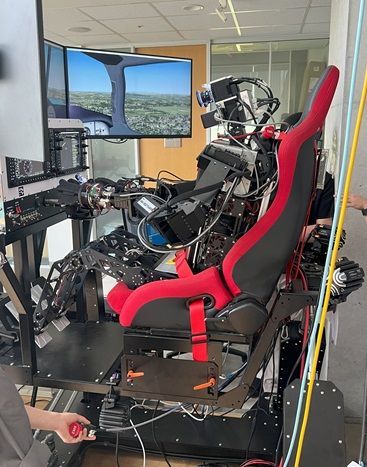
The Korea Advanced Institute of Science and Technology (KAIST) announced on the 19th that they have developed a humanoid robot that can understand manuals written in natural language and pilot an airplane based on that understanding, with plans for practical application.
The research team aimed to develop a "natural language processing-based humanoid pilot robot" that reads and comprehends pilot manuals written in everyday language. By applying AI and robotics technologies, the humanoid robot sits in the cockpit of an actual aircraft without any modification to the existing airplane and directly operates various controls in the cockpit to fly. This approach fundamentally differs from existing autopilot systems or unmanned aerial vehicles that can only perform unmanned flights.
This pilot robot can memorize all global aviation charts (Jeppson Chart), enabling error-free piloting that is impossible for human pilots. In particular, it utilizes the generative AI technology 'Chat GPT,' which has recently become a major topic, to memorize materials such as aircraft operation manuals and Quick Reference Handbook (QRH) emergency procedures, allowing immediate response. Based on the aircraft's flight status, it can calculate safe routes in real-time, enabling much faster emergency responses than human pilots.
Unlike existing robots that can only perform repetitive tasks in fixed positions, the pilot robot uses installed cameras to understand the cockpit interior and external aircraft conditions and can accurately operate various switches on the control stick. By applying high-precision robust control technology, it can precisely control the robot arms and hands inside the highly vibrating aircraft.
The pilot robot currently performs all operations from engine start, taxiing, takeoff, cruising, to parking in a flight simulator. The research team plans to verify the robot by applying it to an actual light aircraft to pilot the airplane directly.
Professor Shim Hyun-cheol, the lead researcher of this study, said, "The humanoid pilot robot can perform immediate automatic flight without any modification to existing aircraft, making it highly practical and versatile. It is expected to be very useful in the current situation of severe manpower shortages, as it can also operate various devices such as cars and armored vehicles." He added, "Development has been ongoing since last year, with completion expected in 2026. Commercialization plans for both civilian and military use are also being explored."
© The Asia Business Daily(www.asiae.co.kr). All rights reserved.
![Clutching a Stolen Dior Bag, Saying "I Hate Being Poor but Real"... The Grotesque Con of a "Human Knockoff" [Slate]](https://cwcontent.asiae.co.kr/asiaresize/183/2026021902243444107_1771435474.jpg)
















